Dudley Hardy portretas

10 garsiausių Dudley Hardy paveikių rinkinys: galerijos išboru

Atnaujinta lapkritis 2026 · pagal mūsų populiarumumo koeficientą (paieškos, lankytojai ir užsakymai kiekvienam kūriniui) · 10 Dudley Hardy darbai mūsų kataloge

Trumpai tariant

Iš visų originalų, kuriuos paliko Dudley Hardy, garsiausias yra Sarah Bernhardt (1889). Tiesiog už jų seka Madame Sarah Bernhardt ir A Gaiety Girl. Mūsų kataloge yra 10 darbų autoriaus Dudley Hardy; galerija išsaugojo 10 labiausiai pasaulyje žyminiausių kūrinių – kiekvienas jų pateikiamas su datos, muziejaus ir istorijos aprašymu.

1867 – 1922, Sheffield

Dudley Hardy geriausios 10 paveikslų: galerijos pasirinkimas

1
Sarah Bernhardt (1889) aut. Dudley Hardy

Sarah Bernhardt

1889 · Oil On Canvas

In this vertical portrait of Sarah Bernhardt by Dudley Hardy, the actress moves through a dreamlike space with a sense of sudden, sweeping motion. She is caught in a dynamic, walking pose, her arms extended to her sides as if mid-gesture during a theatrical performance. This movement creates a sense of ethereal grace, pulling the viewer into her immediate orbit. The perspective is straight-on, establishing an intimate encounter that feels…
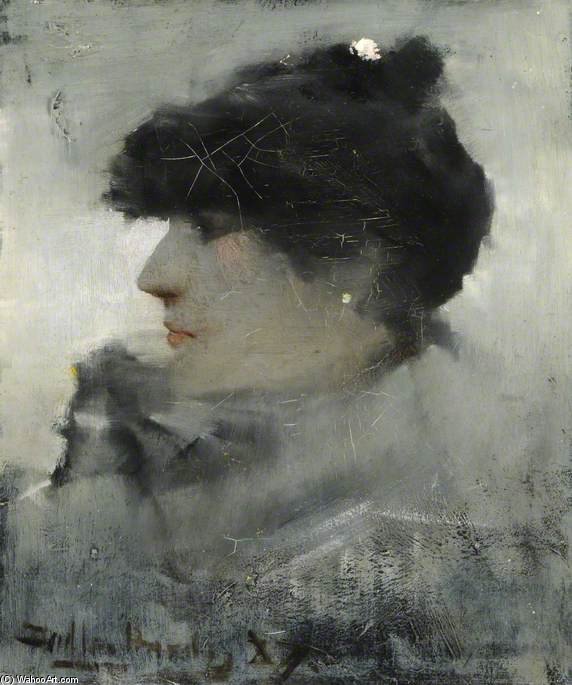
2
Madame Sarah Bernhardt aut. Dudley Hardy

Madame Sarah Bernhardt

Oil On Canvas

In this portrait, titled Madame Sarah Bernhardt, the artist Dudley Hardy captures the likeness of the celebrated actress Sarah Bernhardt. Painted in 1889, the work offers a glimpse into the theatrical world of the late nineteenth century. It is an oil on canvas or board that focuses on the presence of the woman herself, moving through a space that feels both immediate and distant.

3
A Gaiety Girl aut. Dudley Hardy

A Gaiety Girl

Lithograph

The poster A Gaiety Girl by Dudley Hardy captures a moment of pure theatrical glamour. This vintage advertisement promotes a musical comedy production, drawing the eye toward a central figure of immense sophistication. The woman depicted embodies the very essence of fashion and poise, her presence commanding the space with an effortless elegance. She represents the allure of the Gaiety Girl, a figure that once defined the spirit of Parisian…

Dudley Hardy metai po metų: originalūs darbai, apibūdinantys kiekvieną iš jų

1889 yra kiekvieno aprašyto datomis Dudley Hardy kūrinio šioje rinktinėje: štai jie, išvardyti pagal šlovę.

Darbai pagal metus

Pasirinkite metus, kad pamatytumėte originalus darbus.

Kolekcjonerų klausimai apie Dudley Hardy paveikslus

Kuriu darbu Dudley Hardy yra labiausiai garsus?Atsakymas

Sarah Bernhardt (1889). Toliausiai eina Madame Sarah Bernhardt ir A Gaiety Girl.

Kokia buvo Dudley Hardy amžius, kai buvo sukurtas Sarah Bernhardt?Atsakymas

22 metų amžiaus: Sarah Bernhardt sukurta 1889 m. Nr. Dudley Hardy gimė 1867.

Kokie yra 10 garsiausių Dudley Hardy paveikslų?Atsakymas

Sarah Bernhardt, Madame Sarah Bernhardt, A Gaiety Girl, Postcard Artist, Madame Sarah Bernhardt -, Model In Studio, D'oyly Carte Opera Company, The Fish Market, On The Quayside, The Yeomen Of The Guard ir Abbotts Phit-eesi Boots And Shoes. Viršuje esančioje reitingo sąraše nurodyta kiekvieno kūrinio metis ir muziejus.

Kiek paveikslų paliko Dudley Hardy?Atsakymas

Mūsų kataloge yra 10 darbų autoriaus Dudley Hardy.

Kurią techniką Dudley Hardy naudojo dažniausiai?Atsakymas

Oil On Canvas, iš 10 šios puslapio darbų – 2.

Dudley Hardy: gyvenimas ir kūryba

Dudley Hardy: A Victorian Painter Bridging East and West

Dudley Hardy (1867-1922) stands as a fascinating figure in late Victorian art, an illustrator and painter who skillfully blended Orientalist influences with theatrical design sensibilities. Born in Sheffield, England, his artistic journey began amidst the burgeoning fascination for exotic locales and dramatic narratives – themes that would permeate much of his oeuvre. Hardy’s distinctive style—characterized by meticulous detail combined with a lyrical approach to color—established him as a key contributor to the visual culture of his time.
  • Early Life & Education: Hardy pursued formal artistic training at the Royal Institute of Oil Painters and subsequently gained admittance to the Royal Society of British Artists (RBA), institutions that fostered excellence in Victorian art. These formative experiences instilled in him a disciplined technique and an appreciation for classical ideals alongside a burgeoning interest in capturing the spirit of distant lands.
  • Orientalist Visions: Hardy’s artistic reputation solidified through his captivating depictions of the Middle East, particularly Persia. His paintings transported viewers to bustling bazaars, serene mosques, and majestic palaces—scenes rendered with remarkable accuracy and infused with an emotional resonance that reflected Victorian anxieties about colonialism and adventure. Works like “Abbotts Phit-eesi Boots And Shoes” exemplify this stylistic hallmark: a whimsical poster brimming with anthropomorphic footwear, showcasing Hardy’s ability to infuse everyday subjects with imaginative storytelling.
  • Theatre & Poster Design: Beyond Orientalism, Hardy excelled in theatrical illustration and opera poster design for D’Oyly Carte Opera Company. His posters—particularly “A Gaiety Girl” and designs for Gilbert & Sullivan productions—became iconic symbols of the Victorian era's artistic dynamism. These commissions demanded a mastery of composition and color theory, resulting in visually arresting pieces that captured the glamour and excitement of the stage.
  • Notable Paintings: Hardy’s artistic output included portraits like “Madame Sarah Bernhardt,” where he skillfully conveyed Bernhardt’s melancholic gaze through nuanced brushstrokes and atmospheric lighting—a testament to his ability to capture psychological depth within a formal portraiture style. His landscapes, notably those depicting Brittany, showcased a sensitivity to tonal variation and textural richness, reflecting the Impressionistic tendencies gaining traction during Hardy's lifetime.
  • Legacy & Significance: Dudley Hardy’s contribution to Victorian art extends beyond individual masterpieces; he embodies the broader artistic currents of his era—the pursuit of realism tempered by Romantic idealism, and a fascination with both exotic cultures and theatrical spectacle. His work continues to inspire admiration for its technical precision and emotive power, securing his place as an important voice within the visual arts history of Britain.