
1


Atnaujinta spalis 2026 · pagal mūsų populiarumumo koeficientą (paieškos, lankytojai ir užsakymai kiekvienam kūriniui) · 7 David Payne darbai mūsų kataloge
Trumpai tariant
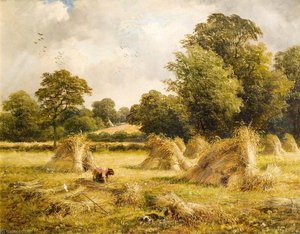
Iš visų originalų, kuriuos paliko David Payne, garsiausias yra Market Place (The Royal Visit, Derby, 21 May 1891) (1891). Tiesiog už jų seka Harvest Home and Golden Corn (1875) ir Rural Landscape with Sheep Grazing in a Meadow with Windsor Castle in the Distance. Mūsų kataloge yra 7 darbų autoriaus David Payne; galerija išsaugojo 7 labiausiai pasaulyje žyminiausių kūrinių – kiekvienas jų pateikiamas su datos, muziejaus ir istorijos aprašymu.



Nuo 1875 iki 1891, David Payne kūrė 17 metų: šiame rinkinyje pristatoma ilga kūrybos kelionė, apimanti geriausius originalius darbus metus po metų.
Pasirinkite metus, kad pamatytumėte originalus darbus.
Market Place (The Royal Visit, Derby, 21 May 1891) (1891). Toliausiai eina Harvest Home and Golden Corn (1875) ir Rural Landscape with Sheep Grazing in a Meadow with Windsor Castle in the Distance.
48 metų amžiaus: Market Place (The Royal Visit, Derby, 21 May 1891) sukurta 1891 m. Nr. David Payne gimė 1843.
Mūsų kataloge yra 7 David Payne darbų, skirtų laikotarpiui nuo 1875 iki 1891.
Šioje pusėje seniausias darbas yra Harvest Home and Golden Corn (1875), o naujausias – Market Place (The Royal Visit, Derby, 21 May 1891) (1891).
The story of David Payne is one of profound transformation, a journey from the practical application of color to the ethereal realms of trompe l'oeil and romantic landscape. Born in 1843 in the quiet town of Annan, Dumfriesshire, Payne’s early life was shaped by the sturdy, tactile world of his father, a skilled mason. This foundational connection to texture and form would later manifest in his extraordinary ability to deceive the eye through paint. Educated at the Annan Academy alongside fellow artist William Ewart Lockhart, Payne possessed an innate sensitivity to the natural world that would eventually lead him far from the borders of Scotland to the heart of the English Midlands.
Before he was a celebrated member of the Royal Scottish Academy, Payne’s hands were engaged in the more utilitarian craft of house painting. This period of his life, while seemingly distant from the fine arts, provided him with a rigorous understanding of pigment, surface, and light—elements that would become the cornerstone of his mature style. When he relocated to Derby in 1869, he entered a vibrant industrial art scene, finding himself deeply influenced by George Turner, often referred to as “Derbyshire’s John Constable.” Under this influence, Payne began to weave together the rugged beauty of the British countryside with a sophisticated technical mastery that sought to elevate the landscape beyond mere documentation.
As his career progressed, Payne’s work became a captivating dialogue between reality and illusion. While he remained a dedicated chronicler of rural scenes, he gained significant renown for his trompe l'oeil techniques, where brushstrokes were used to create three-dimensional illusions so convincing they seemed to leap from the canvas. This fascination with the tactile nature of art allowed him to explore the Romantic spirit of the Victorian era—a period defined by a deep reverence for nature and an ambitious desire to push the boundaries of artistic representation.
His technical prowess was not limited to the two-dimensional plane. In 1882, Payne achieved a monumental milestone when he won the Derby Art Gallery Medal for Industrial Art. The honor was bestowed upon his sculpture, “The Two Anglers,” a piece that showcased his ability to manipulate form and space with the same precision he applied to his landscapes. This achievement cemented his status as one of the preeminent artists of the region, proving that his vision could transcend the medium of oil on canvas to capture the very essence of life through carved stone and clay.
Payne’s significance extends far beyond the aesthetic; he was a witness to the unfolding history of his adopted home. His painting, “Market Place (The Royal Visit, Derby, 21 May 1891),” serves as a breathtaking historical document, capturing the grandeur and communal fervor of Queen Victoria’s visit to Derby for the laying of the foundation stone of the Derbyshire Royal Infirmary. Through his eyes, we see the bustling crowds, the fluttering bunting, and the solemnity of a royal procession, all rendered with a sense of movement and atmosphere that brings the nineteenth century back to life.
Though his life was cut short in 1894, the legacy of David Payne remains preserved in some of Britain’s most esteemed institutions. His contributions to the art world are characterized by:
Today, Payne is remembered not merely as a painter of scenes, but as a master of perception, an artist who could find the extraordinary within the ordinary and invite every viewer to look twice at the world around them.