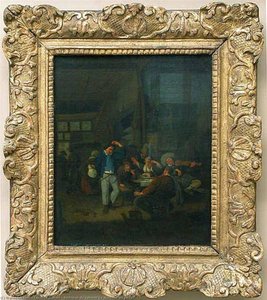
Cornelis Dusart portretas

Cornelis Dusart paveikslai: 37 garsiausi, galerijos akimis

Atnaujinta lapkritis 2026 · pagal mūsų populiarumumo koeficientą (paieškos, lankytojai ir užsakymai kiekvienam kūriniui) · 40 Cornelis Dusart darbai mūsų kataloge

Trumpai tariant

Galerijos akimais, garsiausias Cornelis Dusart tapas yra Peasants in Front of an Inn (1681), kurio originalas eksponuojamas Kunsthistorisches Museum, Viena. Village inn (1690) ir Country Inn with Hurdy-Gurdy Player (1681) užbaia trio, kurį atpažįsta kiekvienas ž)/\ Iš 40 Cornelis Dusart darbų mūsų kataloge, galerija žemiau pristato 37 garsiausius – kiekvienas yra originalus, su nurodytu metais, muziejumi bei unikaliu aprašymu.

1660 – 1704, Haarlem Dutch golden age Daugiausia darbų: Rijksmuseum

10 geriausių galerijos Cornelis Dusart paveikslų

1
Peasants in Front of an Inn (1681) aut. Cornelis Dusart

Peasants in Front of an Inn

1681 · Oil On Panel · Kunsthistorisches Museum, Viena

The air outside the inn feels heavy with the scent of damp earth and woodsmoke. Under the shade of a leafy canopy, a group of peasants gathers, their bodies leaning into the ease of a midday rest. There is a palpable sense of movement held in suspension; a man sits perched on a bench, perhaps listening to the low murmur of conversation or the distant sound of a traveler approaching.…

2
Village inn (1690) aut. Cornelis Dusart

Village inn

1690 · Oil On Panel · Rijksmuseum, Amsterdamas

In this 1690 oil on panel, we find ourselves drawn into the quiet, unhurried rhythm of a Dutch village inn. The scene is one of communal leisure, where the boundaries between public social life and private intimacy blur under the soft, natural light of a rural afternoon. In the foreground, a man and a woman sit together, their presence grounding the composition with a sense of lived experience. He holds…

3
Country Inn with Hurdy-Gurdy Player (1681) aut. Cornelis Dusart

Country Inn with Hurdy-Gurdy Player

1681 · Painting · Städel Museum, Frankfurtas

A group of peasants gathers in the courtyard of a rustic, thatched-roof inn. The composition is crowded, with figures occupying the foreground and midground to create a sense of social activity. On the right, the heavy architecture of the building provides a structured frame, while foliage on the left balances the scene. The light originates from the upper left, casting soft shadows across the courtyard and highlighting the central figures.…

Cornelis Dusart tapiai, rangos nuo 11 iki 37

Temos, kurios domino Cornelis Dusart

Ketverios temos, dažniausiai pasikrausto originaluose, kiekvienos su savo puikiausiu pavyzdžiu.

Muziejai, kuriuose saugomi Cornelis Dusart originalūs darbai

8 muziejai, kuriuose saugoma daugiausia šioje pusėje esamų paveikslų.

Muzejaus Miestas Cornelis Dusart darbai Šiojo sąrašo paveikslai
Rijksmuseum, AmsterdamasRijksmuseum Amsterdamas 6 Village inn, A Mother with her Children, Village fair
Statens Museum For Kunst, KopenhagaStatens Museum For Kunst Kopenhaga 2 Bagpiper at an Inn, Peasants outside an Inn
Frans Hals muziejus, HarenFrans Hals muziejus Haren 2 Drinking party, The Notary
Kunsthistorisches Museum, VienaKunsthistorisches Museum Viena 1 Peasants in Front of an Inn
Städel Museum, FrankfurtasStädel Museum Frankfurtas 1 Country Inn with Hurdy-Gurdy Player
Fine Arts Museums of San Francisco, San FranciscoFine Arts Museums of San Francisco San Francisco 1 Village Scene
Nacionalinis muziejus Varšuvoje, VaršuvaNacionalinis muziejus Varšuvoje Varšuva 1 Fish scraping
National Gallery of Ireland, DublinNational Gallery of Ireland Dublin 1 A Merry-making

Cornelis Dusart, po vieno ikoninio paveikslio kiekvienam dešimtmenės laikotarpiui

Darbai pagal dešimtmečius

Pasirinkite dešimtmetį, kad pamatytėte jį apibrėžusį originalą.

Cornelis Dusart tapyiniai: galerijos atsakymai

Kuris Cornelis Dusart paveikslas yra pats garsiausias iš visų?Atsakymas

Peasants in Front of an Inn (1681), Kunsthistorisches Museum, Viena. Toliau seka Village inn (1690) ir Country Inn with Hurdy-Gurdy Player (1681).

Kiek metų buvo Cornelis Dusart, kai sukūrė Peasants in Front of an Inn?Atsakymas

21 metų amžiaus: Peasants in Front of an Inn sukurta 1681 m. Nr. Cornelis Dusart gimė 1660.

Kuriose yra 10 geriausių Cornelis Dusart paveikslų?Atsakymas

Peasants in Front of an Inn, Village inn, Country Inn with Hurdy-Gurdy Player, Village Scene, teasing the cat, Fish scraping, A Merry-making, A kermess, Bagpiper at an Inn ir Peasants outside an Inn. Viršuje esančioje reitingo sąraše nurodyta kiekvieno kūrinio metis ir muziejus.

Kiek kūrinių sukūrė Cornelis Dusart?Atsakymas

Mūsų kataloge yra 40 Cornelis Dusart darbų, skirtų laikotarpiui nuo 1679 iki 1702.

Kur kabinami garsiausi Cornelis Dusart originalūs darbai?Atsakymas

Daugiausia – Rijksmuseum (Amsterdamas), Statens Museum For Kunst (Kopenhaga) ir Frans Hals muziejus (Haren). Viršuje esančiame muziejų sąraše yra visi jie.

Kada Cornelis Dusart sukūrė savo garsiausias paveikslus?Atsakymas

1680s laikotarpiu: 11 iš 37 šioje pusėje esančių darbų buvo sukurtos tada, iš jų Peasants in Front of an Inn.

Kokie yra ankstyviausi ir vėliausi garsieji Cornelis Dusart kūriniai?Atsakymas

Šioje pusėje seniausias darbas yra The Milk Seller (1679), o naujausias – Drinking party (1702).

Kurią temą Cornelis Dusart kūrė dažniausiai?Atsakymas

Inn (3), Woman (3) ir Men (3) iš 37 šioje pusėje esamų darbų.

Kurią techniką Cornelis Dusart naudojo dažniausiai?Atsakymas

Oil On Panel, iš 37 šios puslapio darbų – 4.

Su kokiu kierliu siejama Cornelis Dusart?Atsakymas

Dutch golden age ir Baroque, vadovaujantis šios puslapio originalais kūriniais.

Kurių Cornelis Dusart originalų turi Rijksmuseum?Atsakymas

Village inn, A Mother with her Children ir Village fair: Rijksmuseum, Amsterdamas kolekcijoje yra 6 šioje pusėje esančių darbų.

Cornelis Dusart: menininkas

Cornelis Dusart: A Window into Dutch Everyday Life

Cornelis Dusart (1660-1704) stands as a fascinating figure within the Haarlem School of painting, offering viewers a glimpse into the vibrant tapestry of 17th-century Dutch society. Unlike many artists of his era focused on grand historical narratives or mythological subjects, Dusart dedicated himself to capturing the commonplace – itinerant peddlers haggling in bustling marketplaces and intimate scenes unfolding within taverns. This deliberate choice reveals a profound interest in portraying the realities of daily life, reflecting a humanist sensibility that was gaining momentum during the Golden Age. His artistic training began under the tutelage of Rembrandt Harmenszoon van Rijn, arguably the most influential painter of his time, cementing Dusart’s connection to the stylistic innovations emerging from Leiden and Amsterdam. Rembrandt's emphasis on dramatic lighting and psychological realism undoubtedly shaped Dusart’s approach, fostering a meticulous attention to detail that distinguishes his oeuvre. However, Dusart developed a unique style—characterized by soft brushstrokes and subtle tonal gradations—that subtly diverged from Rembrandt’s bolder palette. This distinctive technique allowed him to convey atmosphere and emotion with remarkable sensitivity. Dusart's prolific output spanned numerous commissions, primarily focusing on genre scenes. He skillfully rendered the textures of fabrics, the expressions of faces, and the nuances of light and shadow, creating images that feel remarkably authentic. Consider “The Street Seller,” a captivating depiction of a peddler engaging in trade—the artist’s meticulous observation captures not only the physical appearance of the scene but also the palpable energy of the marketplace. Similarly, "The Quack" portrays a physician examining a patient with quiet dignity and precision, highlighting Dusart's ability to convey psychological depth within seemingly simple compositions. Furthermore, Dusart’s work exemplifies the burgeoning fascination with realism that permeated Dutch art circles during his lifetime. He wasn’t merely documenting what he saw; he was striving to evoke feeling and understanding in the viewer. This ambition aligns perfectly with the broader cultural context of the period—a time marked by intellectual curiosity and a desire to represent human experience accurately. Dusart's contribution to Haarlem School painting is significant not only for its stylistic merits but also for its enduring portrayal of ordinary life, securing his place as an artist who captured the spirit of his era with remarkable artistry.
  • Notable Commissions: Dusart undertook numerous commissions for wealthy patrons and civic institutions, showcasing his versatility and artistic skill.
  • Influences: Rembrandt van Rijn’s masterful use of light and psychological realism profoundly impacted Dusart's artistic development.
  • Technique: Dusart employed soft brushstrokes and tonal gradations to create atmospheric paintings imbued with emotion and subtlety.

Major Achievements & Legacy

Dusart’s enduring legacy resides in his ability to distill the essence of everyday life into powerfully evocative images. His genre scenes continue to resonate with audiences today, offering insights into the social customs and psychological complexities of 17th-century Holland. While Dusart may not command the same level of fame as Rembrandt or Vermeer, his meticulous style and humanist vision solidify his position as a pivotal artist within the Haarlem School—a testament to the transformative power of observing and representing the human condition with unwavering dedication.