Cimabue portretas

49 garsiausių Cimabue paveikių – kiekvienas yra unikalus

Atnaujinta spalis 2026 · pagal mūsų populiarumumo koeficientą (paieškos, lankytojai ir užsakymai kiekvienam kūriniui) · 52 Cimabue darbai mūsų kataloge

Trumpai tariant

Kristaus išsmeivė (1280) yra viena矚 most žiūrėlių pritraukiančių Cimabue tapierių; originalas saugomas Liuvro muziejus, Paryžius. Po to akmuo patenka į Kristus kryžius (1287) ir Assizies Šventasis Francisku (detalė). Iš 52 Cimabue darbų mūsų kataloge šios 49 yra garsiausios – kiekvienas yra unikali originali dai̇lia, pateikta su jos metais, muziejumi ir priežastimi, kodėl ji išlieka per amžius.

1240 – 1302, Florencija Protorenesansas Daugiausia darbų: Galleria degli Uffizi

10 geriausių Cimabue paveikslų: galerijos akimais

1
Kristaus išsmeivė (1280) aut. Cimabue

Kristaus išsmeivė

1280 · Kiaušinių temperos ant medinio panoelio · Liuvro muziejus, Paryžius

Spalvos ir formos viduje tykiška atmosfera atrodo lgiara, užpildyta įprūdančio masės įtampos svoriu. Šio mažo, medinio pasaulio centre stovi Jėzus, kurio kūną puoselioja gili mėlyna tunika, uždėta ant rudos tunikos. Jis nepasiduoda, negrįžta smurkiu. Jo rankos soka lyg praresios, o išraiška išlieka rami ir nekaltos, net kai aplinkos figūros užpuola su agresija. Vienas vyras iškiša ranką į viršų, jo pirštai griebia Kristaus aureolės kraštą, bandydami nuimti patį Dievo žavesio simbolį.…

2
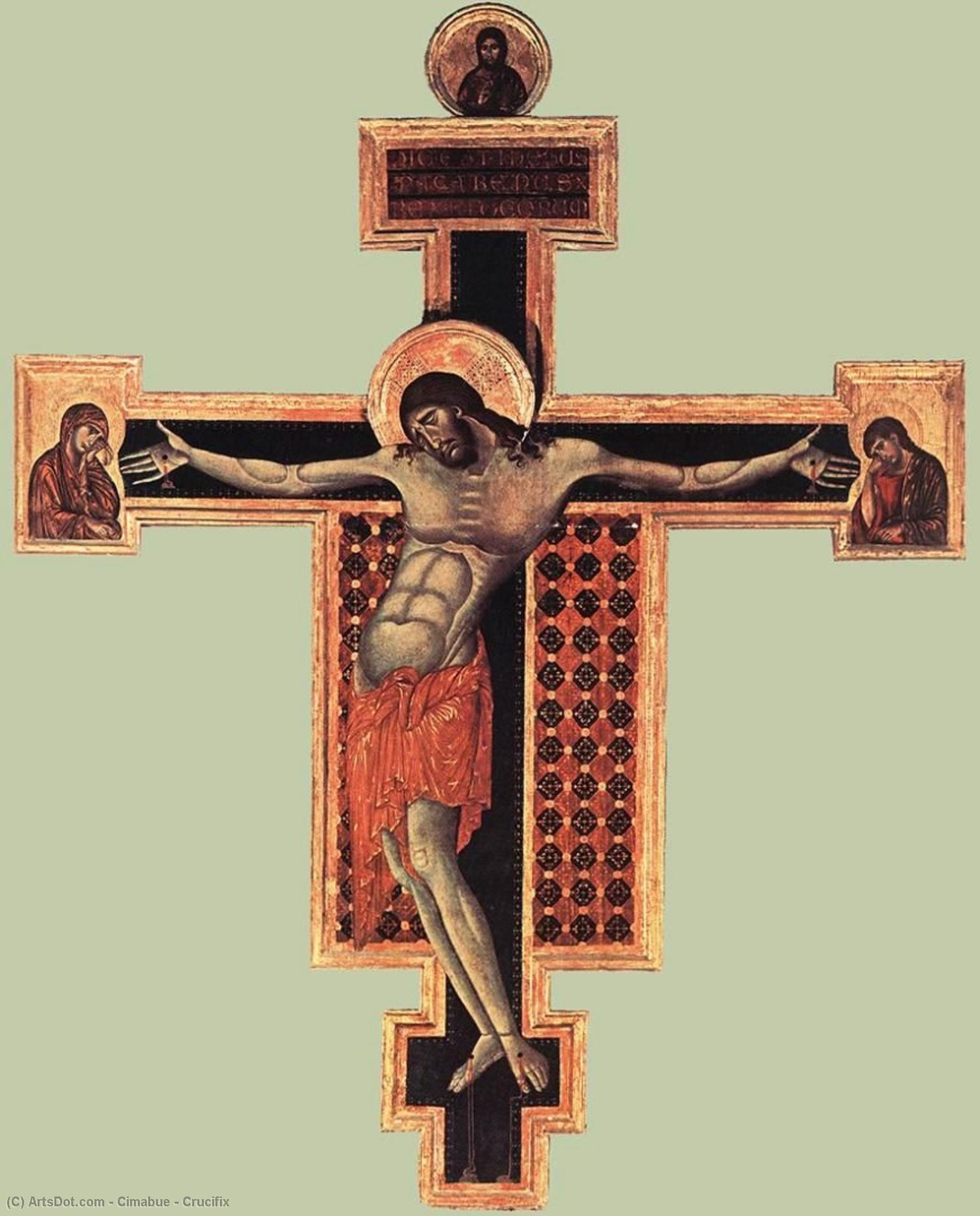
Kristus kryžius (1287) aut. Cimabue

Kristus kryžius

1287 · Kiaušinių temperos ant medinio panoelio · Museo dell'Opera di Santa Croce, Florencija

Bizantinio įtakos šedevras Čimabujo „Kryžius“ iškyla kaip monumentali XIII amžiaus pabaigos darbo kūrinys, įkūnijantis perėjimą nuo bizantinės ikonografijos prie ankstyvojo renesanso realizmo. Sukurtas apie 1287 metus, šis didelio mastelio kryžius yra Čimabujo inovatyvaus požiūrio įrodymas, sujungiantis tradicinę religinę simboliką su pradinėmis meno technikomis, kurios atvėrė kelią tokiems būsimiems meistrams kaip Giotto. Tema ir kompozicija Šis kūrinys vaizduoja Jėzaus Kristaus kryžžekylę – pagrindinę temą krikščioniškesėje meno tradicijose. Kompozicija seka tradicinį kryžminį…

3
Assizies Šventasis Francisku (detalė) aut. Cimabue

Assizies Šventasis Francisku (detalė)

Akrilas ant drobės

Cimabue's “Saint Francis of Assisi (detail)” isn’t merely a depiction of a religious figure; it’s a poignant encapsulation of the burgeoning humanism that would soon define the Italian Renaissance. Painted around 1285-1290, this intimate scene captures a tender moment – the embrace between Saint Francis and a young child, radiating an almost palpable serenity. The work stands as a crucial testament to Cimabue’s role in transitioning Western art away from…

4
Majestato Madonė (detalė) (1285) aut. Cimabue

Majestato Madonė (detalė)

1285 · Akrilas ant drobės · Galleria degli Uffizi, Florencija

Dievo Majestato žvilgsis: Cimabue „Madonna majestate“ (detalė) Ši išskirtinė detalė iš Cimabue „Madonna majestate“, pildyta 1285 m., suteikia įkvėpimą kelionės per Bizantijos tradiciją ir augančią Italijos renesansą. Matydama 91 x 75 cm, šis fragmentas įklausomas savo laikų spiritinį užvedimą ir meninį išnaudojimą. Bizantijos šaknis ir gaunančias realizmo pastangas Cimabue (apsk. 1240–1302 m.), gimęs Cenni di Pepo Florancijoje, yra pagrindinė istorinė figūra. Jis buvo esminis įrankis atssidarius nuo griežto Italo-Bizantijos stiliaus,…

5
Didžioji Madona (detalis) (1285) aut. Cimabue

Didžioji Madona (detalis)

1285 · Kiaušinių temperos ant medinio panoelio · Galleria degli Uffizi, Florencija

Žvelgimas į Dievišką Didybę: Čimabue Ės *Didžioji Madona* (detalė) Šis meistriškas Čimabue 1285 metais parašyto kūrinio *Didžioji Madona* fragmentas atveria užburęją proga įžvelgti į perėjimą nuo bizantiniškos tradicijos iki pradinės Renesanso swornės. Nors šis lentės fragmentas yra nedidelio, vos 48 x 39 cm dydžio – šiuo metu saugomas prestižinėje Florencijos Galleria degli Uffizi galerijoje – jis savo mažumu slepia neįtikėtiną meninę galią ir istorinę reikšmą. Šis fragmentas susitelkia į dalį…

6
Crucifix (1272) aut. Cimabue

Crucifix

1272 · Tempera On Panel

The Crucifix by Cimabue emerges from the shadows of the late thirteenth century, a profound religious work that captures the central moment of the crucifixion of Jesus Christ. Painted about 1272, this piece exists as a powerful meditation on divine suffering. The figure of Christ hangs upon the cross, his body caught in a moment of profound agony. It is a scene that demands an immediate, visceral response from anyone…

7
Crucifix (1268) aut. Cimabue

Crucifix

1268 · Tempera On Panel · San Domenico, Arezzo

In the heart of Italian art history, Giovanni Cimabue stands as a monumental figure, a master who skillfully navigated the artistic currents flowing from the rigid grandeur of the Byzantine Empire toward the burgeoning innovations of the early Renaissance. His Crucifix is not merely a religious icon; it is a profound testament to a period of transformative change. Painted with an unwavering determination that earned him the nickname “bull-ed,” Cimabue…

8
Apocalyptical Christ (detail) (1280) aut. Cimabue

Apocalyptical Christ (detail)

1280 · Fresco

Three angels surge upward in a vertical composition, their forms appearing to burst from the wall. This detail, part of a larger fresco cycle, captures a moment of urgent divine announcement. The figures possess elongated limbs and stylized silhouettes, a hallmark of the transition from the rigid Byzantine tradition toward a more naturalistic approach. Their movement is directed heavenward, mirroring the spiritual aspiration of the viewer. Each angel carries a…

9
Madonna Enthroned with the Child, St Francis and four Angels (detail) (1278) aut. Cimabue

Madonna Enthroned with the Child, St Francis and four Angels (detail)

1278 · Acrylic On Canvas

Giovanni Cimabue's “Madonna Enthroned with the Child, St Francis and four Angels (detail)” – a captivating work from 1278 – isn’t merely a depiction of biblical figures; it’s a pivotal moment in the evolution of Western art. Born Cenni di Pepo in Florence, Cimabue was a courageous innovator who dared to subtly challenge the rigid conventions inherited from Byzantine iconography, laying the groundwork for the vibrant artistic revolution that would…

10
Crucifix (detail) (1268) aut. Cimabue

Crucifix (detail)

1268 · Acrylic On Canvas · San Domenico, Arezzo

A Glimpse into Divine Sorrow: Cimabue’s *Crucifix (detail)* This exquisite detail from Cimabue's larger *Crucifix* (circa 1268) offers a profoundly moving encounter with the Virgin Mary and infant Jesus. Painted during a pivotal moment in art history, this work transcends mere religious iconography to become a powerful expression of maternal grief and spiritual contemplation. It’s a piece that resonates across centuries, offering both artistic beauty and emotional depth. Historical Context…

žinomi Cimabue paveikslai, nuo 11 iki 49 numerio

11Christ Enthroned between the Virgin and St John the Evangelist (detail) (1301) aut. CimabueChrist Enthroned between the Virgin and St John the Evangelist (detail)1301 · Muso dell'Opera del Duomo 12Madonna Enthroned with the Child with Angels aut. CimabueMadonna Enthroned with the Child with Angels 13The Madonna in Majesty (Maestà) (1285) aut. CimabueThe Madonna in Majesty (Maestà)1285 · Galleria degli Uffizi 14The Madonna in Majesty (detail) (1285) aut. CimabueThe Madonna in Majesty (detail)1285 · Galleria degli Uffizi 15St Luke (detail) (1280) aut. CimabueSt Luke (detail)1280 16View of the frescoes in the left transept (1280) aut. CimabueView of the frescoes in the left transept1280 17St Luke (detail) (1280) aut. CimabueSt Luke (detail)1280 18Apocalyptical Christ (detail) (1280) aut. CimabueApocalyptical Christ (detail)1280 19Monaika tronoje su vaiku, Šventasis Franciskas, Šventasis Dominikas ir du Angelai aut. CimabueMonaika tronoje su vaiku, Šventasis Franciskas, Šventasis Dominikas ir du AngelaiGalleria degli Uffizi 20Crucifix (1280) aut. CimabueCrucifix1280 21Crucifix (detail) (1268) aut. CimabueCrucifix (detail)1268 · San Domenico 22St Matthew (detail) (1280) aut. CimabueSt Matthew (detail)1280 23St John (detail) (1280) aut. CimabueSt John (detail)1280 24St Matthew (detail) (1280) aut. CimabueSt Matthew (detail)1280 25Crucifix (detail) (1268) aut. CimabueCrucifix (detail)1268 · San Domenico 26Kristi gripande (detail) aut. CimabueKristi gripande (detail) 27The Flagellation of Christ (1280) aut. CimabueThe Flagellation of Christ1280 · The Frick Collection 28Madonna Enthroned with the Child and Two Angels aut. CimabueMadonna Enthroned with the Child and Two AngelsSanta Maria dei Servi 29Virgin and Child aut. CimabueVirgin and Child 30Madonna Enthroned with the Child, St Francis and Four Angels (1278) aut. CimabueMadonna Enthroned with the Child, St Francis and Four Angels1278 31Virgin and Child aut. CimabueVirgin and Child 32Virgin Enthroned with Angels (1290) aut. CimabueVirgin Enthroned with Angels1290 · Liuvro muziejus 33Maestà di Santa Maria dei Servi (1280) aut. CimabueMaestà di Santa Maria dei Servi1280 34Saint Francis (1290) aut. CimabueSaint Francis1290 35Madonna with Child (1284) aut. CimabueMadonna with Child1284 36Vision of the Throne (1277) aut. CimabueVision of the Throne1277 37The Virgin and Child Enthroned with Two Angels aut. CimabueThe Virgin and Child Enthroned with Two AngelsNational Gallery 38Miracle of Saint Peter (1277) aut. CimabueMiracle of Saint Peter1277 39Vault of the Evangelists (1277) aut. CimabueVault of the Evangelists1277 40Dormition (1277) aut. CimabueDormition1277 41Peter heals a lame man (1277) aut. CimabuePeter heals a lame man1277 42St Michael and the Dragon by Cimabue (1277) aut. CimabueSt Michael and the Dragon by Cimabue1277 43Fall of Simon Magus (1277) aut. CimabueFall of Simon Magus1277 44Vision of Saint John at Patmos (1277) aut. CimabueVision of Saint John at Patmos1277 45Christ at the Apocalypse (1277) aut. CimabueChrist at the Apocalypse1277 46Crucifixion of Peter (1283) aut. CimabueCrucifixion of Peter1283 47Vision of Angels at the Four Corners of the Earth (1277) aut. CimabueVision of Angels at the Four Corners of the Earth1277 48Martyrdom of Saint Paul (1283) aut. CimabueMartyrdom of Saint Paul1283 49Fragment of angels (1277) aut. CimabueFragment of angels1277

žymios Cimabue tapiojamos, pagal laikotarpį

Florentine Dawn

1280 – 1284 · 3 darbai šiame sąraše

Temos, kurios domino Cimabue

Ketverios temos, dažniausiai pasikrausto originaluose, kiekvienos su savo puikiausiu pavyzdžiu.

Muziejai, kuriuose saugomi Cimabue originalūs darbai

8 muziejai, kuriuose saugoma daugiausia šioje pusėje esamų paveikslų.

Muzejaus Miestas Cimabue darbai Šiojo sąrašo paveikslai
Galleria degli Uffizi, FlorencijaGalleria degli Uffizi Florencija 5 Majestato Madonė (detalė), Didžioji Madona (detalis), The Madonna in Majesty (Maestà)
San Domenico, ArezzoSan Domenico Arezzo 4 Crucifix, Crucifix (detail), Crucifix (detail)
Liuvro muziejus, ParyžiusLiuvro muziejus Paryžius 2 Kristaus išsmeivė, Virgin Enthroned with Angels
Museo dell'Opera di Santa Croce, FlorencijaMuseo dell'Opera di Santa Croce Florencija 1 Kristus kryžius
Muso dell'Opera del Duomo, PizaMuso dell'Opera del Duomo Piza 1 Christ Enthroned between the Virgin and St John the Evangelist (detail)
The Frick Collection, NiujorkasThe Frick Collection Niujorkas 1 The Flagellation of Christ
Santa Maria dei Servi, BolonijaSanta Maria dei Servi Bolonija 1 Madonna Enthroned with the Child and Two Angels
National Gallery, LondonasNational Gallery Londonas 1 The Virgin and Child Enthroned with Two Angels

Cimabue per dešimtmečius: vieniškas originalas kiekvienam

Darbai pagal dešimtmečius

Pasirinkite dešimtmetį, kad pamatytėte jį apibrėžusį originalą.

Cimabue tapų klausimai galerijai

Koks yra garsiausias Cimabue kūrinys?Atsakymas

Kristaus išsmeivė (1280), Liuvro muziejus, Paryžius. Toliau seka Kristus kryžius (1287) ir Assizies Šventasis Francisku (detalė).

Kuriuo amžiaus atσταση Cimabue sukūrė Kristaus išsmeivė?Atsakymas

40 metų amžiaus: Kristaus išsmeivė sukurta 1280 m. Nr. Cimabue gimė 1240.

Kurios Cimabue dešimt paveikslų yra garsiausi?Atsakymas

Kristaus išsmeivė, Kristus kryžius, Assizies Šventasis Francisku (detalė), Majestato Madonė (detalė), Didžioji Madona (detalis), Crucifix, Crucifix, Apocalyptical Christ (detail), Madonna Enthroned with the Child, St Francis and four Angels (detail) ir Crucifix (detail). Viršuje esančioje reitingo sąraše nurodyta kiekvieno kūrinio metis ir muziejus.

Kiek žinoma Cimabue darbų?Atsakymas

Mūsų kataloge yra 52 Cimabue darbų, skirtų laikotarpiui nuo 1268 iki 1301.

Kur galima pamatyti garsiausių Cimabue originalų?Atsakymas

Daugiausia – Galleria degli Uffizi (Florencija), San Domenico (Arezzo) ir Liuvro muziejus (Paryžius). Viršuje esančiame muziejų sąraše yra visi jie.

Kuriuo laikotarpiu Cimabue sukūrė savo žymiausias paveikslus?Atsakymas

1280s laikotarpiu: 20 iš 49 šioje pusėje esančių darbų buvo sukurtos tada, iš jų Kristaus išsmeivė.

Kuris iš garsių Cimabue paveikslų yra pirmasis, o kuris – paskutinis?Atsakymas

Šioje pusėje seniausias darbas yra Crucifix (1268), o naujausias – Christ Enthroned between the Virgin and St John the Evangelist (detail) (1301).

Kokia temos Cimabue mėgavosi?Atsakymas

Medieval art (13), Angels (13) ir Religious iconography (11) iš 49 šioje pusėje esamų darbų.

Kuriomis medžiagomis Cimabue tapė dažniausiai?Atsakymas

Acrylic On Canvas, iš 49 šios puslapio darbų – 11.

Kelią meno kryžkelę priklauso Cimabue kūryba?Atsakymas

Protorenesansas, vadovaujantis šios puslapio originalais kūriniais.

Kurius Cimabue originalius galėčiau pamatyti Galleria degli Uffizi?Atsakymas

Majestato Madonė (detalė), Didžioji Madona (detalis) ir The Madonna in Majesty (Maestà): Galleria degli Uffizi, Florencija kolekcijoje yra 5 šioje pusėje esančių darbų.

Cimabue: meno kūrinys – autoportretas

The Life and Identity of Cimabue

In the bustling streets of Florence, Italy, a man named Giovanni Cimabue began his life around 1240. He was known to many by the names Cenni di Pepo or Cenni di Pepi, names that belonged to a man destined to shape the visual language of his age. He was a painter and a designer of mosaics, a craftsman whose hands worked with both the delicate brush and the enduring stone. His spirit was said to be strong, perhaps even rebellious, earning him a nickname that suggested a bull-headed determination. This stubbornness was not a flaw, but rather the driving force that allowed him to look at the rigid traditions of the Byzantine style and seek something more human.

His path was one of constant movement and evolving purpose. While his roots remained firmly planted in the Florentine tradition, his work carried him across the landscape of Tuscany. He did not merely replicate the icons of the past; he sought to breathe a sense of life into the figures he painted. This ambition led him to experiment with how light might fall upon a face or how a body might occupy space. He was a man caught between two worlds, honoring the spiritual formality of the old ways while reaching toward a new way of seeing the world through a more natural lens.

The final years of his life took him away from the city of his birth, leading him toward the coast. He eventually passed away in Pisa in 1302. Though his life was marked by the quiet labor of the workshop and the grand scale of mosaic design, his presence left a permanent mark on the history of Italian art. He lived through a time of profound change, acting as a bridge for those who would follow in his footsteps.

Early Life and Artistic Training

Born in Florence, Italy, around 1240, the young man who would become known as Cimabue entered a world where the traditions of Byzantium still held a firm grip on the spirit of art. He was a child of the Florentine streets, growing up in a landscape where the heavy, golden formality of the East met a new, restless desire for something more human. While the exact details of his childhood remain veiled by the passage of centuries, his early years were clearly shaped by the rigorous discipline of the Florentine workshops. Here, he learned to command the delicate medium of egg tempera and the demanding art of mosaic design, skills that would define his long career as both a painter and a designer of mosaics.

His training was not merely a matter of learning to apply pigment to wood, but a deep immersion into the sacred language of iconography. He absorbed the ways in which light was used to signify the divine, often through the application of shimmering gold leaf that seemed to radiate from the panel itself. Yet, even in these formative years, a certain strength of will began to emerge. There was a sense that he was not content to simply replicate the flat, symbolic figures of the past. Instead, he began to experiment with the way a body might occupy space, seeking to give his figures a sense of weight and presence that had been absent in the works of those who came before him. This early struggle to balance established religious tradition with a burgeoning interest in the natural world would become the defining characteristic of his hand.

Artistic Technique and Evolving Style

In the quiet labor of his workshop, Cimabue sought to breathe a new kind of life into the sacred figures of his age. He worked largely with egg tempera on wood panels, a medium that demanded a patient, disciplined hand. To achieve the celestial glow required for his religious subjects, he often applied this pigment over a background of shimmering gold leaf. In other instances, he utilized distemper with gold leaf to create a sense of divine light. His hands were equally adept at the grand scale of fresco and the intricate, enduring patterns of mosaic, showing a versatility that allowed him to move between the walls of a cathedral and the intimate size of a devotional panel.

As his vision matured, a subtle change began to appear in the way he treated the human form. He moved away from the flat, two-dimensional silhouettes of the Byzantine tradition, seeking instead to capture the weight and presence of real flesh. He achieved this through a more sophisticated use of shading to suggest volume, allowing a face or a limb to appear rounded and three-dimensional rather than merely outlined. This growing interest in lifelike figural proportions meant that his saints and Madonnas possessed a physical reality that felt closer to the people who knelt before them. He was no longer content with mere symbols; he wanted to show the body as a vessel of actual weight and emotion.

Major Commissions and Key Works

The early years of his career reveal a man already wrestling with the weight of tradition. Around 1268, he produced a Crucifix, a work that would later be studied for its profound meditation on suffering. This was followed by the Crucifix at San Domenico in Arezzo, dating around 1270, where the body of Christ appears to buckle under the weight of his own agony. In that same period, he painted the Virgin and Child in Majesty surrounded by Six Angels, a work from 1270 that shows his hand working within the established patterns of the time. Even in these early efforts, one can sense a spirit seeking to move beyond the flat, distant figures of the past.

As the decades passed, his brush grew more daring. By 1278, he had completed the Madonna Enthroned with the Child, St Francis and Four Angels, a composition that brought a new sense of presence to the sacred figures. This evolution continued into the next decade. Around 1280, he executed the Maestà, now held in the Louvre, and the Flagellation of Christ, a complex scene that suggests a growing interest in spatial relationships. He was a man of many hands, also working in the medium of mosaic, leaving his mark upon the very stones of the Baptistery of Florence.

His later works show a refined ability to suggest volume and human emotion. A detail from his Madonna in Majesty, painted in 1285, reveals a subtle use of shading that hints at the physical reality of the Virgin. Even in smaller, more intimate pieces like the 13th-century Mocking of Christ, his ability to capture a sense of human experience remains evident. His output was vast, spanning from large altarpieces to small, devotional panels.

The Master and His Famous Pupil

The legacy of Cimabue lived on through the hands of those who sat at his side in the Florentine workshops. Among his most significant pupils was Giotto di Bondone, who received crucial training under Cimabue's guidance. Their relationship was marked by a dynamic that pushed the boundaries of what a painter could achieve. It is said that during his apprenticeship, the young Giotto once playfully painted a fly upon a portrait Cimabue was working, a small prank that revealed a spirit as spirited as the master's own. While Giotto would eventually move toward a more radical naturalism, his foundation was built upon the lessons learned from Cimabue's evolving approach to form and expression.

Beyond this famous connection, Cimabue's influence reached other talented hands that operated within his artistic orbit. One such figure is the artist known as the Master of Varlungo, who has been identified as a principal pupil of Cimabue. This painter worked during the same transformative period, absorbing the stylistic shifts that Cimabue helped initiate. Through these students, the transition from the rigid Byzantine traditions toward a more humanistic style was carried forward, ensuring that the innovations of the master would ripple through the generations of Italian painters.

Where to See His Masterpieces Today

To follow the path of his brush is to travel across the great cities of Europe and beyond. In Paris, the Musée du Louvre holds the Maestà, a work that once graced the church of San Francesco in Pisa. The museum also recently welcomed The Mocking of Christ, which was acquired in 2023. These works allow us to see how his hand moved through the halls of such grand institutions, bridging the distance between the sacred spaces of the past and the public galleries of the present.

The spirit of his work remains deeply rooted in the Italian landscape. In Florence, the Galleria degli Uffizi preserves a detail of the Madonna in Majesty, offering a close look at his evolving hand. Nearby, the Museo dell'Opera del Duomo in Pisa keeps a detail of Christ Enthroned between the Virgin and St John the Evangelist. If one travels to Assisi, the Madonna with Child Enthroned, Four Angels and St Francis can still be found, while the Basilica of San Domenico in Arezzo holds the Crucifix that shows his departure from older traditions.

His reach extended far across the seas, finding homes in collections far from his Florentine origins. The Frick Collection in New York preserves The Flagellation of Christ, and the National Gallery in London holds a detail of the Crucifix. These scattered treasures remind us of the many hands that have cared for his legacy through the centuries.