Christopher Pearse Cranch portretas

34 garsiausių Christopher Pearse Cranch paveikių – kiekvienas yra unikalus

Atnaujinta spalis 2026 · pagal mūsų populiarumumo koeficientą (paieškos, lankytojai ir užsakymai kiekvienam kūriniui) · 34 Christopher Pearse Cranch darbai mūsų kataloge

Trumpai tariant

River Running between Pastures (1850) yra Christopher Pearse Cranch paveikslas, kuriuo gausiausia žmonių žavisi. Po to akmuo patenka į Sunset Landscape ir View on the Catskill River (1846). Iš 34 Christopher Pearse Cranch darbų mūsų kataloge šios 34 yra garsiausios – kiekvienas yra unikali originali dai̇lia, pateikta su jos metais, muziejumi ir priežastimi, kodėl ji išlieka per amžius.

1813 – 1892, Columbia Hudson river school Daugiausia darbų: New York Historical Society

10 geriausių Christopher Pearse Cranch paveikslų: galerijos akimais

1
River Running between Pastures (1850) aut. Christopher Pearse Cranch

River Running between Pastures

1850 · Oil

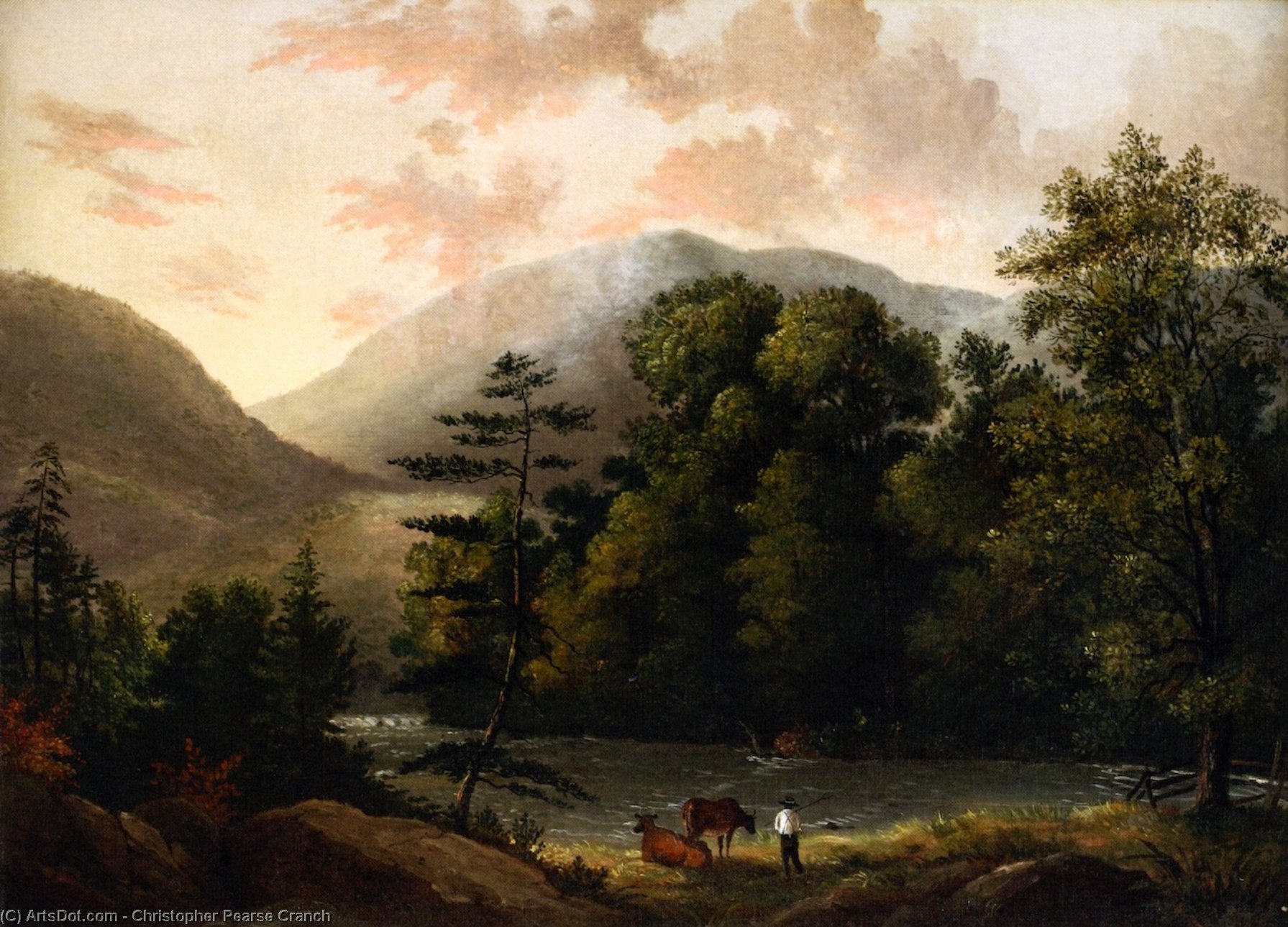
A river carves a path through a lush valley, flanked by dense, green foliage. In the distance, mountains rise against the horizon, framing a scene of quiet pastoral life. Along the riverbanks, cows graze peacefully, while horses move through the landscape. A solitary figure stands near the center, observing the movement of the water or tending to the livestock. The composition captures a moment of stillness within the natural world.

žinomi Christopher Pearse Cranch paveikslai, nuo 11 iki 34 numerio

Temos, kurios domino Christopher Pearse Cranch

Ketverios temos, dažniausiai pasikrausto originaluose, kiekvienos su savo puikiausiu pavyzdžiu.

Muziejai, kuriuose saugomi Christopher Pearse Cranch originalūs darbai

5 muziejai, kuriuose saugoma daugiausia šioje pusėje esamų paveikslų.

Muzejaus Miestas Christopher Pearse Cranch darbai Šiojo sąrašo paveikslai
New York Historical Society, NiujorkasNew York Historical Society Niujorkas 2 View on the Catskill River, Landscape
Addison Gallery of American Art, MasedusetsasAddison Gallery of American Art Masedusetsas 1 Sunset Landscape
Fogg Art Museum, KembridžasFogg Art Museum Kembridžas 1 View on the Hudson
National Gallery of Art, VašingtonasNational Gallery of Art Vašingtonas 1 Castle Gondolfo, Lake Albano, Italy
Museum of Fine Arts, BostonasMuseum of Fine Arts Bostonas 1 San Pietro in Castello, Venice

Christopher Pearse Cranch per dešimtmečius: vieniškas originalas kiekvienam

Darbai pagal dešimtmečius

Pasirinkite dešimtmetį, kad pamatytėte jį apibrėžusį originalą.

Christopher Pearse Cranch tapų klausimai galerijai

Koks yra garsiausias Christopher Pearse Cranch kūrinys?Atsakymas

River Running between Pastures (1850). Toliausiai eina Sunset Landscape ir View on the Catskill River (1846).

Kuriuo amžiaus atσταση Christopher Pearse Cranch sukūrė River Running between Pastures?Atsakymas

37 metų amžiaus: River Running between Pastures sukurta 1850 m. Nr. Christopher Pearse Cranch gimė 1813.

Kurios Christopher Pearse Cranch dešimt paveikslų yra garsiausi?Atsakymas

River Running between Pastures, Sunset Landscape, View on the Catskill River, Rome, Man with Two Cows, Landscape with Fishermen and Artist Sketching, Tivoli, East of Rome, Mountain Landscape, View on the Hudson ir Landscape. Viršuje esančioje reitingo sąraše nurodyta kiekvieno kūrinio metis ir muziejus.

Kiek žinoma Christopher Pearse Cranch darbų?Atsakymas

Mūsų kataloge yra 34 Christopher Pearse Cranch darbų, skirtų laikotarpiui nuo 1844 iki 1885.

Kur galima pamatyti garsiausių Christopher Pearse Cranch originalų?Atsakymas

Daugiausia – New York Historical Society (Niujorkas), Addison Gallery of American Art (Masedusetsas) ir Fogg Art Museum (Kembridžas). Viršuje esančiame muziejų sąraše yra visi jie.

Kuriuo laikotarpiu Christopher Pearse Cranch sukūrė savo žymiausias paveikslus?Atsakymas

1850s laikotarpiu: 13 iš 34 šioje pusėje esančių darbų buvo sukurtos tada, iš jų River Running between Pastures.

Kuris iš garsių Christopher Pearse Cranch paveikslų yra pirmasis, o kuris – paskutinis?Atsakymas

Šioje pusėje seniausias darbas yra Man with Two Cows (1844), o naujausias – McIntyre Mountain (1885).

Kokia temos Christopher Pearse Cranch mėgavosi?Atsakymas

Landscape (13), Italy (10) ir Sunset (4) iš 34 šioje pusėje esamų darbų.

Kelią meno kryžkelę priklauso Christopher Pearse Cranch kūryba?Atsakymas

Hudson river school, judging by the originals on this page.

Kurius Christopher Pearse Cranch originalius galėčiau pamatyti New York Historical Society?Atsakymas

View on the Catskill River ir Landscape: New York Historical Society, Niujorkas kolekcijoje yra 2 šioje pusėje esančių darbų.

Christopher Pearse Cranch: meno kūrinys – autoportretas

The Transcendental Vision of Christopher Pearse Cranch

In the rich tapestry of nineteenth-century American culture, few figures embody the era's intellectual and aesthetic synthesis as gracefully as Christopher Pearse Cranch. Born in 1813 in Columbia, Maryland, into a distinguished legal family, Cranch was destined for a life where the boundaries between the spiritual and the material would perpetually blur. While his early path led him toward the pulpit and the rigorous study of theology at Harvard Divinity School, his soul remained deeply tethered to the visual world. This unique duality—the disciplined mind of a Unitarian minister paired with the observant eye of an artist—allowed him to approach the canvas not merely as a surface for depiction, but as a medium for profound philosophical inquiry.

Cranch’s creative identity was profoundly shaped by his proximity to the Transcendentalist movement. As a contemporary and participant in Ralph Waldo Emerson’s inner circle, he breathed the same intellectual air that celebrated the divinity found within nature. His involvement with Emerson’s transcendental club provided him with a conceptual framework that would forever inform his landscapes. To Cranch, a waterfall or a morning mist was not just a meteorological event; it was a manifestation of the sublime, a visible sign of the underlying spiritual unity of the universe. This connection to the Hudson River School ethos allowed his work to transcend mere topographical accuracy, reaching instead for an emotional and spiritual resonance that mirrored the era's optimism and reverence for the American wilderness.

A Multifaceted Legacy of Art and Letters

The brilliance of Cranch lay in his refusal to be confined to a single discipline. He was a true Renaissance man of the American nineteenth century, weaving together a legacy that spanned painting, poetry, and prose. His literary contributions were as diverse as they were impactful, ranging from the whimsical charm of his "Huggermugger Books"* for children to the sophisticated, contemplative verses found in publications like Emerson’s Dial. This versatility extended into the realm of visual satire, where his caricatures for Harper's Weekly demonstrated a keen wit and an ability to capture the social nuances of his time.

In his paintings, Cranch achieved a delicate balance between the grandiosity of the landscape tradition and a more intimate, impressionistic sensitivity. His works, such as "Landscape with Waterfall" and his evocative depictions of Venice, reveal an artist capable of capturing both the rugged majesty of the New World and the luminous, atmospheric light of the Old. Through his brush, one can trace the evolution of a man who sought to translate the intangible truths of his faith into the tangible beauty of color and form.

The historical significance of Christopher Pearse Cranch resides in his role as a bridge between eras and ideologies. He stood at the intersection of:

  • Theological Thought: Bringing the moral depth of Unitarianism to the visual arts.
  • Literary Innovation: Contributing to the development of American prose and poetry through both scholarly essays and imaginative children's tales.
  • Artistic Tradition: Enhancing the Hudson River School tradition with a uniquely transcendentalist perspective on the natural world.

Ultimately, Cranch’s life serves as a testament to the power of integrated thought. He did not see art and intellect as opposing forces, but as two halves of a single, harmonious pursuit of truth. His enduring contribution to American art remains a luminous example of how the observation of nature can become an act of profound spiritual devotion.