Bruno Liljeforsas portretas

Bruno Liljeforsas tapiai: 72 garsiausi πίναšiai, galerijos akimis

Atnaujinta lapkritis 2026 · pagal mūsų populiarumumo koeficientą (paieškos, lankytojai ir užsakymai kiekvienam kūriniui) · 77 Bruno Liljeforsas darbai mūsų kataloge

Trumpai tariant

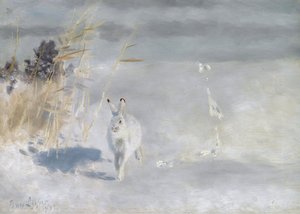
Galerijos akimais, garsiausias Bruno Liljeforsas tapas yra Title in Swedish: Duvhök och orrar (1884), kurio originalas eksponuojamas Nationalmuseum, Stokholmas. Winterhare (Snow Hare), (1932) ir Title in Swedish: Rävfamilj (1886) užbaia trio, kurį atpažįsta kiekvienas ž)/\ Iš 77 Bruno Liljeforsas darbų mūsų kataloge, galerija žemiau pristato 72 garsiausius – kiekvienas yra originalus, su nurodytu metais, muziejumi bei unikaliu aprašymu.

1860 – 1939, Uppsala Impressionism Daugiausia darbų: Nationalmuseum

10 geriausių galerijos Bruno Liljeforsas paveikslų

1
Title in Swedish: Duvhök och orrar (1884) aut. Bruno Liljeforsas

Title in Swedish: Duvhök och orrar

1884 · Oil On Canvas · Nationalmuseum, Stokholmas

The frozen landscape of Ärentuna provides the stage for a sudden, violent encounter. In this 1884 oil on canvas, a goshawk descends with outstretched wings and claws, targeting a juvenile bird amidst a flurry of black grouse. The scene captures a precise moment of avian predation, where the stillness of the snow is broken by the frantic movement of flight and the tension of survival. The composition focuses on the…

3
Title in Swedish: Rävfamilj (1886) aut. Bruno Liljeforsas

Title in Swedish: Rävfamilj

1886 · Oil · Nationalmuseum, Stokholmas

In this 1886 work, we find ourselves observing a private moment within the Swedish wilderness. A family of foxes occupies a meadow, their forms nestled among the tall grass and wildflowers. There is a sense of stillness here, a pause in the constant movement of the natural world. Several adults and their young ones are positioned throughout the scene, some closer to the viewer and others receding into the depth…

4
Cat on a flowery meadow (1887) aut. Bruno Liljeforsas

Cat on a flowery meadow

1887 · Oil · Nationalmuseum, Stokholmas

In this 1887 oil painting, a black and white cat rests within a dense meadow of wildflowers. The animal is positioned in the lower right foreground, its body oriented toward the left side of the frame. Its fur is rendered in solid patches of black and white, contrasting with the surrounding vegetation. The meadow is composed of various flora, including yellow wildflowers and small white blossoms, interspersed with green grass…

5
The Fox (1893) aut. Bruno Liljeforsas

The Fox

1893 · Oil On Canvas · Nationalmuseum, Stokholmas

The Fox is an oil on canvas work by Bruno Liljefors, dated about 1893. The subject features a single red fox moving through a snowy landscape. This naturalist study captures the animal within its natural habitat, focusing on the interaction between the creature and the winter environment.

6
Landscape with Fox (Fox pursued by Jackals) (1899) aut. Bruno Liljeforsas

Landscape with Fox (Fox pursued by Jackals)

1899 · Oil On Canvas · Rijksmuseum Twenthe, Enschede

The scene unfolds within the oil on canvas work titled Landscape with Fox (Fox pursued by Jackals). This piece, created by Bruno Liljefors, captures a moment of tension amidst the forest. The artist, Bruno Liljefors, was born in Uppsala Cathedral Assembly, Sweden, in 1860 and lived until 1939. His hand guides the viewer through this natural setting, where the subject matter is deeply rooted in the wild realities of the…

8
An Eagle Owl (1905) aut. Bruno Liljeforsas

An Eagle Owl

1905 · Oil · Nationalmuseum, Stokholmas

An Eagle Owl by Bruno Liljefors, created about 1905, features a centered composition where the bird occupies much of the middle ground. The owl is positioned against a dark, indistinct background that suggests the interior of a hollow or a shaded forest floor. This setting creates a shallow depth, focusing the viewer's attention entirely on the subject. The color palette is dominated by earthy tones, including various shades of brown,…

9
Duckling (1903) aut. Bruno Liljeforsas

Duckling

1903 · Oil On Board

This naturalist oil painting, created in 1903, presents an intimate and highly realistic depiction of a single young duckling. The composition is centered, with the small bird positioned slightly off-center towards the left to evoke a sense of natural spontaneity. Rendered on a rectangular substrate, likely wood or board, the work focuses entirely on the subject, which emerges from a shallow, atmospheric, and indistinct background.

10
Fox with Cubs (1912) aut. Bruno Liljeforsas

Fox with Cubs

1912 · Oil On Canvas · Nationalmuseum, Stokholmas

In this work, titled Fox with Cubs, we encounter a quiet moment from the life of a Swedish artist, Bruno Liljefors. Painted in 1912, the piece reflects the naturalist sensibilities that defined his career. Liljefors was born in 1860 in Uppsala, Sweden, and his deep connection to the Swedish landscape remained a constant throughout his life until his death in Stockholm in 1939.

Bruno Liljeforsas tapiai, rangos nuo 11 iki 72

11Självporträtt (1913) aut. Bruno LiljeforsasSjälvporträtt1913 · National Portrait Gallery of Sweden 12Foxes Emerging from Snowy Forest Edge (1919) aut. Bruno LiljeforsasFoxes Emerging from Snowy Forest Edge1919 · Rijksmuseum Twenthe 13Peregrine Falcon with Little Owl (?) as Prey at its Eyrie on the Coast (1923) aut. Bruno LiljeforsasPeregrine Falcon with Little Owl (?) as Prey at its Eyrie on the Coast1923 · Rijksmuseum Twenthe 14Fox in Winter Landscape (1938) aut. Bruno LiljeforsasFox in Winter Landscape1938 · Nationalmuseum 15A Family of Foxes aut. Bruno LiljeforsasA Family of Foxes 16Title in Swedish: Nötskrikor (1886) aut. Bruno LiljeforsasTitle in Swedish: Nötskrikor1886 · Nationalmuseum 17Eluding the fox aut. Bruno LiljeforsasEluding the fox 18Cat Hunting Birds (1883) aut. Bruno LiljeforsasCat Hunting Birds1883 · Gothenburg Museum of Art 19Sledging (1882) aut. Bruno LiljeforsasSledging1882 · Nationalmuseum 20A Cat with a Young Bird in its Mouth. Five studies in one frame NM 2223-2227 (1885) aut. Bruno LiljeforsasA Cat with a Young Bird in its Mouth. Five studies in one frame NM 2223-22271885 · Nationalmuseum 21Sparrows in a Cherry Tree. Five studies in one frame, NM 2223-2227 (1885) aut. Bruno LiljeforsasSparrows in a Cherry Tree. Five studies in one frame, NM 2223-22271885 · Nationalmuseum 22A Cat and a Chaffinch. Five animal studies in one frame, NM 2223-2227 (1885) aut. Bruno LiljeforsasA Cat and a Chaffinch. Five animal studies in one frame, NM 2223-22271885 · Nationalmuseum 23Chaffinches and Dragonflies. Five studies in one frame, NM 2223-2227 (1885) aut. Bruno LiljeforsasChaffinches and Dragonflies. Five studies in one frame, NM 2223-22271885 · Nationalmuseum 24Redstarts and Butterflies. Five studies in one frame, NM 2223-2227 (1885) aut. Bruno LiljeforsasRedstarts and Butterflies. Five studies in one frame, NM 2223-22271885 · Nationalmuseum 25Swedish Foxhound and Fox (1885) aut. Bruno LiljeforsasSwedish Foxhound and Fox1885 · Nationalmuseum 26Black Grouse Display (1889) aut. Bruno LiljeforsasBlack Grouse Display1889 · Bavarijos valstybinės paveikslų kolekcijos 27Nestlings of Red-Backed Shrike (1887) aut. Bruno LiljeforsasNestlings of Red-Backed Shrike1887 · Nationalmuseum 28Four Bird Studies, Red-Backed Shrike, Corncrake, Chaffinches, Willow Warbler. (1887) aut. Bruno LiljeforsasFour Bird Studies, Red-Backed Shrike, Corncrake, Chaffinches, Willow Warbler.1887 · Nationalmuseum 29The Hunter (1891) aut. Bruno LiljeforsasThe Hunter1891 · Nationalmuseum 30Man Warping (1888) aut. Bruno LiljeforsasMan Warping1888 · Nationalmuseum 31Hooded Crows (1891) aut. Bruno LiljeforsasHooded Crows1891 · Gothenburg Museum of Art 32Wild Geese (1898) aut. Bruno LiljeforsasWild Geese1898 · Statens Museum For Kunst 33Sea Eagles (1897) aut. Bruno LiljeforsasSea Eagles1897 · Nationalmuseum 34Eider Ducks (1894) aut. Bruno LiljeforsasEider Ducks1894 · Nationalmuseum 35Landscape (Fox pursued by Snipe) (1899) aut. Bruno LiljeforsasLandscape (Fox pursued by Snipe)1899 · Rijksmuseum Twenthe 36Dovekies (1901) aut. Bruno LiljeforsasDovekies1901 · National Museum of Art, Architecture and Design 37Capercaillies in a Winter Landscape (1899) aut. Bruno LiljeforsasCapercaillies in a Winter Landscape1899 · Finnish National Gallery 38Capercailzie Hen (1904) aut. Bruno LiljeforsasCapercailzie Hen1904 · Nationalmuseum 39White-tailed Eagle with White-tailed Eagle Prey at its Nest on the Coast (1907) aut. Bruno LiljeforsasWhite-tailed Eagle with White-tailed Eagle Prey at its Nest on the Coast1907 · Rijksmuseum Twenthe 40Sparrowhawk Buffeting a Reed Bunting (1907) aut. Bruno LiljeforsasSparrowhawk Buffeting a Reed Bunting1907 · Rijksmuseum Twenthe 41Blackgame in Springtime (1907) aut. Bruno LiljeforsasBlackgame in Springtime1907 · Nationalmuseum 42Curlew (1907) aut. Bruno LiljeforsasCurlew1907 · Nationalmuseum 43Sea Eagle's Nest (1907) aut. Bruno LiljeforsasSea Eagle's Nest1907 · Nationalmuseum 44Wildgeese Settling (1907) aut. Bruno LiljeforsasWildgeese Settling1907 · Nationalmuseum 45Red Grouse In The Snow aut. Bruno LiljeforsasRed Grouse In The Snow 46Eider Ducks Above Turbulent Sea (1912) aut. Bruno LiljeforsasEider Ducks Above Turbulent Sea1912 · Rijksmuseum Twenthe 47Rolling Capercaillie with Three Hens (1913) aut. Bruno LiljeforsasRolling Capercaillie with Three Hens1913 · Rijksmuseum Twenthe 48Autumn Landscape with Partridges (1913) aut. Bruno LiljeforsasAutumn Landscape with Partridges1913 · Nationalmuseum 49Bellowing Capercaillies with Them (1919) aut. Bruno LiljeforsasBellowing Capercaillies with Them1919 · Rijksmuseum Twenthe 50Grazing Brent Geese at Sunset (1921) aut. Bruno LiljeforsasGrazing Brent Geese at Sunset1921 · Rijksmuseum Twenthe 51Pair of wild ducks by a hole in the ice (1919) aut. Bruno LiljeforsasPair of wild ducks by a hole in the ice1919 · Rijksmuseum Twenthe 52Partridges (1922) aut. Bruno LiljeforsasPartridges1922 · Finnish National Gallery 53Pair of Male and Female Ducks by a Cliff (1928) aut. Bruno LiljeforsasPair of Male and Female Ducks by a Cliff1928 · Rijksmuseum Twenthe 54White-tailed Eagle Strikes at Wigeon Nest (1924) aut. Bruno LiljeforsasWhite-tailed Eagle Strikes at Wigeon Nest1924 · Rijksmuseum Twenthe 55Whooper Swans on Evening Migration (1925) aut. Bruno LiljeforsasWhooper Swans on Evening Migration1925 · Rijksmuseum Twenthe 56Winter Landscape with Snow Hare (1923) aut. Bruno LiljeforsasWinter Landscape with Snow Hare1923 · Rijksmuseum Twenthe 57Herring Gulls and Arctic Terns on the Skerries off the Scandinavian Coast (1923) aut. Bruno LiljeforsasHerring Gulls and Arctic Terns on the Skerries off the Scandinavian Coast1923 · Rijksmuseum Twenthe 58Two curlews in a peat landscape (1927) aut. Bruno LiljeforsasTwo curlews in a peat landscape1927 · Rijksmuseum Twenthe 59Black Grouse in a Treetop (1923) aut. Bruno LiljeforsasBlack Grouse in a Treetop1923 · Finnish National Gallery 60Moose shifting across a swamp in Sweden (1929) aut. Bruno LiljeforsasMoose shifting across a swamp in Sweden1929 · Rijksmuseum Twenthe 61Moose Family Entering a Clearing (1930) aut. Bruno LiljeforsasMoose Family Entering a Clearing1930 · Minneapolis Institute of Art 62Hawk attacking prey aut. Bruno LiljeforsasHawk attacking prey 63By the Sea. A Spring Day aut. Bruno LiljeforsasBy the Sea. A Spring DayNationalmuseum 64Fox In A Winter Landscape aut. Bruno LiljeforsasFox In A Winter Landscape 65I know this works ''Hans Dahl'' aut. Bruno LiljeforsasI know this works ''Hans Dahl'' 66Rocher Dans Une Foret aut. Bruno LiljeforsasRocher Dans Une Foret 67Study Of A Wild Duck aut. Bruno LiljeforsasStudy Of A Wild Duck 68Fox By The Fence aut. Bruno LiljeforsasFox By The Fence 69A sea eagle chasing eider duck aut. Bruno LiljeforsasA sea eagle chasing eider duck 70The Morning Sun (i Know This Works ''august Wilhelm Nikolaus Hagborg'') aut. Bruno LiljeforsasThe Morning Sun (i Know This Works ''august Wilhelm Nikolaus Hagborg'') 71A Poacher (1894) aut. Bruno LiljeforsasA Poacher1894 · Nationalmuseum 72Morning Mood by the Sea (1896) aut. Bruno LiljeforsasMorning Mood by the Sea1896 · Thiel Gallery

žymios Bruno Liljeforsas tapiojamos, pagal laikotarpį

Temos, kurios domino Bruno Liljeforsas

Ketverios temos, dažniausiai pasikrausto originaluose, kiekvienos su savo puikiausiu pavyzdžiu.

Muziejai, kuriuose saugomi Bruno Liljeforsas originalūs darbai

8 muziejai, kuriuose saugoma daugiausia šioje pusėje esamų paveikslų.

Muzejaus Miestas Bruno Liljeforsas darbai Šiojo sąrašo paveikslai
Nationalmuseum, StokholmasNationalmuseum Stokholmas 29 Title in Swedish: Duvhök och orrar, Title in Swedish: Rävfamilj, Cat on a flowery meadow
Rijksmuseum Twenthe, EnschedeRijksmuseum Twenthe Enschede 19 Landscape with Fox (Fox pursued by Jackals), Landscape with Hounds (Fox pursued by Brachies), Foxes Emerging from Snowy Forest Edge
Finnish National Gallery, HelsinkisFinnish National Gallery Helsinkis 3 Capercaillies in a Winter Landscape, Partridges, Black Grouse in a Treetop
Gothenburg Museum of Art, GothenburgGothenburg Museum of Art Gothenburg 2 Cat Hunting Birds, Hooded Crows
National Portrait Gallery of Sweden, SträngnäsNational Portrait Gallery of Sweden Strängnäs 1 Självporträtt
Bavarijos valstybinės paveikslų kolekcijos, MiunchasBavarijos valstybinės paveikslų kolekcijos Miunchas 1 Black Grouse Display
Statens Museum For Kunst, KopenhagaStatens Museum For Kunst Kopenhaga 1 Wild Geese
National Museum of Art, Architecture and Design, OsloNational Museum of Art, Architecture and Design Oslo 1 Dovekies

Bruno Liljeforsas, po vieno ikoninio paveikslio kiekvienam dešimtmenės laikotarpiui

Darbai pagal dešimtmečius

Pasirinkite dešimtmetį, kad pamatytėte jį apibrėžusį originalą.

Bruno Liljeforsas tapyiniai: galerijos atsakymai

Kuris Bruno Liljeforsas paveikslas yra pats garsiausias iš visų?Atsakymas

Title in Swedish: Duvhök och orrar (1884), Nationalmuseum, Stokholmas. Toliau seka Winterhare (Snow Hare), (1932) ir Title in Swedish: Rävfamilj (1886).

Kiek metų buvo Bruno Liljeforsas, kai sukūrė Title in Swedish: Duvhök och orrar?Atsakymas

24 metų amžiaus: Title in Swedish: Duvhök och orrar sukurta 1884 m. Nr. Bruno Liljeforsas gimė 1860.

Kuriose yra 10 geriausių Bruno Liljeforsas paveikslų?Atsakymas

Title in Swedish: Duvhök och orrar, Winterhare (Snow Hare), (1932), Title in Swedish: Rävfamilj, Cat on a flowery meadow, The Fox, Landscape with Fox (Fox pursued by Jackals), Landscape with Hounds (Fox pursued by Brachies), An Eagle Owl, Duckling ir Fox with Cubs. Viršuje esančioje reitingo sąraše nurodyta kiekvieno kūrinio metis ir muziejus.

Kiek kūrinių sukūrė Bruno Liljeforsas?Atsakymas

Mūsų kataloge yra 77 Bruno Liljeforsas darbų, skirtų laikotarpiui nuo 1882 iki 1938.

Kur kabinami garsiausi Bruno Liljeforsas originalūs darbai?Atsakymas

Daugiausia – Nationalmuseum (Stokholmas), Rijksmuseum Twenthe (Enschede) ir Finnish National Gallery (Helsinkis). Viršuje esančiame muziejų sąraše yra visi jie.

Kada Bruno Liljeforsas sukūrė savo garsiausias paveikslus?Atsakymas

1880s laikotarpiu: 16 iš 72 šioje pusėje esančių darbų buvo sukurtos tada, iš jų Title in Swedish: Duvhök och orrar.

Kokie yra ankstyviausi ir vėliausi garsieji Bruno Liljeforsas kūriniai?Atsakymas

Šioje pusėje seniausias darbas yra Sledging (1882), o naujausias – Fox in Winter Landscape (1938).

Kurią temą Bruno Liljeforsas kūrė dažniausiai?Atsakymas

Fox (6), Winter (5) ir Wildlife (5) iš 72 šioje pusėje esamų darbų.

Kurią techniką Bruno Liljeforsas naudojo dažniausiai?Atsakymas

Oil On Canvas, iš 72 šios puslapio darbų – 10.

Su kokiu kierliu siejama Bruno Liljeforsas?Atsakymas

Impressionism, vadovaujantis šios puslapio originalais kūriniais.

Kurių Bruno Liljeforsas originalų turi Nationalmuseum?Atsakymas

Title in Swedish: Duvhök och orrar, Title in Swedish: Rävfamilj ir Cat on a flowery meadow: Nationalmuseum, Stokholmas kolekcijoje yra 29 šioje pusėje esančių darbų.

Bruno Liljeforsas: menininkas

Wilding Susienimų Meistras: Bruno Liljeforsas ir jo Menas

Bruno Andreas Liljeforsas, gimęs 1860 m. Švedijoje, Upsaloje, tapo itin svarbiu XIX a. pamento ir XX a. pradžios meno šaliu, garsėjančiu dėl savo dinamiškų gamtos atstaidų vaizdavimo. Jis nebuvo tik paprastas gyvūnų paveikslavęs menininkas; jis buvo grynosios gamtos dramos kronikierius, meistras, gebantis įamžinti trumpalaikiškus plėtrai ir avieniai būdingus momentus, įkvėptus jų senoviniško žaidimo. Liljeforsas išsiskirto savo inovatyviu impresionizmo technikų ir kruopštaus stebėjimo derininiu, kurdamas darbus, kuriuose susitiko mokslinis tikslumas ir emocinis gėda. Jo įtaka išsiperjo už gimtosios Švedijos ribų, paveikdamas pokalnius laiko gamtos menininkų kartas. Jo ankstyvoji gyvenimo etapa nedavė jokio uždavario to meninio kelio, kurį jis vėliau išskaičiuos. Nors jis gimė skurtoje šeimoje – jo tėvas buvo švedijos švencų pramonės valdininkas – natūralus dailės talentas greitai tapo akivaizdus. Vietos pardavėjai pastebėjo ir puoselėjo šį dovano, suteikdami jaunajam Bruno dailės priemones, kurios dar daugiau paskelbė jo aistrą. Šis ankstyvasis skatinimas padėjo pagrindus oficialiam mokymui Stokochoje, Karališkio Švedijos meno akademijoje, prasidžiamiam 1879 metais.

Iš Akademinės Šaknų į Impresionistines Vizijas

Liljeforso meninis kelias nebuvo tiesus ar paprastas. Jo pirminiai studijos laikotarpiai laikosi to laiko vyravusio akademinio realizmo, orientuotio į istorinius paveikslavus ir tradicinius temus. Tačiau kelionės per Europą – iš Dūsenbergo iki Venecijos, iš Florencijos iki Romas ir Paryžiaus – tapo transformatyviomis. Susidūrimas su įvairiais meniniais sūkiais, ypač Prancūzijoje, sukūrė poslinkį link impresionizmo. Jis pajautė trauką prie laisvo brusherių naudojimo, gyvų spalvų ir šviesos momentų vaizdavimo, kurie būdingi Claude'o Monet'o ar Pierre'o-Auguste'o Renoir'o kūriniams. Ši nauja estetinė jautrė nebuvo tiesiog perimta; Liljeforsas ją ingenioziškai sujungė su giliu gyvūnų anatomijos ir elgsenos supratimu. Jis ne tik tapė gyvūnus *pridėjus* prie gamtos, jis tapė gamtą *per* gyvūnus, pertegdamas jų esmę dinamiškoje aplinkoje. Šis laikotarpis taip pat apima jo bendrystę su skandinavų menininkų kolonija Gréz-sur-Loing, kas dar labiau tobulino jo viziją ir sukūrė ryšius, formavusius jo karjerą. Taip pat pradėjo subtiliai perskriepti jo stilių Japonijos medžiojoje grafikos įtampa su jos unikaliomis perspektyvomis ir plokčiais kompozicijomis.

Gautos Dramas: Liljeforso Stiliaus Esė

Liljeforsas užsitikino savo vietą fokusuodamas į medžioklės scenas – lekią, besileidžiančią ant avienio, kastingą kastingą, gąsdinantį avienį, ar lapę, stebinčią kiaulę. Tai nebuvo tik smurtės vaizdinimas; tai buvo gamtos inherentinės dramos tyrimas, pateikiamas su neįtikėtinu jautrumu ir psichologiniu glaždu. Jis vengė sensacingumą ar moralizavimą, aplinką ir susidūrimus pristomdamas kaip natūralius įvykius plačiame ekologiniame kontekste. Jo technika buvo esminė šiam efektui pasiekti. Liljeforsas naudojo skaidrius brusherių traukus ir gyvą paletę, kad užtektų šviesos ir šešėlio žaidimą per plumas, kailį ir kraštoves. Jis turėjo išskirtinį gebėjimą vaizduoti kamufliažo džiugmenis, demonstruodamas gilią supratimą apie tai, kaip gyvūnai susiliepa su savo aplinka. Tai nebuvo tik vizualinis tikslumas; tai buvo gyvulo perspektyvos perteikimas – to, kaip jie suvokia ir persitys su savo aplinkyne. Siekdamas užtikrinti autentiškumą, Liljeforsas savo namuose laikė gyvų gyvūnų kolekciją, leidžiančią jam tiesiogiai stebėti jų judesius ir elgseną. Jis nesireigia eskizų ar fotografijų; jis tapė iš gyvenimo, suteikdamas savo darbiams skubumo ir gyvybės, kurie išskiria juos iš kitų.

Palikimas ir Ilgalaikė Įtampa

Bruno Liljeforsas mirė Stokochoje 1939 m., palikdamas kūrybos veiklą, kuri iki šių dien užburia auditorijas. Jo tapyba yra saugoma didelėse muziejų kolekcijose Švedijoje ir tarptautiniu mastu, tarnaujanti kaip jo meno meistriškės ir neišnykdamos vizijos įrodymas. Jis išlieka ikoninis švedų meno ir kultūros veikėjas, pagarba pelnęjęs už gebėjimą įamžinti gamtos pasaulio esmę tiek moksliniu tikslumu, tiek poetišku švelnumu. Jo įtaka būsimoms gamtos menininkų kartoms yra neabejotinga. Menininkai, tokie kaip Michael Coleman, atvirai pripažįsta savo dėmę Liljeforso inovatyvioms technikoms ir giliam gyvūnų elgsenos supratimui. Be grynosios dailės srities, Liljeforso darbas taip pat turėjo subtilią, bet reikšmingą poveikį mūsų suvokimui apie pačią gamtą. Jo paveikslai skatina mus stebėti aplinką balsiau, vertinti ekologinių santykių grožį ir sudėtingumą bei atpažinti dramą, kuri vyksta net ir pati ramingiausiose kraštovėse. Jo palikimas yra ne tik meno pasiekimų, bet ir gilesnio ryšio kūrimo tarp žmonių ir gamtos pasaulio. Jis yra įrodymas apie meno galimybę apšviesti, įkvėpti ir galiausiai priminti mums mūsų vietą didžiojoje gyvybės audinyje.