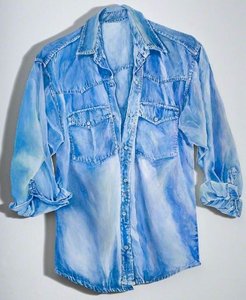
A Life Woven in Thread: The Textile Art of Beryl Christina Woodhall
Beryl Christina Woodhall, born in 1944, is an Australian artist whose work quietly yet powerfully redefines the boundaries between craft and fine art. While not a household name, her dedication to textile practice—specifically needlework depicting everyday clothing—has earned her significant recognition within contemporary art circles and a growing appreciation for its poignant exploration of memory, domesticity, and the often-overlooked beauty of the mundane. Woodhall’s journey is one of subtle rebellion against traditional artistic hierarchies, elevating seemingly humble materials and techniques to a level of profound aesthetic and emotional resonance. Her work isn't about grand narratives or sweeping statements; it’s about the intimate stories held within the fabric of our lives, quite literally.
From Observation to Intricate Representation
Woodhall’s artistic path wasn’t forged in formal art schools but through keen observation and a deeply personal connection to her surroundings. She initially trained as a teacher, which instilled in her a methodical approach and an appreciation for the power of visual communication. However, it was her fascination with clothing—specifically the garments worn by those around her—that ultimately steered her towards textile art. She began meticulously documenting these items, not as fashion statements but as vessels of personal history. A faded denim shirt, a well-worn t-shirt, underwear – each piece became a subject worthy of intense scrutiny and artistic rendering. Her technique is characterized by an extraordinary level of detail achieved through painstaking needlework, often employing watercolor studies as preliminary sketches to capture the nuances of texture, light, and shadow. These aren’t mere copies; they are interpretations imbued with Woodhall's sensitivity and understanding of her subjects. The choice of clothing itself is significant. These are not glamorous or aspirational items but rather the everyday wear that speaks to a life lived, a body inhabited, a story unfolded.
The Shrine of Remembrance Project: A Monument to the Unsung
A pivotal moment in Woodhall’s career came with her commission for the Shrine of Remembrance in Melbourne. This project involved creating a series of needlework panels depicting clothing worn by Australian service personnel during wartime. This was not about glorifying conflict but rather honoring the individual experiences of those who served, and their families left behind. The intimacy of the medium—needlework traditionally associated with domesticity and remembrance—was particularly powerful in this context. Each stitch became a testament to loss, sacrifice, and the enduring power of memory. This work demonstrated Woodhall’s ability to use textile art as a vehicle for profound social commentary and emotional healing. It also challenged conventional notions of what constitutes war memorial art, moving away from grand monuments towards a more personal and human-scale representation of conflict.
Influences and Artistic Context
While Woodhall’s style is distinctly her own, it exists within a broader context of contemporary craft movements that emerged in the latter half of the 20th century. She shares affinities with artists who sought to elevate traditionally “feminine” crafts—such as quilting, embroidery, and weaving—to the status of fine art. Artists like Judy Chicago, with her groundbreaking work *The Dinner Party*, paved the way for a re-evaluation of craft practices and their potential for social and political expression. However, Woodhall’s work differs in its quiet intimacy and focus on everyday objects. She isn't making overt political statements but rather inviting viewers to contemplate the hidden stories embedded within the fabric of our lives. Her meticulous realism also draws parallels with hyperrealist painting, though she achieves her effects through a distinctly tactile and labor-intensive process.
Legacy and Historical Significance
Beryl Christina Woodhall’s contribution to contemporary art lies in her ability to transform the ordinary into the extraordinary. She has demonstrated that textile art is not merely decorative but can be a powerful medium for exploring complex themes of memory, identity, and social history. Her work challenges us to reconsider our relationship with clothing—to see it not just as functional objects but as repositories of personal stories and cultural meaning. By elevating needlework to the level of fine art, she has also helped to legitimize craft practices that were historically undervalued. As her work continues to gain recognition, Woodhall’s legacy will undoubtedly inspire future generations of artists to explore the rich potential of textile media and the power of quiet observation. Her pieces are not just artworks; they are fragments of lives woven into thread, offering a poignant reflection on the human condition.