Benjamin Duterrau portretas

Benjamin Duterrau tapiai: 5 garsiausi πίναšiai, galerijos akimis

Atnaujinta lapkritis 2026 · pagal mūsų populiarumumo koeficientą (paieškos, lankytojai ir užsakymai kiekvienam kūriniui) · 6 Benjamin Duterrau darbai mūsų kataloge

Trumpai tariant

Galerijos akimais, garsiausias Benjamin Duterrau tapas yra Woureddy, a wild native of Brune Island (1835), kurio originalas eksponuojamas National Portrait Gallery, Kanbera. Truggernana, a native of southern part of V.D. Land (1835) ir Mr Robinson's first interview with Timmy (1840) užbaia trio, kurį atpažįsta kiekvienas ž)/\ Iš 6 Benjamin Duterrau darbų mūsų kataloge, galerija žemiau pristato 5 garsiausius – kiekvienas yra originalus, su nurodytu metais, muziejumi bei unikaliu aprašymu.

1768 – 1851, London Daugiausia darbų: National Portrait Gallery

10 geriausių galerijos Benjamin Duterrau paveikslų

2
Truggernana, a native of southern part of V.D. Land (1835) aut. Benjamin Duterrau

Truggernana, a native of southern part of V.D. Land

1835 · Ink On Paper · National Portrait Gallery, Kanbera

The ink meets the paper with a quiet, deliberate precision, capturing a moment of profound stillness. A figure emerges from the pale expanse of the page, rendered in the meticulous lines of a pen and ink drawing. This is Truggernana, a woman of the Nuennone people, her presence felt through the delicate hatching and the careful weight of every stroke. She exists in a space that feels both intimate and…

3
Mr Robinson's first interview with Timmy (1840) aut. Benjamin Duterrau

Mr Robinson's first interview with Timmy

1840 · Oil On Canvas · Australijos nacionalinė galerija, Kanbera

The painting depicts a formal meeting between a European man and several Indigenous men under a heavy, overcast sky. In the foreground, the two primary figures are engaged in a handshake, a gesture that anchors the composition. The European man wears a dark, heavy coat over a shirt with white and blue stripes. His skin tone and the skin of the Indigenous men are rendered in deep browns and earthy…

5
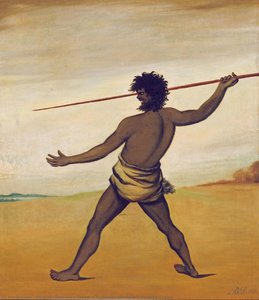
Timmy, a Tasmanian Aboriginal, throwing a spear (1838) aut. Benjamin Duterrau

Timmy, a Tasmanian Aboriginal, throwing a spear

1838 · Oil On Canvas · Art Gallery of South Australia, Adelaida

In this 1838 oil painting, titled Timmy, a Tasmanian Aboriginal, throwing a spear, we encounter a singular moment of focused intensity. The artist, Benjamin Duterrau, captures a solitary Tasmanian Aboriginal man at the precise instant of action. There is a palpable sense of muscular tension in the figure, frozen in the middle of a throw. It is a quiet, heavy moment that speaks to the skill and survival required by…

Temos, kurios domino Benjamin Duterrau

Ketverios temos, dažniausiai pasikrausto originaluose, kiekvienos su savo puikiausiu pavyzdžiu.

Muziejai, kuriuose saugomi Benjamin Duterrau originalūs darbai

3 muziejai, kuriuose saugoma daugiausia šioje pusėje esamų paveikslų.

Muzejaus Miestas Benjamin Duterrau darbai Šiojo sąrašo paveikslai
National Portrait Gallery, KanberaNational Portrait Gallery Kanbera 2 Woureddy, a wild native of Brune Island, Truggernana, a native of southern part of V.D. Land
Art Gallery of South Australia, AdelaidaArt Gallery of South Australia Adelaida 2 Jack, a Tasmanian Aboriginal, holding a club, Timmy, a Tasmanian Aboriginal, throwing a spear
Australijos nacionalinė galerija, KanberaAustralijos nacionalinė galerija Kanbera 1 Mr Robinson's first interview with Timmy

Benjamin Duterrau, pagrindiniai kiekvienų metų paveiksliai

7 metų, nuo 1835 iki 1841, šiame puslapyje pristatoma visa Benjamin Duterrau karjera: trumpa apžvalga, kurioje metinis chronologijos principu per žymiausius originalus atskleidžiama kūrybos istorija.

Darbai pagal metus

Pasirinkite metus, kad pamatytumėte originalus darbus.

Benjamin Duterrau tapyiniai: galerijos atsakymai

Kuris Benjamin Duterrau paveikslas yra pats garsiausias iš visų?Atsakymas

Woureddy, a wild native of Brune Island (1835), National Portrait Gallery, Kanbera. Toliau seka Truggernana, a native of southern part of V.D. Land (1835) ir Mr Robinson's first interview with Timmy (1840).

Kiek metų buvo Benjamin Duterrau, kai sukūrė Woureddy, a wild native of Brune Island?Atsakymas

67 metų amžiaus: Woureddy, a wild native of Brune Island sukurta 1835 m. Nr. Benjamin Duterrau gimė 1768.

Kiek kūrinių sukūrė Benjamin Duterrau?Atsakymas

Mūsų kataloge yra 6 Benjamin Duterrau darbų, skirtų laikotarpiui nuo 1835 iki 1841.

Kur kabinami garsiausi Benjamin Duterrau originalūs darbai?Atsakymas

Daugiausia – National Portrait Gallery (Kanbera), Art Gallery of South Australia (Adelaida) ir Australijos nacionalinė galerija (Kanbera). Viršuje esančiame muziejų sąraše yra visi jie.

Kada Benjamin Duterrau sukūrė savo garsiausias paveikslus?Atsakymas

1835 laikotarpiu: 2 iš 5 šioje pusėje esančių darbų buvo sukurtos tada, iš jų Woureddy, a wild native of Brune Island.

Kokie yra ankstyviausi ir vėliausi garsieji Benjamin Duterrau kūriniai?Atsakymas

Šioje pusėje seniausias darbas yra Woureddy, a wild native of Brune Island (1835), o naujausias – Jack, a Tasmanian Aboriginal, holding a club (1841).

Kurią temą Benjamin Duterrau kūrė dažniausiai?Atsakymas

Man (3), Indigenous australia (2) ir Cloudy sky (2) iš 5 šioje pusėje esamų darbų.

Kurią techniką Benjamin Duterrau naudojo dažniausiai?Atsakymas

Oil On Canvas, iš 5 šios puslapio darbų – 3.

Kurių Benjamin Duterrau originalų turi National Portrait Gallery?Atsakymas

Woureddy, a wild native of Brune Island ir Truggernana, a native of southern part of V.D. Land: National Portrait Gallery, Kanbera kolekcijoje yra 2 šioje pusėje esančių darbų.

Benjamin Duterrau: menininkas

A Life Between Two Hemispheres

Benjamin Duterrau arrived in Van Diemen's Land in August 1832, a man of sixty-five years who had already seen the bustling streets of London and the rigorous training of an English apprenticeship. Born in Soho to Anglo-French parents, his early life was shaped by the precision of an engraver’s craft and the artistic shadows of masters like Thomas Gainsborough and William Hogarth. He did not seek a quiet retirement in the colonies; instead, he brought with him a drive to lecture on the civilizing influence of art at the Hobart Mechanics' Hall only months after his arrival.

His transition from the established art circles of England to the rugged landscape of Tasmania was marked by a singular purpose. While many migrants sought fortune through trade, Duterrau sought to document a world in flux. He settled in Hobart, establishing a studio where he could apply the meticulous observation learned in London to the faces and environments of a new territory. His work as a painter, etcher, and sculptor allowed him to capture the nuances of a society undergoing profound colonial shifts.

The Documentation of a Vanishing People

Duterrau’s most significant contribution lies in his sensitive treatment of the Indigenous Tasmanian population. Working alongside figures such as George Augustus Robinson, he found himself positioned at the intersection of colonial expansion and the survival of Aboriginal culture. He did not merely paint subjects; he recorded individuals with a level of dignity that was rare for the 1830s. His etchings and portraits of Aboriginal men and women provided a visual record of people whose lives were being irrevocably altered by settlement.

His technical approach often relied on a realistic style, prioritizing ethnographic accuracy. In works such as his depiction of "Timmy, a Tasmanian Aboriginal, throwing a spear," he utilized layered brushstrokes to build physical presence and texture. He possessed a particular skill for capturing the tension of a moment, such as the muscular focus of a hunter or the quiet strength in a sitter's expression. These portraits remain vital historical documents for those studying the Nuennone and other tribes of the region.

Historical Weight and Artistic Legacy

The scale of Duterrau’s ambition is perhaps best seen in his larger-scale historical compositions. His painting "The Conciliation" (1840) depicts a formal meeting between European colonists and Aboriginal chiefs, utilizing light and color to convey the gravity of the encounter. This work was intended as a study for an even more expansive project titled "A National Picture," an epic canvas that remains lost to history. Despite the disappearance of his largest intended works, his presence in the Tasmanian colonial narrative is firmly established through his surviving sketches and etchings.

Duterrau’s life ended in Hobart in 1851, leaving behind a body of work that functions as both art and archive. His legacy is found in the collections of the Tasmanian Museum and Art Gallery, where his depictions of the landscape and its original inhabitants continue to provide insight into the nineteenth century. He remains a figure who used the tools of an engraver and painter to illuminate the human dimension of Australian colonization.