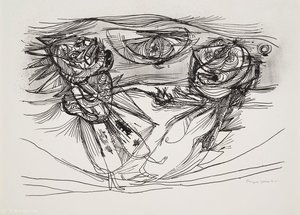
Asger Jornas portretas

21 garsiausių Asger Jornas paveikių rinkinys: galerijos išboru

Atnaujinta lapkritis 2026 · pagal mūsų populiarumumo koeficientą (paieškos, lankytojai ir užsakymai kiekvienam kūriniui) · 26 Asger Jornas darbai mūsų kataloge

Trumpai tariant

Iš visų paliktų originalų kūrinių Asger Jornas garsiausias yra In the Beginning was the Image (1965), esantis Statens Museum For Kunst kolekcijoje, Kopenhaga. Tiesiog už jų seka Abstraction (1947) ir My Castle in Spain (1954). Mūsų kataloge yra 26 darbų autoriaus Asger Jornas; galerija išsaugojo 21 labiausiai pasaulyje žyminiausių kūrinių – kiekvienas jų pateikiamas su datos, muziejaus ir istorijos aprašymu.

1914 – 1973, Vejle Cobra Daugiausia darbų: Statens Museum For Kunst

Asger Jornas geriausios 10 paveikslų: galerijos pasirinkimas

1
In the Beginning was the Image (1965) aut. Asger Jornas

In the Beginning was the Image

1965 · Acrylic On Canvas · Statens Museum For Kunst, Kopenhaga

The canvas titled In the Beginning was the Image pulses with a restless energy that seems to defy the stillness of the gallery. Created in 1965, this work emerges from the creative spirit of Asger Jorn, a Danish artist who brought a sense of rebellion to the medium. Born in Vejrum Parish, Denmark, in 1914, Jorn spent his life—until his death in 1973—challenging the boundaries of what a painting can…

4
Saxnäs (1946) aut. Asger Jornas

Saxnäs

1946 · Oil On Canvas · Statens Museum For Kunst, Kopenhaga

The canvas presents a dense network of interlocking organic and geometric forms. A series of swirling, curvilinear lines move across the surface, creating a non-hierarchical arrangement where movement flows without a single focal point. The color palette consists of deep blues, earthy ochres, bright reds, forest greens, and touches of pale pink and yellow. These pigments are applied with thick, visible brushstrokes and heavy impasto textures that create physical depth.…

5
Springtime (1939) aut. Asger Jornas

Springtime

1939 · Oil On Canvas · Statens Museum For Kunst, Kopenhaga

In Asger Jorn's Springtime, a dreamlike atmosphere unfolds across a deep, monochromatic blue expanse. On the left side of the frame, two elongated, vertical, biomorphic figures emerge from the shadows. These forms are rendered with dark, sweeping lines, punctuated by sudden patches of black and red. They appear to stand firmly upon a flat, ochre-colored ground plane that cuts through the blue void. A small red dot punctuates the vastness…

6
Boundless (1959) aut. Asger Jornas

Boundless

1959 · Oil On Canvas · Statens Museum For Kunst, Kopenhaga

The canvas presents a non-representational arrangement of thick, gestural brushstrokes. On the left side, the palette is dominated by fiery reds and oranges. This transitions into bright yellows and ochre on the right. A heavy black mass occupies the upper central portion of the frame. In the foreground and center, deep blues and teals create a sense of layered pigment. The surface features thick impasto textures, where the oil paint…

7
Composition With Birds (1939) aut. Asger Jornas

Composition With Birds

1939 · Gouache · Statens Museum For Kunst, Kopenhaga

The canvas unfolds as a silent, surrealist dream, where the boundaries between the biological and the abstract begin to dissolve. Deep purples dominate the field, creating a somber, nocturnal atmosphere that feels heavy with contemplation. Within this dark expanse, organic shapes float like memories or fragments of a subconscious thought. A vertical, totem-like structure anchors the left side of the composition, providing a sense of weight to an otherwise weightless…

8
Untitled (1945) aut. Asger Jornas

Untitled

1945 · Oil On Canvas · Statens Museum For Kunst, Kopenhaga

In "Untitled" by Asger Jorn, an energetic abstraction unfolds across a deep blue field. The composition avoids a central focus, opting instead for a decentralized arrangement that pushes the eye through a non-linear space. Cobalt and ultramarine tones anchor the work, creating a heavy, liquid atmosphere. Amidst this blue expanse, fragmented shapes emerge like sudden movements in deep water. These colorful forms break the stillness of the background.

9
The Sun is Pissing Me Off (1961) aut. Asger Jornas

The Sun is Pissing Me Off

1961 · Oil On Canvas · Statens Museum For Kunst, Kopenhaga

The Sun is Pissing Me Off by Asger Jorn, created about 1961, is an energetic and highly expressive abstract expressionist work. The composition is chaotic and emotive, centered around a vertically oriented cluster of thick, impasto strokes. These strokes suggest a fragmented figure or organic form through their heavy, tactile application. In the upper left area, bright yellow strokes radiate outward, mimicking the appearance of light or energy. The arrangement…

10
Untitled (1940) aut. Asger Jornas

Untitled

1940 · Oil On Canvas · Statens Museum For Kunst, Kopenhaga

This work, titled Untitled, was created by the Danish artist Asger Jorn. It dates to 1945, a period of significant transition in the artist's development. The piece is currently held within the collection of the Statens Museum For Kunst in Copenhagen.

Asger Jornas darba rinkinys tęsiamas, nuo 11 iki 21

žymios Asger Jornas tapiojamos, pagal laikotarpį

Temos, kurios domino Asger Jornas

Ketverios temos, dažniausiai pasikrausto originaluose, kiekvienos su savo puikiausiu pavyzdžiu.

Muziejai, kuriuose saugomi Asger Jornas originalūs darbai

2 muziejai, kuriuose saugoma daugiausia šioje pusėje esamų paveikslų.

Muzejaus Miestas Asger Jornas darbai Šiojo sąrašo paveikslai
Statens Museum For Kunst, KopenhagaStatens Museum For Kunst Kopenhaga 19 In the Beginning was the Image, Abstraction, My Castle in Spain
Tate Modern, LondrasTate Modern Londras 1 The Black Flight

Asger Jornas dešimtmetėms po dešimtmetės: originalus kūrinys, apibūdinantis kiekvieną iš jų

Darbai pagal dešimtmečius

Pasirinkite dešimtmetį, kad pamatytėte jį apibrėžusį originalą.

Kolekcjonerų klausimai apie Asger Jornas paveikslus

Kuriu darbu Asger Jornas yra labiausiai garsus?Atsakymas

In the Beginning was the Image (1965), Statens Museum For Kunst, Kopenhaga. Toliau seka Abstraction (1947) ir My Castle in Spain (1954).

Kokia buvo Asger Jornas amžius, kai buvo sukurtas In the Beginning was the Image?Atsakymas

51 metų amžiaus: In the Beginning was the Image sukurta 1965 m. Nr. Asger Jornas gimė 1914.

Kokie yra 10 garsiausių Asger Jornas paveikslų?Atsakymas

In the Beginning was the Image, Abstraction, My Castle in Spain, Saxnäs, Springtime, Boundless, Composition With Birds, Untitled, The Sun is Pissing Me Off ir Untitled. Viršuje esančioje reitingo sąraše nurodyta kiekvieno kūrinio metis ir muziejus.

Kiek paveikslų paliko Asger Jornas?Atsakymas

Mūsų kataloge yra 26 Asger Jornas darbų, skirtų laikotarpiui nuo 1939 iki 1967.

Kuriuose muziejuose eksponuojami Asger Jornas šedevrai?Atsakymas

Daugiausia – Statens Museum For Kunst (Kopenhaga) ir Tate Modern (Londras). Viršuje esančiame muziejų sąraše yra visi jie.

Kuriomis metais Asger Jornas tapo savo garsiausius kūrinius?Atsakymas

1940s laikotarpiu: 8 iš 21 šioje pusėje esančių darbų buvo sukurtos tada, iš jų Abstraction.

Kokie yra pirmasis ir paskutinis garsieji Asger Jornas originalūs darbai?Atsakymas

Šioje pusėje seniausias darbas yra Springtime (1939), o naujausias – Pixilated Garden (1967).

Kurią temą Asger Jornas rinkosi dažniausiai?Atsakymas

Organic shapes (3), Blue background (2) ir Jagged shapes (2) iš 21 šioje pusėje esamų darbų.

Kurią techniką Asger Jornas naudojo dažniausiai?Atsakymas

Oil On Canvas, iš 21 šios puslapio darbų – 6.

Kelią meno kryptį priklauso Asger Jornas?Atsakymas

Cobra, vadovaujantis šios puslapio originalais kūriniais.

Kurių Asger Jornas darbai eksponuojami Statens Museum For Kunst?Atsakymas

In the Beginning was the Image, Abstraction ir My Castle in Spain: Statens Museum For Kunst, Kopenhaga kolekcijoje yra 19 šioje pusėje esančių darbų.

Asger Jornas: gyvenimas ir kūryba

A Life Forged in Rebellion: The Artistic Journey of Asger Jorn

Asger Oluf Jørn, a name synonymous with artistic rebellion and avant-garde innovation, emerged from the quiet landscapes of Jutland, Denmark, in 1914. His life was not merely a chronicle of paintings and sculptures; it was a passionate engagement with the tumultuous currents of 20th-century thought, a relentless questioning of societal norms, and an unwavering commitment to artistic freedom. Born into a family of teachers, Jørn’s early years were marked by intellectual stimulation but also shadowed by loss – the death of his father when he was just twelve profoundly shaped his rebellious spirit. This formative experience ignited within him a skepticism towards authority, both religious and societal, that would become a defining characteristic of his artistic and political life. A diagnosis of tuberculosis at fifteen led to a period of convalescence on the Danish coast, fostering introspection and a deepening connection with the natural world – elements that would subtly permeate his later work. Even during these early years, Jørn’s intellectual curiosity extended beyond conventional boundaries; studies at Vinthers Seminarium were coupled with an active involvement in the Communist Party of Denmark, and a crucial mentorship under Christian Christensen, laying the groundwork for a life dedicated to challenging the status quo.

From Parisian Studios to Avant-Garde Manifestos

Jørn’s artistic education began formally at the Royal Danish Academy of Fine Arts in Copenhagen (1937-1942), but it was his time in Paris that proved truly transformative. Initially drawn to the tutelage of Wassily Kandinsky, he soon found himself more aligned with the principles espoused by Fernand Léger’s Académie Contemporaine. This shift marked a decisive move away from figurative representation and towards the liberating possibilities of abstraction. The Parisian art scene, buzzing with new ideas and challenging conventions, ignited Jørn's creative fire. However, it wasn’t simply about adopting a style; it was about forging a unique artistic language that reflected his own deeply held beliefs. This quest for originality led him to co-found two pivotal avant-garde movements: COBRA (1948-1951) and the Situationist International (1957). COBRA, an acronym derived from Copenhagen, Brussels, and Amsterdam – the cities of its founders – championed spontaneous creation, experimentation, and a fusion of artistic traditions. Jørn’s involvement was instrumental in defining COBRA's ethos, advocating for an art that was raw, immediate, and unburdened by intellectual constraints. Later, his engagement with the Situationist International saw him applying his scientific and mathematical knowledge – drawing inspiration from figures like Henri Poincaré and Niels Bohr – to develop a unique ‘situlogical’ technique, further blurring the lines between art, theory, and social critique.

Themes of Kitsch, Society, and Spontaneous Creation

Jørn's artistic output is remarkably diverse, encompassing painting, sculpture, ceramics, and writing, yet it remains unified by a set of recurring themes and stylistic characteristics. He possessed a provocative fascination with kitsch, arguing in his influential essay "Intimate Banalities" that these often-dismissed works held greater artistic merit than conventional fine art – a bold statement challenging the established hierarchies of taste. His work frequently served as a platform for social commentary, reflecting his socialist convictions and critiques of societal structures. The monumental painting Stalingrad, a powerful depiction of the brutal battle, stands as a testament to this engagement with historical events and human suffering. Beyond explicit political statements, Jørn’s art is characterized by an embrace of experimentation – not just in materials but also in technique. He was a prolific ceramicist alongside his painting practice, constantly exploring new possibilities. Above all, spontaneity and improvisation were central to his artistic process; he rejected rigid planning in favor of intuitive creation, allowing the work to evolve organically through chance encounters and unexpected gestures.

A Lasting Legacy: The Museum Jorn and Beyond

Asger Jørn’s impact on modern art is undeniable. His contributions to COBRA helped shape the development of European avant-garde movements in the post-World War II era, fostering a spirit of experimentation and collaboration that continues to inspire artists today. His involvement with the Situationist International cemented his reputation as a radical thinker who challenged conventional notions of art, society, and politics. Jørn’s legacy is powerfully preserved at the Museum Jorn in Silkeborg, Denmark – a space he generously bequeathed to the community, including his property and an extensive collection of his works. The museum serves not only as a repository of his artistic achievements but also as a vital center for research and appreciation of his multifaceted body of work. Jørn’s art continues to resonate with audiences worldwide, recognized for its unique blend of artistic innovation, social critique, and intellectual depth – a testament to the enduring power of an artist who dared to question everything and forge his own path.