Albert Nikolayevich Benois: A Watercolorist of Russian Landscapes and Cultural Bridges
Born in St. Petersburg on March 14, 1852, into a family deeply intertwined with the artistic and intellectual currents of Russia, Albert Nikolayevich Benois (died May 16, 1936) emerged as a significant figure in late 19th and early 20th-century Russian art. His lineage—descended from Louis Jules Benois, a French confectioner who became a royal headwaiter—combined European sophistication with the rich traditions of his homeland, shaping an artistic sensibility that would ultimately bridge diverse cultural landscapes. Benois’s life was not merely one of artistic creation; it was a tapestry woven with family legacies, academic pursuits, and extensive travels, all contributing to the unique perspective reflected in his evocative watercolor paintings.
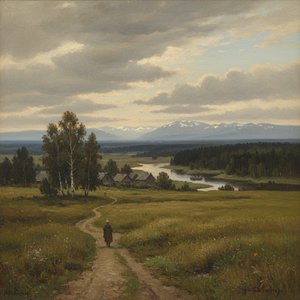
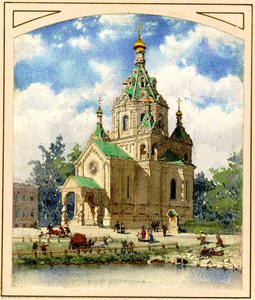
His early years were steeped in artistic influence. Educated at the Imperial Academy of Arts from 1871 to 1877, Benois initially focused on architecture before discovering a profound passion for watercolor painting under the guidance of Luigi Premazzi. This shift proved pivotal, establishing his signature style—characterized by delicate washes, atmospheric perspective, and an intimate portrayal of Russian landscapes and architectural details. Crucially, he was part of the founding members of the “Circle of Russian Watercolorists” (Russkoe Kratokrasnoye Obshchestvo) in 1880, a group that championed watercolor as a serious artistic medium and challenged the dominance of oil painting within the Russian art establishment. This association exposed him to innovative techniques and fostered a spirit of experimentation that would inform his later work.
The Influence of Family and Travel
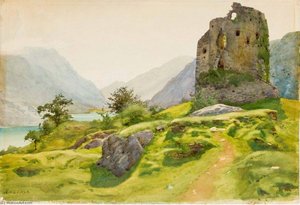
Benois’s family history profoundly shaped his artistic trajectory. His father, Nicholas Benois, was a renowned architect responsible for many iconic buildings in St. Petersburg, including the Principal Imperial Stables at Peterhof. His mother, Camilla Cavos, a granddaughter of Catterino Cavos (the designer of the Mariinsky Theatre), instilled within him an appreciation for elegance and theatricality. The family’s connections to prominent musicians—particularly Nikolai Tcherepnin, with whom he maintained a close relationship—further enriched his cultural awareness. However, it was Benois's own travels that truly broadened his artistic horizons. Beginning in 1890, he embarked on extensive journeys through Europe, North Africa, Central Asia, Korea, and Japan, meticulously documenting the landscapes, architecture, and people he encountered. These experiences weren’t merely sightseeing trips; they were immersive investigations into diverse cultures, resulting in a series of paintings that captured the essence of these faraway lands with remarkable sensitivity and detail.
A Curator and Artistic Collaborator
Beyond his painting practice, Benois played an active role in the Russian art world. He served as a keeper at the Alexander III Russian Museum from 1895 to 1903, gaining invaluable experience in museum management and collection curation. In 1894, he was appointed a professor of watercolor painting at the Imperial Academy of Arts, a position he held until 1905, shaping generations of young artists. His involvement extended beyond academia; he became a curator at the Russian Museum in 1903, contributing to its expansion and development. Notably, his collaboration with Sergei Diaghilev’s Ballets Russes proved transformative. Benois's stage designs—particularly for “Les Sylphides,” “Giselle,” and “Petrushka”—were groundbreaking, employing innovative color palettes, architectural elements, and a sense of theatricality that redefined ballet aesthetics. His work with the Moscow Art Theatre further solidified his reputation as a versatile artist and designer.
Legacy and Artistic Significance
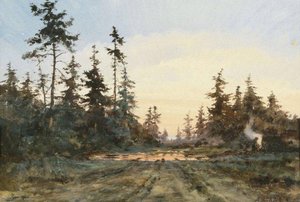
Albert Nikolayevich Benois’s legacy extends far beyond his individual paintings. He was a pivotal figure in the development of Russian watercolor, elevating it from a secondary medium to one of serious artistic merit. His meticulous observation, atmospheric rendering, and ability to capture both the grandeur and intimacy of landscapes—from the vast expanse of the Finnish skerries to the bustling streets of St. Petersburg—established him as a master of his craft. His travels not only enriched his artistic repertoire but also fostered a deep appreciation for cultural diversity, reflected in the nuanced portrayals of foreign lands within his oeuvre. Benois’s work continues to be celebrated for its beauty, technical skill, and profound connection to Russian culture and history. His influence can still be felt today in the works of contemporary watercolor artists who draw inspiration from his innovative techniques and artistic vision.
Klausimai ir atsakymai
Kuriame istoriniame laikotarpyje kūrė Albert Nikolaevich Benois?
Albert Nikolaevich Benois kūrė 19th Century laikotarpiu. Šis laikotarpis leidžia įvertinti kūrybinę veiklą istoriniame kontekste.
Kokia Albert Nikolaevich Benois kūryba yra populiari?
Statistika apie Albert Nikolaevich Benois kūrybinį veiklą galima rasti puslapyje Statistika.
Kur galima rasti Albert Nikolaevich Benois kūrybą, suskirstytą pagal meno kryptis?
Meno kryptis, kuriomis dirbo Albert Nikolaevich Benois, galima rasti puslapio Visi meno kryptys, kuriame kūriniai sugrupuoti pagal meno kryptis.