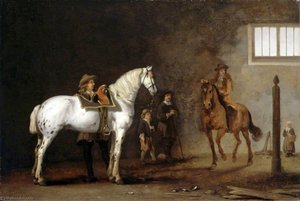
Abraham van Calraet portretas

66 garsiausių Abraham van Calraet paveikių rinkinys: galerijos išboru

Atnaujinta lapkritis 2026 · pagal mūsų populiarumumo koeficientą (paieškos, lankytojai ir užsakymai kiekvienam kūriniui) · 77 Abraham van Calraet darbai mūsų kataloge

Trumpai tariant

Iš visų paliktų originalų kūrinių Abraham van Calraet garsiausias yra Herder and Cattle under Trees (1660), esantis Kunsthistorisches Museum kolekcijoje, Viena. Tiesiog už jų seka Equestrian Combat (1674) ir the horsemen in battle (1674). Mūsų kataloge yra 77 darbų autoriaus Abraham van Calraet; galerija išsaugojo 66 labiausiai pasaulyje žyminiausių kūrinių – kiekvienas jų pateikiamas su datos, muziejaus ir istorijos aprašymu.

1642 – 1722, Dordrecht Dutch golden age Daugiausia darbų: Dordrechts Museum

Abraham van Calraet geriausios 10 paveikslų: galerijos pasirinkimas

1
Herder and Cattle under Trees (1660) aut. Abraham van Calraet

Herder and Cattle under Trees

1660 · Oil On Canvas · Kunsthistorisches Museum, Viena

The sun hangs low, casting a soft, golden light across a Dutch landscape. Under the heavy, twisting branches of large trees, a herder tends to cattle. The scene is still. A sense of late afternoon settles over the undulating terrain, where the earth meets a hazy, distant horizon. The composition leans heavily to one side, using the vertical weight of the trees to frame a view that opens into a…

2
Equestrian Combat (1674) aut. Abraham van Calraet

Equestrian Combat

1674 · Oil · Dordrechts Museum, Dordrecht

In this 1674 oil painting, we find ourselves thrust into the center of a violent cavalry engagement. The composition is intentionally crowded, pulling the viewer into a frantic, swirling struggle where horses and riders clash in a desperate melee. It is a scene of profound instability, defined by energetic, diagonal lines that follow the rearing of muscular animals and the thrust of outstretched weapons. The landscape itself feels rugged and…

3
the horsemen in battle (1674) aut. Abraham van Calraet

the horsemen in battle

1674 · Oil On Canvas

The composition centers on a cluster of horses and riders caught in a moment of violent movement. A white horse occupies the middle ground, its coat catching a sharp, direct light that contrasts against the surrounding darkness. Around this central figure, the forms of other horses and men overlap in a chaotic arrangement. The limbs of the animals extend in irregular lines, and the thrust of weapons creates diagonal vectors…

4
Portrait of a family (1662) aut. Abraham van Calraet

Portrait of a family

1662 · Oil On Canvas · Dordrechts Museum, Dordrecht

In Abraham van Calraet's "Portrait of a family," a dense and crowded scene unfolds, pulling the viewer into a moment of heavy, tactile abundance. The composition relies on a pyramidal arrangement of figures and objects, creating a sense of structured weight amidst the bounty. A family group sits surrounded by a lavish spread of food and game, their presence anchored by the sheer volume of the items piled in the…

5
The Interior of a Stable aut. Abraham van Calraet

The Interior of a Stable

Oil

Step closer and observe the lived-in atmosphere of this stable. There is a certain weight to the air here, a sense of the heavy, rhythmic breathing of animals and the soft movement of people within a confined space. We find ourselves in a scene of quiet, bustling activity, where the boundaries between human labor and animal existence blur. At least twelve horses occupy the interior, their forms varying in scale…

6
Portrait of a Man (1692) aut. Abraham van Calraet

Portrait of a Man

1692 · Oil On Canvas

A formal, somber presence dominates this three-quarter length portrait. The subject is positioned slightly off-center, emerging from a dark, atmospheric background of draped fabric. Directional lighting strikes the man's face and the heavy folds of his brown drapery, creating a sharp contrast between illuminated skin and deep shadow. His long, wavy dark hair and poised gestures—one hand near the hip, the other near the chest—suggest a dignified, quiet composure. The…

7
Wooded landscape with horsemen, peasants and cattle on a road (1689) aut. Abraham van Calraet

Wooded landscape with horsemen, peasants and cattle on a road

1689 · Oil On Canvas · Dordrechts Museum, Dordrecht

A serene 17th-century landscape unfolds along a wooded road, where the movement of travelers and livestock defines the pace of rural life. Towering deciduous trees anchor the composition on the left, their dense, dark green and brownish foliage creating a sense of enclosure. Sunlight breaks through the clouds to illuminate distant golden-brown hills, casting a warm glow over the scene. This interplay of light and shadow establishes a deep sense…

8
The Interior of a Stable (1690) aut. Abraham van Calraet

The Interior of a Stable

1690 · Oil On Canvas

The Interior of a Stable is an oil painting by Abraham van Calraet. Created about 1690, the work belongs to the Dutch Golden Age. It captures a moment of quiet utility within a rustic setting, focusing on the intersection of animal life and human labor.

9
Boy Holding Three Horses (1700) aut. Abraham van Calraet

Boy Holding Three Horses

1700 · Oil

This oil painting, titled Boy Holding Three Horses, was created by the artist Abraham van Calraet. The work is dated 1700. It belongs to the Dutch Golden Age, a period characterized by a focus on realistic depictions of the natural world and everyday life.

10
Feeding a Horse (1700) aut. Abraham van Calraet

Feeding a Horse

1700 · Oil On Canvas

Feeding a Horse by Abraham van Calraet, created about 1700, presents a pastoral scene centered on the interaction between a human and an animal. On the right side of the composition, a large figure of a horse and a man are positioned together. This grouping is anchored by the presence of a dark building, which provides a heavy, structural weight to the right edge of the frame. In contrast, the…

Abraham van Calraet darba rinkinys tęsiamas, nuo 11 iki 66

11Parade with Easter Ox in a village (1700) aut. Abraham van CalraetParade with Easter Ox in a village1700 · Woburn Abbey 12Brown horse standing by a trough (1700) aut. Abraham van CalraetBrown horse standing by a trough1700 13Horses (1700) aut. Abraham van CalraetHorses1700 · Ermitažas 14Horsemen Watering Their Horses (1700) aut. Abraham van CalraetHorsemen Watering Their Horses1700 · Philadelphia Museum of Art 15Still Life with Peaches (1689) aut. Abraham van CalraetStill Life with Peaches1689 · Museum Boijmans Van Beuningen 16Still-life with Peaches and Grapes (1680) aut. Abraham van CalraetStill-life with Peaches and Grapes1680 · Mauritshuis 17White Horse in a Riding School (1722) aut. Abraham van CalraetWhite Horse in a Riding School1722 18Still Life with Fruit and Shells (1689) aut. Abraham van CalraetStill Life with Fruit and Shells1689 · Museum Boijmans Van Beuningen 19Scene on the Ice outside Dordrecht (1665) aut. Abraham van CalraetScene on the Ice outside Dordrecht1665 20A Brown and White Skewbald Horse with a Saddle beside it (1680) aut. Abraham van CalraetA Brown and White Skewbald Horse with a Saddle beside it1680 21Still Life with Peaches (1696) aut. Abraham van CalraetStill Life with Peaches1696 · Dordrechts Museum 22Fruit Still Life with Peaches (1689) aut. Abraham van CalraetFruit Still Life with Peaches1689 · Amsterdam Museum 23Riders near an inn (1693) aut. Abraham van CalraetRiders near an inn1693 · Dordrechts Museum 24Peaches in a porcelain bowl (1690) aut. Abraham van CalraetPeaches in a porcelain bowl1690 · Kröller-Müller muziejus 25Two Horsemen in a Landscape (1689) aut. Abraham van CalraetTwo Horsemen in a Landscape1689 · Statens Museum For Kunst 26Interior of a stable with two dapple-greys (1689) aut. Abraham van CalraetInterior of a stable with two dapple-greys1689 · Museum Boijmans Van Beuningen 27Seashells in a purple tapestry (1690) aut. Abraham van CalraetSeashells in a purple tapestry1690 · Nacionalinis muziejus Varšuvoje 28Dordrecht with the Apple Market and the Oude Haven (1693) aut. Abraham van CalraetDordrecht with the Apple Market and the Oude Haven1693 29The Interior of a Stable (1690) aut. Abraham van CalraetThe Interior of a Stable1690 · National Gallery 30Landscape with a brown horse (1700) aut. Abraham van CalraetLandscape with a brown horse1700 31Still life with lobster (1700) aut. Abraham van CalraetStill life with lobster1700 32Still life with pâté. (1722) aut. Abraham van CalraetStill life with pâté.1722 33Cattle, Abraham van Calraet, 1660 - 1722 (1722) aut. Abraham van CalraetCattle, Abraham van Calraet, 1660 - 17221722 · Rijksmuseum 34Cavalry Skirmish, Abraham van Calraet, 1660 - 1722 (1722) aut. Abraham van CalraetCavalry Skirmish, Abraham van Calraet, 1660 - 17221722 · Rijksmuseum 35Cows and Sheep (1722) aut. Abraham van CalraetCows and Sheep1722 36Two Horsemen at a Tavern (1722) aut. Abraham van CalraetTwo Horsemen at a Tavern1722 · Wallace Collection 37Two Horses (1722) aut. Abraham van CalraetTwo Horses1722 38Fishing on the Ice (1722) aut. Abraham van CalraetFishing on the Ice1722 39A Riding School in the Open Air (1722) aut. Abraham van CalraetA Riding School in the Open Air1722 · Dulwich Picture Gallery 40Halt at an Inn (1722) aut. Abraham van CalraetHalt at an Inn1722 · Wallace Collection 41Cattle on a River Bank (1722) aut. Abraham van CalraetCattle on a River Bank1722 · Wallace Collection 42Bowl of peaches (1689) aut. Abraham van CalraetBowl of peaches1689 · Museum Boijmans Van Beuningen 43Stopping Place for Horsemen and Horses aut. Abraham van CalraetStopping Place for Horsemen and HorsesAntverpio karališkasis gražiųjų menų muziejus 44The start aut. Abraham van CalraetThe start 45Horses Tied to a Tree aut. Abraham van CalraetHorses Tied to a TreeWallace Collection 46Saddling Horses aut. Abraham van CalraetSaddling Horses 47Horsemen in a Ravine aut. Abraham van CalraetHorsemen in a RavinePetworth House 48Young Artist Painting a Horse and Rider aut. Abraham van CalraetYoung Artist Painting a Horse and Rider 49White Horse in a Stable aut. Abraham van CalraetWhite Horse in a StablePhiladelphia Museum of Art 50Landscape with Rider in the Evening Light aut. Abraham van CalraetLandscape with Rider in the Evening LightDordrechts Museum 51Still Life with Fruit aut. Abraham van CalraetStill Life with Fruit 52Landscape with Figures and Horses aut. Abraham van CalraetLandscape with Figures and HorsesFitzwilliam Museum 53View of a River Town aut. Abraham van CalraetView of a River TownPetworth House 54A Dappled Stallion with a Dog in a Stable aut. Abraham van CalraetA Dappled Stallion with a Dog in a StableNostell Priory 55Cavalier on a Grey Horse aut. Abraham van CalraetCavalier on a Grey Horse 56A Horse and Cows in a Landscape aut. Abraham van CalraetA Horse and Cows in a Landscape 57Boy Holding a Horse aut. Abraham van CalraetBoy Holding a HorseWallace Collection 58A Saddled Horse with a Goat in a Stable aut. Abraham van CalraetA Saddled Horse with a Goat in a StableNostell Priory 59Scene on the Ice outside Dordrecht aut. Abraham van CalraetScene on the Ice outside DordrechtNational Gallery 60Landscape with Figures and Horses aut. Abraham van CalraetLandscape with Figures and HorsesFitzwilliam College 61Horses and Cattle in a Landscape aut. Abraham van CalraetHorses and Cattle in a LandscapeThe Barber Institute of Fine Arts 62A Boy holding a Grey Horse aut. Abraham van CalraetA Boy holding a Grey HorseNational Gallery 63A Cavalier with a Grey Horse aut. Abraham van CalraetA Cavalier with a Grey HorseEnglish Heritage 64A Glass Vase of Flowers aut. Abraham van CalraetA Glass Vase of FlowersFitzwilliam College 65Poultry in a Farmyard aut. Abraham van CalraetPoultry in a FarmyardThe Hepworth Wakefield 66A Horse with a Saddle Beside it aut. Abraham van CalraetA Horse with a Saddle Beside it

žymios Abraham van Calraet tapiojamos, pagal laikotarpį

Temos, kurios domino Abraham van Calraet

Ketverios temos, dažniausiai pasikrausto originaluose, kiekvienos su savo puikiausiu pavyzdžiu.

Muziejai, kuriuose saugomi Abraham van Calraet originalūs darbai

8 muziejai, kuriuose saugoma daugiausia šioje pusėje esamų paveikslų.

Muzejaus Miestas Abraham van Calraet darbai Šiojo sąrašo paveikslai
Dordrechts Museum, DordrechtDordrechts Museum Dordrecht 6 Equestrian Combat, Portrait of a family, Wooded landscape with horsemen, peasants and cattle on a road
Wallace Collection, LondonasWallace Collection Londonas 5 Two Horsemen at a Tavern, Halt at an Inn, Cattle on a River Bank
Museum Boijmans Van Beuningen, RoterdamasMuseum Boijmans Van Beuningen Roterdamas 4 Still Life with Peaches, Still Life with Fruit and Shells, Interior of a stable with two dapple-greys
National Gallery, LondonasNational Gallery Londonas 3 The Interior of a Stable, Scene on the Ice outside Dordrecht, A Boy holding a Grey Horse
Philadelphia Museum of Art, FiladelfijaPhiladelphia Museum of Art Filadelfija 2 Horsemen Watering Their Horses, White Horse in a Stable
Rijksmuseum, AmsterdamasRijksmuseum Amsterdamas 2 Cattle, Abraham van Calraet, 1660 - 1722, Cavalry Skirmish, Abraham van Calraet, 1660 - 1722
Petworth House, PetworthPetworth House Petworth 2 Horsemen in a Ravine, View of a River Town
Nostell Priory, WakefieldNostell Priory Wakefield 2 A Dappled Stallion with a Dog in a Stable, A Saddled Horse with a Goat in a Stable

Abraham van Calraet dešimtmetėms po dešimtmetės: originalus kūrinys, apibūdinantis kiekvieną iš jų

Darbai pagal dešimtmečius

Pasirinkite dešimtmetį, kad pamatytėte jį apibrėžusį originalą.

Kolekcjonerų klausimai apie Abraham van Calraet paveikslus

Kuriu darbu Abraham van Calraet yra labiausiai garsus?Atsakymas

Herder and Cattle under Trees (1660), Kunsthistorisches Museum, Viena. Toliau seka Equestrian Combat (1674) ir the horsemen in battle (1674).

Kokia buvo Abraham van Calraet amžius, kai buvo sukurtas Herder and Cattle under Trees?Atsakymas

18 metų amžiaus: Herder and Cattle under Trees sukurta 1660 m. Nr. Abraham van Calraet gimė 1642.

Kokie yra 10 garsiausių Abraham van Calraet paveikslų?Atsakymas

Herder and Cattle under Trees, Equestrian Combat, the horsemen in battle, Portrait of a family, The Interior of a Stable, Portrait of a Man, Wooded landscape with horsemen, peasants and cattle on a road, The Interior of a Stable, Boy Holding Three Horses ir Feeding a Horse. Viršuje esančioje reitingo sąraše nurodyta kiekvieno kūrinio metis ir muziejus.

Kiek paveikslų paliko Abraham van Calraet?Atsakymas

Mūsų kataloge yra 77 Abraham van Calraet darbų, skirtų laikotarpiui nuo 1660 iki 1722.

Kuriuose muziejuose eksponuojami Abraham van Calraet šedevrai?Atsakymas

Daugiausia – Dordrechts Museum (Dordrecht), Wallace Collection (Londonas) ir Museum Boijmans Van Beuningen (Roterdamas). Viršuje esančiame muziejų sąraše yra visi jie.

Kuriomis metais Abraham van Calraet tapo savo garsiausius kūrinius?Atsakymas

1720s laikotarpiu: 11 iš 66 šioje pusėje esančių darbų buvo sukurtos tada, iš jų White Horse in a Riding School.

Kokie yra pirmasis ir paskutinis garsieji Abraham van Calraet originalūs darbai?Atsakymas

Šioje pusėje seniausias darbas yra Herder and Cattle under Trees (1660), o naujausias – White Horse in a Riding School (1722).

Kurią temą Abraham van Calraet rinkosi dažniausiai?Atsakymas

Landscape (15), Horse (14) ir Animals (9) iš 66 šioje pusėje esamų darbų.

Kurią techniką Abraham van Calraet naudojo dažniausiai?Atsakymas

Oil On Canvas, iš 66 šios puslapio darbų – 20.

Kelią meno kryptį priklauso Abraham van Calraet?Atsakymas

Dutch golden age, vadovaujantis šios puslapio originalais kūriniais.

Kurių Abraham van Calraet darbai eksponuojami Dordrechts Museum?Atsakymas

Equestrian Combat, Portrait of a family ir Wooded landscape with horsemen, peasants and cattle on a road: Dordrechts Museum, Dordrecht kolekcijoje yra 6 šioje pusėje esančių darbų.

Abraham van Calraet: gyvenimas ir kūryba

A Life Immersed in Dutch Light: Abraham Pietersz van Calraet

Abraham Pietersz van Calraet, a name resonating softly through the annals of the Dutch Golden Age, embodies the quiet mastery and evolving artistic sensibilities of 17th-century Holland. Born in Dordrecht in 1642 and passing away there in 1722, his life was deeply interwoven with the fabric of this thriving mercantile city—a center for both commerce and burgeoning artistic expression. Calraet’s journey began not with a brush, but with the sculptor's chisel. He initially apprenticed under Aemilius and Samuel Hup, respected sculptors in Dordrecht, absorbing their technical precision and understanding of form. However, it was a shift towards painting that would ultimately define his legacy, spurred by assisting his father, a wood sculptor, and an early fascination with capturing the delicate beauty of fruit. This foundational training in three-dimensional art undoubtedly informed the remarkable realism and tactile quality present in his still lifes.

From Still Life to Landscape: A Developing Style

Calraet’s artistic development was not linear but rather a fascinating exploration of genre and technique. He initially gained recognition for his exquisitely rendered still life paintings, particularly those depicting luscious arrangements of fruit. These works weren't merely depictions; they were celebrations of abundance, often imbued with subtle symbolism reflecting the transience of earthly pleasures. The surfaces gleam with an almost photographic realism, a testament to his meticulous observation and skillful handling of oil paint. However, Calraet’s ambition extended beyond the confines of the still life. He resided in Dordrecht throughout his life, and it is believed he may have been influenced by Aelbert Cuyp, a generation older master known for his idyllic landscapes. This connection proved pivotal, though complicated. Cuyp's signature was frequently—and often fraudulently—added to Calraet’s paintings, highlighting the esteem with which Cuyp was held and perhaps suggesting an attempt to capitalize on his established reputation.

The Cuyp Controversy and Rediscovery

The attribution of works became a source of considerable debate in the early 20th century. For years, many of Calraet's still lifes were mistakenly attributed to Cuyp himself. It was Abraham Bredius, a renowned art historian, who spearheaded the “rediscovery” of Calraet, meticulously re-attributing two paintings previously considered Cuyp’s work. This sparked intense discussion, with Cornelis Hofstede de Groot vehemently disagreeing with Bredius' findings. The debate even escalated into public discourse when Frits Lugt announced a new Calraet painting at the Frans Hals Museum in 1915. Ultimately, Bredius prevailed, and his attributions largely stand today, solidifying Calraet’s position as an independent artist of significant merit. This episode underscores the challenges inherent in art historical research and the importance of careful analysis and scholarly debate.

Themes and Techniques: A Master of Observation

Calraet's oeuvre encompasses both still life compositions and landscapes featuring horses—a subject he embraced with increasing enthusiasm later in his career. His still lifes are characterized by a warm, intimate atmosphere, often employing rich, earthy tones and dramatic chiaroscuro to accentuate the textures and forms of the fruit. He possessed an exceptional ability to capture the play of light on surfaces, creating a sense of depth and realism that draws the viewer into the scene. In his landscapes, Calraet demonstrates a keen eye for atmospheric effects and a talent for depicting horses in dynamic poses. These works often feature riders traversing rural scenes, evoking a sense of movement and vitality. He was known to be a teacher as well, passing on his knowledge and skills to his younger brother, Barent van Kalraet, who also became a landscape painter.

Legacy and Historical Significance

Abraham Pietersz van Calraet’s contribution to the Dutch Golden Age lies in his ability to seamlessly blend meticulous realism with subtle artistic expression. While perhaps not as widely celebrated as some of his contemporaries, his works offer a compelling glimpse into the everyday life and aesthetic sensibilities of 17th-century Holland. His still lifes are testaments to the beauty of nature and the transience of earthly pleasures, while his landscapes capture the dynamism and vitality of rural life. Today, Calraet is recognized as a skilled painter who successfully navigated evolving artistic trends, leaving behind a body of work that continues to captivate and inspire. His story serves as a reminder that even within a period renowned for its iconic masters, there existed a wealth of talented artists whose contributions deserve recognition and appreciation. His paintings offer a window into the Dutch Golden Age, revealing not only artistic skill but also a profound connection to the natural world.