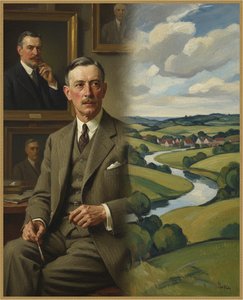
Early Life & Artistic Foundations: Manchester Roots and Parisian Studies
Thomas Cantrell Dugdale, a name synonymous with refined portraiture and poignant historical scenes, emerged from the industrial heartland of Lancashire in 1880. His artistic journey began not amidst idyllic landscapes but within the bustling environment of Manchester, where he initially honed his skills at the Manchester School of Art. This early exposure to a dynamic urban setting likely instilled in him an appreciation for capturing the nuances of human character and the complexities of modern life – qualities that would become hallmarks of his mature work. However, Dugdale’s ambition extended beyond the regional boundaries of England; he sought further training on the continent, embarking on studies at the prestigious Royal College of Art in London before immersing himself in the artistic fervor of Paris. The Académie Julian and the Académie Colarossi provided a crucial foundation in classical techniques and an understanding of European artistic traditions, shaping his approach to composition, form, and color.
These formative years were not merely about technical proficiency; they represented a deliberate pursuit of artistic excellence and a broadening of perspective. The Parisian experience, with its rich history of art and intellectual discourse, undoubtedly influenced Dugdale’s developing style, fostering a sensitivity to light, atmosphere, and the subtleties of human expression. His consistent exhibition at the Royal Academy from 1901 onwards demonstrates an early commitment to establishing himself within the established art world, signaling his intent to engage with – and contribute to – the ongoing dialogue surrounding British painting.
Portraiture as Social Commentary: Dugdale's Depiction of Victorian Society
 Lambeth
Experience 'Lambeth' by Thomas Cantrell Dugdale – a captivating portrait of a woman in Victorian attire. Hand-painted reproduction, 130x71cm. Add timeless elegance to your collection.
Dugdale quickly distinguished himself as a skilled portraitist, but his work transcended mere representation. He wasn’t simply capturing likenesses; he was offering insightful glimpses into the lives and personalities of his sitters, often revealing subtle social commentaries within the formality of the genre. His portraits, such as Lambeth, exemplify this approach – a captivating study of a woman in Victorian attire that speaks volumes about societal expectations and feminine grace. The hand-painted reproduction available through OriginalUniqueArt allows for an intimate appreciation of Dugdale’s meticulous brushwork and his ability to convey character through subtle details of expression and posture.
The early 20th century saw a shift in portraiture, moving away from idealized representations towards a more psychological realism. Dugdale embraced this evolution, imbuing his subjects with a sense of dignity and individuality. W. B. Pritchard, painted in 1912, is a prime example – the muted tones and dignified pose convey a sense of intellectual gravitas and quiet strength. These weren’t portraits of wealth or status alone; they were studies of individuals within a rapidly changing world, reflecting the anxieties and aspirations of the era.
Beyond the Portrait Studio: War Art and Documenting Historical Moments
 The Arrival of the Jarrow Marchers in London, Viewed from an Interior
View "The Arrival of the Jarrow Marchers in London" by Thomas Cantrell Dugdale (1936). A poignant oil painting capturing a historic moment. Hand-painted reproduction available.
The outbreak of World War One dramatically altered Dugdale's artistic trajectory. He enlisted in the British Army, serving as a Staff Sergeant in the Middlesex Yeomanry and witnessing firsthand the horrors of conflict in Egypt, Palestine, and Gallipoli. This experience profoundly impacted his work, leading him to document the realities of war with a newfound sense of urgency and empathy. Four paintings from this period were acquired by the British War Memorials Committee, recognizing their historical significance.
While many artists focused on grand battle scenes, Dugdale’s wartime works often centered on the human cost of conflict – the weariness of soldiers, the resilience of local populations, and the stark landscapes scarred by war. This commitment to portraying authentic experiences continued during World War Two, where he received commissions from the War Artists' Advisory Committee to depict merchant seamen and RAF pilots. The Arrival of the Jarrow Marchers in London, Viewed from an Interior (1936) stands as a particularly poignant example of his ability to capture moments of social and political importance, offering a powerful visual record of a historic protest.
Dugdale’s Textile Designs: A Lesser-Known Facet of His Creative Output
Beyond the realm of oil paintings, Dugdale possessed a remarkable versatility as a textile designer. For twenty years, beginning in 1919, he served as an advisor to Tootal Broadhurst Lee, a prominent textile company. This role allowed him to apply his artistic sensibilities to a different medium, creating innovative designs that blended aesthetic appeal with commercial viability.
While less celebrated than his paintings, Dugdale’s textile work demonstrates his broader creative vision and his ability to adapt his skills to diverse applications. It also reveals a pragmatic side to his artistry – a willingness to engage with the demands of the market while maintaining a commitment to quality and design excellence. This often-overlooked aspect of his career provides valuable insight into the economic realities faced by artists during this period.
Academic Recognition & Artistic Style: Realism, Detail, and Influences
 W. B. Pritchard
1912 portrait of W. B. Pritchard by Thomas Cantrell Dugdale. Academic realism, muted tones, & dignified pose. Explore this impressive oil painting – a glimpse into early 20th-century British art.
Dugdale’s artistic achievements were formally recognized through his election as a member of the Royal Institute of Oil Painters in 1910, followed by membership in the Royal Society of Portrait Painters in 1925. His ultimate acknowledgement came with his election as a full member of the Royal Academy in 1943 – a testament to his enduring contribution to British art.
His style is characterized by academic realism, meticulous attention to detail, and a masterful use of light and shadow. Influenced by classical traditions honed during his Parisian studies, Dugdale’s paintings possess a sense of timeless elegance and technical precision. However, he wasn't merely replicating past masters; he infused his work with a distinctly modern sensibility, capturing the psychological complexities of his subjects and reflecting the changing social landscape of the 20th century.
A Lasting Legacy: Dugdale's Place in British Genre Painting
Thomas Cantrell Dugdale’s legacy extends far beyond the confines of portraiture. He was a versatile artist who seamlessly navigated between historical documentation, social commentary, and commercial design. His paintings offer invaluable insights into Victorian society, the realities of war, and the lives of ordinary people during times of upheaval.
Today, his works continue to captivate audiences with their technical brilliance, emotional depth, and enduring relevance. Through OriginalUniqueArt.com, you can experience the beauty and power of Dugdale’s art firsthand – whether through a meticulously reproduced oil painting or a high-quality print that brings his vision into your home. His commitment to capturing the human spirit, combined with his mastery of technique, ensures his place as a significant figure in British genre painting and a compelling voice within the broader history of 20th-century art.