Early Life & Apprenticeship: Forging a Flemish Master
Peter Paul Rubens, born in Siegen, Westphalia in 1577, was not destined for the quiet life of a provincial artist. His early years were marked by displacement; his father, Jan Rubens, a lawyer and ardent Calvinist, fled religious persecution in Antwerp, seeking refuge first in Cologne and then settling back in the bustling port city upon the elder Rubens’s death. This formative period instilled in young Peter Paul a resilience and cosmopolitan outlook that would profoundly shape his artistic career. While initially educated classically – a testament to his father's aspirations – it was the vibrant atmosphere of Antwerp, slowly recovering from the turmoil of religious conflict, that truly ignited his passion for art. His initial training under Tobias Verhaecht, a local landscape painter, provided a foundation in observation and technique, but it was his subsequent apprenticeship with Adam van Noort and, crucially, Otto van Veen, that proved pivotal. Van Veen, a respected humanist scholar and guild dean, didn’t merely teach Rubens painting; he instilled within him an appreciation for the intellectual currents of the Renaissance, exposing him to classical literature, mythology, and the principles of ideal beauty – concepts that would become cornerstones of his mature style.
Rubens' Italian Sojourn: Embracing Renaissance Ideals
The Renaissance in the Low Countries was a cultural period in the Northern Renaissance that took place in around the 16th century in the Low Countries (corresponding to modern-day Belgium, the Netherlands and French Flanders). Culture in the Low Coun...
In 1600, at the age of twenty-three, Rubens embarked on a transformative journey to Italy. This was not simply a trip for artistic inspiration; it was an immersion into the very heart of the Renaissance. He spent time in Venice, Rome, and Florence, meticulously studying the works of masters like Titian, Raphael, and Michelangelo. The impact was profound. Rubens wasn’t merely copying these artists; he was absorbing their principles – the dynamism of composition, the mastery of color, the idealized forms, and the sheer emotional power of narrative. He became captivated by the frescoes adorning Roman palaces, recognizing the potential for large-scale decorative projects that would define much of his later career. His notebooks from this period are filled with sketches and observations, revealing a relentless pursuit of anatomical accuracy and an evolving understanding of *sprezzatura* – the artful display of effortless grace. This Italian sojourn wasn’t just about technique; it was about cultivating a sophisticated artistic sensibility that would set him apart.
The Height of Baroque Innovation: Dynamic Compositions & Sensuous Forms
Baroque painting is the painting associated with the Baroque cultural movement. The movement is often identified with Absolutism, the Counter Reformation and Catholic Revival, but the existence of important Baroque art and architecture in non-absolut...
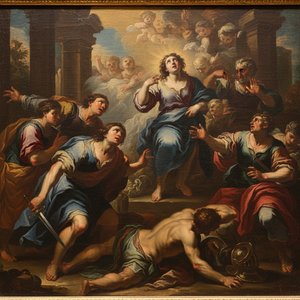
Upon his return to Antwerp in 1608, Rubens quickly established himself as the leading painter of the Flemish Baroque. His style wasn’t simply an imitation of Italian Renaissance ideals; it was a synthesis – a fusion of Northern realism with Southern grandeur. He possessed an unparalleled ability to imbue religious and mythological scenes with dramatic energy and emotional intensity. “The Elevation of the Cross”, commissioned for the Saint Paul's Church in Antwerp, exemplifies this new Baroque aesthetic. The swirling composition, the muscular figures straining under the weight of the cross, and the rich, saturated colors create a visceral sense of movement and pathos. Equally compelling are his depictions of female nudes – often allegorical or mythological – celebrated for their voluptuous forms and radiant flesh tones. The term “Rubenesque” wasn’t merely descriptive; it became synonymous with an ideal of feminine beauty characterized by abundance, sensuality, and vitality. His unique technique involved layering colors to create depth and luminosity, and a masterful use of chiaroscuro – the dramatic contrast between light and shadow – to heighten emotional impact.
Beyond the Canvas: Rubens as Diplomat and Court Painter
 Wikipedia: Peter Paul Rubens
Sir Peter Paul Rubens ( ROO-bənz; Dutch: [ˈpeːtər pʌul ˈrybəns]; 28 June 1577 – 30 May 1640) was a Flemish artist and diplomat. He is considered the most influential artist of the Flemish Baroque tradition. Rubens' highly charged compositions referen...
Rubens was far more than just an artist; he was a skilled diplomat and trusted advisor to European royalty. His fluency in multiple languages, coupled with his affable personality, made him ideally suited for navigating the complex political landscape of 17th-century Europe. He undertook numerous missions on behalf of the Spanish Habsburgs, negotiating treaties, securing alliances, and promoting peace. This diplomatic role wasn’t separate from his artistic practice; it was intertwined. He received commissions from powerful patrons – kings, queens, and archdukes – who valued not only his artistic talent but also his discretion and political acumen. His paintings often served as instruments of propaganda, glorifying the power and legitimacy of his patrons. “Equestrian Portrait of the Duke of Lerma”, for example, is a masterful display of aristocratic grandeur designed to enhance the Duke’s prestige. Rubens' ability to seamlessly blend art and diplomacy solidified his position as one of the most influential figures of his time.
Legacy and Influence: The Enduring Impact of a Baroque Giant
Peter Paul Rubens died in Antwerp in 1640, leaving behind an extraordinary legacy that continues to resonate today. His impact on subsequent generations of artists is immeasurable. He established the concept of a thriving artist’s studio – a workshop where numerous assistants contributed to large-scale projects under his direction – effectively creating a model for artistic production that would be emulated for centuries. Artists like Anthony van Dyck and Erasmus Quellinus II were among his most talented pupils, carrying forward his stylistic innovations and expanding upon his techniques. His emphasis on movement, color, and sensuality profoundly influenced the development of Baroque painting throughout Europe. Even beyond painting, Rubens’s influence can be seen in sculpture, architecture, and decorative arts. His work continues to inspire awe and admiration, reminding us of the power of art to capture the human spirit and celebrate the beauty of life.
Exploring Rubens’ Masterpieces Today: Museums & Collections
Fortunately, experiencing the brilliance of Peter Paul Rubens firsthand is readily accessible through numerous museums and collections worldwide. The Rubenshuis in Antwerp, his former home and studio, offers a unique glimpse into his life and working methods. The Prado Museum in Madrid boasts an exceptional collection of his works, including “Equestrian Portrait of the Duke of Lerma” and several other masterpieces. Other notable collections can be found at the Staatsgalerie Aschaffenburg in Germany and the Palazzo Bianco in Genoa, Italy. These institutions provide invaluable opportunities to appreciate the scale, detail, and emotional power of Rubens’s paintings. Whether you are captivated by his religious scenes, mythological narratives, or portraits, exploring his work is a journey into the heart of the Baroque – a testament to the enduring legacy of one of history's greatest artists.