
fresco vs secco
The distinction between fresco and secco lies in the interaction between pigment and the wall. Buon fresco involves applying water-based pigments to wet plaster, fusing them into the surface. Fresco secco involves painting on dry plaster or stone, where pigments form a surface film rather than integrating.
True fresco, or buon fresco, requires a complex preparation of three plaster layers, culminating in a smooth final coat called the intonaco. This method creates a permanent bond between the color and the architecture. We see this mastery in the Roman frescoes of the House of the Golden Bracelet in Pompeii.
In contrast, the secco technique is the oldest method, used by our ancestors on cave walls like the Chauvet-Pont d’Arc in France. While it allows for more flexibility, it lacks the structural adhesion of the wet method. Key differences include:
- Fresco: Pigments are diluted in water and applied to damp plaster.
- Secco: Pigments must be lime-resistant and are applied to dry surfaces.
- Adhesion: Fresco becomes part of the wall; secco sits on the surface.
how does drying time affect the painting process?
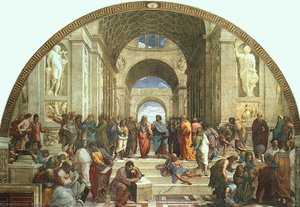 School of Athens
, Raphael
Drying time dictates the artist's entire workflow. In buon fresco, the artist must work while the plaster is damp, necessitating a segmented approach called giornate, or "a day's work." Once the plaster dries, the window for application closes, making corrections impossible without replastering the entire section.
This technical constraint requires immense discipline. Michelangelo’s work on the Sistine Chapel ceiling (1508–1512) and Raphael’s School of Athens in the Vatican required precise planning to manage these daily sections. If an artist fails to finish a giornata before it dries, the work must be scraped away and restarted.
The secco method avoids this race against time, allowing for more intricate detail and the use of dry plaster. However, this convenience comes with a cost in longevity. Leonardo da Vinci’s The Last Supper (c. 1495–1498) is a famous example of the risks involved; he chose to use oil and egg tempera on dry plaster to achieve specific effects, a decision that led to the work's significant deterioration.
which technique produces more durable colors?
Buon fresco produces the most durable colors because the pigments are chemically fused with the damp plaster ground. This makes the artwork a permanent part of the wall. Secco results in weaker colors and less detail over time, often requiring periodic re-painting as the surface film fades.
The longevity of true fresco is proven by the survival of monumental works. Giotto’s frescoes in the Arena Chapel (c. 1303–1305) in Padua remain vibrant centuries later. Similarly, the History of Mexico (1929–35) by Diego Rivera in the Palacio Nacional demonstrates the enduring power of the medium.
When considering the permanence of a mural, the method of application is the deciding factor:
- Highest Durability: Buon fresco, seen in the Sistine Chapel ceiling by Michelangelo.
- Moderate Durability: Secco on dry plaster, such as the Lily Crucifix in Godshill, Isle of Wight.
- Low Durability: Experimental mixtures on dry walls, which risk significant degradation.
Frequently asked questions
What is the final layer of a fresco called?
The final smooth coat of plaster applied during the fresco process is known as the intonaco.
How long have the Chauvet-Pont d’Arc Cave paintings survived?
The Chauvet-Pont d’Arc Cave paintings in France have survived for thirty-six millennia.
Learn more
- Leonardo da Vinci · 1495Leonardo da Vinci's The Last SupperDiscover how Leonardo's experimental technique on dry plaster impacted the preservation of this High Renaissance masterpiece.


