The Architect's Vision: Ferré’s Early Life and Influences
Gianfranco Ferré, a name synonymous with sculpted elegance and architectural precision, didn’t begin his creative journey sketching silhouettes but rather drafting blueprints. Born in Legnano, Italy, in 1944, his formative years were steeped not in the ephemeral world of fashion trends, but in the enduring principles of design – those of structure, balance, and form. This early immersion in architecture at the Polytechnic University of Milan would prove to be the defining characteristic of his later work, setting him apart as a unique voice within the often-fluid landscape of haute couture. Ferré himself frequently spoke of the “values and certitudes” instilled by his upbringing – a sense of duty, discipline, and meticulous attention to detail – qualities that translated directly into his approach to garment construction. While many designers drew inspiration from art or social movements, Ferré’s foundational influence remained resolutely architectural; he wasn't merely *inspired* by buildings, he sought to *build* with fabric.
His initial foray into the creative world wasn’t through ready-to-wear collections but through accessories. Designing jewelry and belts in the early 1970s allowed him to experiment with materials and form without the constraints of an established fashion system. These pieces, noticed by Rosy Biffi – a Milanese boutique owner known for her discerning eye – marked the first glimmer of recognition. They weren’t simply decorative; they possessed a sculptural quality, hinting at the rigorous design process that would become his hallmark. This period also saw early travels to India, a country that profoundly impacted his understanding of craftsmanship and textile artistry, introducing him to techniques and traditions that would later enrich his collections.
From Structure to Silhouette: The Architectural Principles in Ferré’s Design Philosophy
 Gianfranco Ferré, Fall / Winter 2002
Capture the drama of Gianfranco Ferré's Fall/Winter 2002 collection with this striking runway photograph. A study in contrasts, elegance & architectural design.
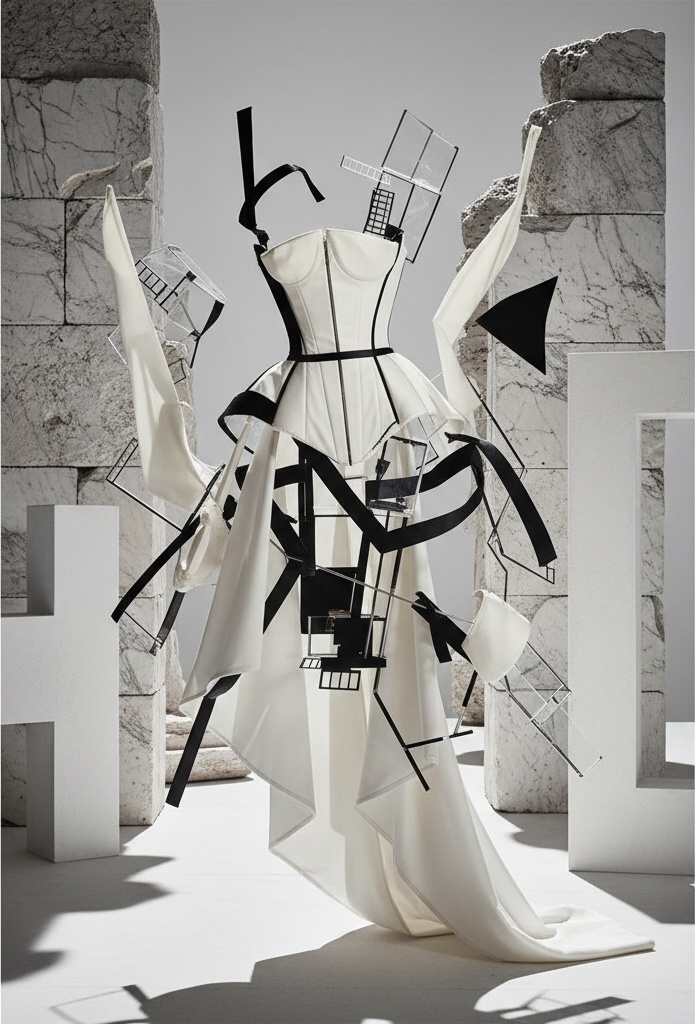
The transition from architecture to fashion wasn't abrupt; it was a natural extension of Ferré’s core beliefs. He didn’t view clothing as mere adornment but as a second skin, capable of shaping and defining the body. This perspective led him to approach design with an architect’s sensibility – analyzing form, volume, and space. Unlike designers who draped fabric intuitively, Ferré began with precise calculations and structural frameworks. Sketches weren't free-flowing expressions; they were detailed plans, often resembling architectural renderings. He believed in understanding the underlying anatomy of a garment, meticulously crafting each piece to enhance and complement the wearer’s form.
This emphasis on structure wasn’t about rigidity or constraint but rather about creating garments that possessed both strength and fluidity. His collections frequently featured sharp tailoring, defined waists, and dramatic shoulders – elements that evoked the lines of modern architecture. He masterfully employed contrasting volumes, playing with oversized shapes and cinched silhouettes to create a dynamic tension. The Fall/Winter 2002 collection, for example, exemplifies this interplay of contrasts—a study in elegance achieved through precise architectural design. He wasn’t simply following trends; he was constructing them, building garments that were both visually striking and intellectually engaging.
Dior Reimagined: Ferré’s Transformative Years as Artistic Director
 gianfranco jekyll ferré
gianfranco jekyll ferré: Italian fashion visionary blending architecture & haute couture. Known for innovative designs & Dior influence. Explore his legacy at OriginalUniqueArt.com!
In 1989, Gianfranco Ferré accepted the formidable challenge of becoming Artistic Director at Christian Dior. Taking on such a legacy could have been daunting, but Ferré approached it with his characteristic rigor and vision. He didn't attempt to replicate Dior’s past glories; instead, he sought to reinterpret them through his own architectural lens. He understood the importance of honoring the house’s heritage – the New Look, the emphasis on femininity – while simultaneously injecting a modern sensibility.
Ferré’s tenure at Dior was marked by a renewed focus on structure and tailoring. He reintroduced strong shoulders, defined waists, and sculpted silhouettes, creating garments that were both powerful and elegant. He also explored new materials and techniques, pushing the boundaries of haute couture while remaining true to Dior's commitment to craftsmanship. His collections often featured dramatic contrasts – soft fabrics juxtaposed with sharp lines, delicate embellishments paired with bold architectural forms. He revitalized the house, proving that tradition and innovation could coexist harmoniously. His ability to balance respect for the past with a forward-thinking vision cemented his place as one of Dior’s most influential creative directors.
A Signature Style: Key Elements Defining the Ferré Aesthetic – White Shirts, Tailoring & Geometry
 Gianfranco Ferré, Spring / Summer 1991
Step back into the vibrant world of 1990s fashion with this runway photograph from Gianfranco Ferré's Spring/Summer 1991 collection. A striking orange dress and pink jacket create a bold, unforgettable look.
While Ferré's work was characterized by its overall architectural sensibility, certain elements consistently appeared throughout his collections, becoming hallmarks of his signature style. Perhaps the most iconic is the white shirt. He elevated this seemingly simple garment to an art form, experimenting with different cuts, fabrics, and details. For Ferré, the white shirt wasn’t merely a basic wardrobe staple; it was a canvas for exploring shape, volume, and texture – “a sign of my style,” as he often stated. Each iteration was unique, yet unmistakably Ferré, reflecting his constant search for novelty within tradition.
Tailoring was another defining element. He possessed an unparalleled mastery of construction, meticulously crafting each garment to fit the body perfectly. His suits were known for their sharp lines, defined waists, and impeccable attention to detail. Geometry also played a crucial role in his designs. He frequently employed geometric shapes – squares, triangles, rectangles – creating garments that possessed both structure and dynamism. The Spring/Summer 1991 collection showcased this perfectly, with bold color combinations and striking silhouettes that exemplified his architectural approach. These elements—the white shirt, impeccable tailoring, and precise geometry—combined to create a style that was instantly recognizable and profoundly influential.
Beyond Fashion: Ferré's Enduring Legacy and Influence on Contemporary Design
Gianfranco Ferré’s impact extends far beyond the garments he created. He fundamentally altered the way designers approached fashion, demonstrating that structure, precision, and architectural principles could be seamlessly integrated into haute couture. His influence can be seen in the work of countless contemporary designers who prioritize form, volume, and craftsmanship. He wasn't simply a designer; he was an innovator, challenging conventions and pushing the boundaries of what fashion could achieve.
His legacy continues to inspire through the Fondazione Gianfranco Ferré Research Center, dedicated to preserving his work and promoting design education. While the Ferré brand itself faced challenges in later years, his aesthetic remains timeless—a testament to the enduring power of his vision. He proved that fashion could be both intellectually stimulating and visually captivating, a harmonious blend of art, architecture, and craftsmanship. For collectors and enthusiasts alike, Gianfranco Ferré represents not just a designer but a pivotal moment in fashion history – a time when clothing was elevated from mere adornment to a true form of artistic expression. Explore the world of Gianfranco Ferré at OriginalUniqueArt.com, where you can discover and appreciate his iconic designs and lasting legacy.