The Genesis of Fragmentation: Precursors to Cubism
 Pablo Ruiz Picasso
Discover Pablo Picasso (1881-1973), the Spanish master & Cubism co-founder. Explore iconic works like Guernica & Les Demoiselles d'Avignon, and his revolutionary impact on 20th-century art.
Before the radical fracturing of form that defined Cubism, a subtle yet profound shift was underway in the art world. The late 19th and early 20th centuries witnessed artists grappling with new ways to represent reality, moving beyond strict imitation towards subjective experience. Paul Cézanne, often hailed as the “father of modern art,” laid crucial groundwork. His insistence on treating the picture plane as a two-dimensional surface, rather than a window onto the world, and his exploration of geometric volumes—reducing natural forms to cylinders, spheres, and cones—challenged centuries of artistic convention. He wasn’t merely depicting objects; he was analyzing their underlying structure, hinting at multiple perspectives simultaneously. This intellectual approach to form resonated deeply with a younger generation seeking to break free from academic constraints.
Simultaneously, the burgeoning interest in non-Western art—particularly African sculpture—provided another vital impetus. Artists like Picasso and Braque were captivated by the expressive power of these forms, their stylized representations, and their rejection of naturalistic proportions. These sculptures weren’t concerned with replicating reality; they conveyed essence, spirit, and emotion through abstraction. The influence wasn't about direct copying but rather a liberation from Western artistic norms—a permission to explore alternative modes of representation. This fascination coincided with a broader cultural context of scientific advancements questioning traditional perceptions of time and space, further fueling the desire for new visual languages.
Analytic Cubism: Breaking Down Form and Space
 The Mandolinist
Experience Pablo Picasso's 'The Mandolinist,' a pivotal Cubist masterpiece capturing music and movement. Explore its analytical style, historical context & artistic legacy.
The true birth of Cubism occurred in Paris between 1908 and 1912, primarily through the collaborative efforts of Pablo Picasso and Georges Braque. This initial phase, known as Analytic Cubism, was a rigorous intellectual exercise—a systematic dismantling of objects into fragmented geometric shapes. Imagine taking an object, like a musical instrument or a still life arrangement, and dissecting it from multiple viewpoints simultaneously. These perspectives weren’t merely juxtaposed; they were interwoven, creating a complex web of intersecting planes and lines.
The Mandolinist, painted by Picasso in 1910, exemplifies this approach. The instrument isn't presented as a unified whole but rather broken down into its constituent parts—its curves, angles, and surfaces—and reassembled on the canvas in a fractured manner. Similarly, Braque’s Clarinet showcases this analytical process, with the instrument dissolving into a series of overlapping forms. A muted palette – typically browns, grays, and blacks – further emphasized the intellectual nature of the work, focusing attention on form rather than color or emotional expression. The goal wasn't to depict what they *saw* but what they *knew* about the object—its structure, its volume, its essence.
This period was characterized by a deliberate reduction of representational elements, pushing abstraction to its limits. The canvases became almost monochromatic, challenging viewers to actively reconstruct the depicted subject in their minds. It demanded engagement, forcing a new way of seeing – one that acknowledged multiple perspectives and rejected traditional notions of spatial depth.
Synthetic Cubism: Reassembling Reality with New Materials
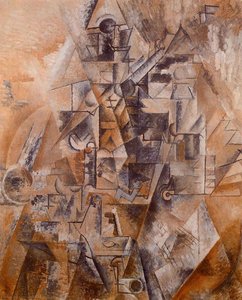 Clarinet
Witness Pablo Picasso's revolutionary 'Clarinet,' a seminal work of Analytical Cubism depicting a musician amidst fragmentation and emotion. Explore its historical context & artistic impact on OriginalUniqueArt.com.
Around 1912, Cubism underwent another significant transformation, evolving into Synthetic Cubism. While Analytic Cubism focused on breaking down objects, Synthetic Cubism embraced reassembly—building up forms from simpler shapes and introducing new materials into the composition. This phase marked a shift from analyzing existing reality to constructing a new one.
Collage became central to this development. Artists began incorporating fragments of everyday life – newspaper clippings, wallpaper, fabric – directly onto the canvas. These elements weren’t merely decorative; they were integral parts of the artwork, blurring the boundaries between painting and sculpture, representation and reality. This introduction of real-world textures and patterns added another layer of complexity to the Cubist vocabulary.
The palette also brightened during this period, with bolder colors and more defined shapes. Synthetic Cubism wasn’t about replicating an object's appearance but rather creating a new visual language—a dynamic interplay of form, color, and texture that evoked the essence of the subject matter. This phase saw a greater emphasis on pattern and decorative elements, reflecting a move towards a more playful and accessible aesthetic.
Key Figures Beyond Picasso & Braque: Expanding the Cubist Circle
While Picasso and Braque are rightfully considered the pioneers of Cubism, their influence extended to a wider circle of artists who contributed significantly to the movement’s evolution. Juan Gris, for example, emerged as a key figure after 1911, bringing a more mathematical and structured approach to Synthetic Cubism. His works often featured bold geometric shapes and vibrant colors, creating a sense of order and clarity within the fragmented composition.
Fernand Léger explored the intersection of Cubism with industrial themes, depicting machines and urban landscapes in his distinctive style. His paintings celebrated the dynamism of modern life, incorporating mechanical forms and simplified figures. Other artists like Robert Delaunay and Henri Le Fauconnier also experimented with Cubist principles, pushing the boundaries of abstraction and exploring new ways to represent space and form.
These artists weren’t simply imitators; they each brought their unique perspectives and sensibilities to the movement, enriching its vocabulary and expanding its possibilities. The Salon Cubists, a group of French painters who exhibited together in 1912, further popularized the style and introduced it to a wider audience.
Cubism's Enduring Legacy: Influence on Subsequent Art Movements
The impact of Cubism reverberated throughout the 20th century, profoundly influencing countless art movements. Futurism, with its celebration of speed and technology, adopted Cubism’s fragmentation of form to convey dynamism and energy. Suprematism, a Russian abstract movement, drew inspiration from Cubism's rejection of representational imagery, focusing on pure geometric shapes and colors.
Dada, a reaction against the horrors of World War I, embraced Cubism’s anti-rational spirit and its willingness to challenge artistic conventions. Constructivism, another Russian abstract movement, built upon Cubism’s technique of constructing sculpture from separate elements. Even Surrealism, with its exploration of the subconscious mind, owed a debt to Cubism's disruption of traditional perspectives and its embrace of illogical juxtapositions.
Beyond painting and sculpture, Cubism influenced architecture, literature, and music. Its emphasis on multiple viewpoints and fragmented forms challenged conventional modes of expression across various disciplines. The movement’s legacy continues to resonate today, inspiring contemporary artists to explore new ways of representing reality and pushing the boundaries of artistic innovation.
Experiencing Cubism Today: Museums and Contemporary Interpretations
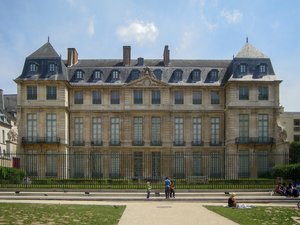 Musée National Picasso
To truly appreciate the power and complexity of Cubism, experiencing the works firsthand is essential. The Musée National Picasso in Paris houses an extensive collection of Picasso’s paintings, sculptures, and drawings, offering a comprehensive overview of his artistic evolution, including his pivotal role in developing Cubism. Major museums worldwide—including the Museum of Modern Art (MoMA) in New York and the Tate Modern in London—also feature significant collections of Cubist works.
Contemporary artists continue to draw inspiration from Cubism’s principles, reinterpreting its techniques and exploring new possibilities within the fragmented aesthetic. The movement's emphasis on abstraction, multiple perspectives, and the interplay of form and space remains relevant in today’s rapidly changing world. OriginalUniqueArt.com offers high-quality reproductions of iconic Cubist masterpieces, allowing you to bring these revolutionary works into your own home. Explore our collection and discover the enduring power of Cubism—a movement that forever changed the course of art history.