Peržiūrėti realaus dydžio版
 Siųsti
 Dalintis
 Išsamiau
 Vadovas

 Atsisiųsti
 Panašūs eksponatai
 Rentgeno spindulių nuotrauka
 Diaporama
 Statistika
Interjeras (Mano valgomasis)
 Akrilas ant drobės
- Sieninis menas
- Post-Impressionism
 1909
1909- Modernizmas
 50.0 x 65.0 cm
 Rodyti daugiau
Rankų darbo aliejinės reprodukcijos
Rankiniu būdu tapytas aliejus ant droblio jūsų pageidaujamame dydį ir rėmuose – mūsų menininkų darbas pagal užsakymą. ( Perjungti į spausdinimą Perejti prie skaitmeninių vaizdų)




P118B €10

P118H €10

P118W €10

P438Z €10

P508JH €12

P508YH €12

P805H €10

P805Z €10

P919BZ €10

P919G €10

P919XJ €10

P959ZH €10

P968JZ €12

W106C €8

W218G €10

W218JH €8

W218Y €10

W307PJ €10

W316G €10

W316PJ €8

W316Y €10

W398PJ €8

W4111J €10

W500HY €15

W500JH €15

W692G €12

W849H €8

W940BG €15

W953PJ €8




Pasirinkite iš mūsų nustatytų dydžių, atitinkančių originalaus meno kūrinio proporcijas.

Įveskite jums reikiamą plotį ir aukštį, kad paveikslas atitiktų jūsų rėmą ar sieną. Kadangi šis darbas yra rankinio darbo, siekiant išgauti kitokio formos dydį, paveikslas gali būti šiek tiek didesnis (nuo kraštų bus palikta daugiau erdvės) arba mažesnis – pasirinkite jums patogiausią variantą. Prieš pradedant tapyti, atsiųsime jums skaitmeninį maketą patvirtinimui. Šioje puslapio nuotraukoje matomas vaizdas nėra galutinis rezultatas – jį parodys tik sukurtas maketas.
Gavus užsakymą, OriginalUniqueArt.com komanda susisieks su klientu el. paštu dėl instrukcijų ir pateiks maketo pavyzdį
Pristatymas visame pasaulyje () per 3–4 savaites, o ne įprastai – per 5 savaites. (26 spalis). Kokybė lieka nepakeičiama.

Nemokamas greitasis pristatymas visame pasaulyje

Aukštos kokybės lininis drobė

Pilnas siuntimo draudimas

Muitinės mokesčių grąžinimo garantija

Tikro spalvų atitikimo garantija

100 dienų grąžinimo politika (tik esant įtaigoms)

100% pinigų grąžinimo garantija

Nuolaida dideliems užsakymams
 Stiklo variantas prieinamas tik pasirinkus dydį iki 110 cm

Interjeras (Mano valgomasis)
Reprodukcijos technika
Reprodukcijos dydis
-


Visų pasirinktų variantų kaina
€ 263
Vivulias buitinės scenos Kandinskio interpretacija
Vasilijus Kandinskis kūrinys „Interjeras (Mano valgomasisis)“ yra užburiantis buitinio gyvenimo tyrimas, atskleidžiamas per drąsias spalvas ir dinamiškus toegos traukus. Šis 1909 metais sukurtas postimpresionistinis šedevras kviečia žiūrovį į gyvybingą, kiek chaotišką interjero sceną, kuri pulsuoja energija ir emocija.
Kompozicija ir spalvų paletė
Paveikslą dominuoja centrinis stalas, uždėtas raudonos ir baltos rūtšiaus audiniu, aplink kurį išsidėstė įvairūs indai bei reikmenys. Dešinėje pusėje nedidelis šalinis stalas laiko vaisių dubenėlį, o fone iškilę didelis medinis spintelė, papuoštas dekoratyviniais daiktais, sukuria pagrindinę akcentą. Du atviri durys prideda kompozicijai gylio ir intrigos.
Spalvų paletė yra turtinga ir intensyvi, kurioje dominuoja šiltos raudonos, oranžinės ir geltonos spalvos, kontrastuojančios su vėsesnėmis žalių ir mėlynų tonais. Gilios rausvamedinės sienos sukuria gyvą fono paveikslą, sustiprindami bendrą scenos gyvybingumą.
Stilius ir technika
Kandinskio postimpresionistinis stilius aiškiai išsiskiria drągiomis spalvomis, išraišmingais traukais ir akcentuotu asmeniniu išsəkimu, viršijančiu realistišką vaizdavimą. Lygios, gestiški trauksai sukuria judėjimo ir energijos pojūtį, o supaprastinti bei padidinti formos sutelkia dėmesį į bendrą siluetą, o ne į tikslius detalius.
Storas dažų sluoksnis (impasto) ir įvairios tekstūros suteikia kūriniui gylį bei dimensiją. Difuzinis apšvietimas ir kiek iškraipyta perspektyva prisideda prie sapniškos nuotaikos, pausdami šį paveikslą kaip įtraukiančią abstrakčiosios ekspresijos studiją.
Istorinis kontekstas
Sukurta Kandinskio Müncheno laikotarpiu, ši paveikslas atspindi jo ankstyvąjį meninę plėtrą ir perėjimo procesą link abstrakcijos. Šis laikotarpis buvo pažymėtas jo dalyvavimu „Der Blaue Reiter“ grupėje, kuri meno kūryboje pabrėžė dvasinį ir emocinį rezonansą. Kūrinys yra įrodymas apie Kandinskio inovatyvų požiūrį, sujungiantį buitinį realizmą su ekspresyvia abstrakcija.
Simbolika ir emocinis poveikis
Buitinio interjero tema primena kasdienį gyvenimą ir namų šilumą, tačiau vibrantiškos spalvos bei energingi traukai perteikia šilumos ir gyvybės pojūtį. Daiktų chaotiška išsidėstymo maniera ir iškraipyta perspektyva sukelia tiek komforto, tiek nerimo jausmą, kurdamas emociniu하게 užkrautą atmosferą.
Drąsių, nerealistiškų spalvų bei ekspresyvių traukų naudojimas įneša į sceną stiprų emocinį ir psichologinį buvimą. Šis kūrinys išsiskiria gebėjimu įamžinti buitinės erdvės esmę, kartu suteikiant jai sapnišką ir vaizduotės kupiną prigimtį.
Kodėl verta rinktis ar eksponuoti šį kūrinį
„Interjeras (Mano valgomasis)“ yra būtina kolekcija turinti skirta meno mylėtojams, kolekcionieriams ir interjero dizaineriams, ieškantiems paveikslą, kuris sujungia ryškias spalvas, dinamiškus traukus ir emocinį gylį. Jo postimpresionistinis stilius ir ekspresyvi technika daro jį universaliu priedu prie bet kokios meno kolekcijos ar gyvenamosios erdvės.
Nesvarbu, ar jus traukia Kandinskio inovatyvus požiūris, ar scenos emocinis rezonansas, šis paveikslas siūlo unikalią buitinio realizmo ir abstrakčiosios ekspresijos sintezę. Aukštos kokybės šio kūrinio reprodukcija gali įnešti energijos ir kūrybiškumo jūsų namams ar biurui, tapdama ne tik diskusijų tema, bet ir įkvėpimo šaltiniu.
问答 (or more naturally for a website heading): Klausimai ir atsakymai
Ar galiu pamatyti „Interjeras (Mano valgomasis)“, autorius – Vasilijus Kandinskis skirtingame apšvietime?
„Interjeras (Mano valgomasis)“ galima tyrinėti sluoksniu sluoksnį pusėje, naudojant kūrinio Rentgenas puslapį – interaktyvų vaizdo peržiūrą, įkvėptą restauratoriaus šviesos stalo ir siūlantį vien ambivalentišką vaizdą, sudarytą iš vienylies optinių sluoksnių.
Kokia atmosferą sukelia „Interjeras (Mano valgomasis)“?
„Interjeras (Mano valgomasis)“ kūrinį lygina su Elegantiška atmosfera.
Kokia buvo „Interjeras (Mano valgomasis)“ kūrimo metai ir kokiam stiliui jis priklauso?
„Interjeras (Mano valgomasis)“, autorius – Vasilijus Kandinskis sukurta 1909 m. ir priklauso Post-Impressionism stiliui.
Autoriaus biografija
A Life Immersed in Color and Spirit
Wassily Wassilyevich Kandinsky, born December 4, 1866, in Moscow, Russia, was a revolutionary figure who irrevocably altered the course of modern art. His journey wasn’t one of immediate artistic calling; initially destined for a career in law and economics at the University of Moscow, it was a profound encounter with Impressionist painting – specifically Claude Monet's “Haystacks” – and a deeply moving experience witnessing Wagner’s opera "Lohengrin" that ignited within him an irrepressible desire to pursue art. This pivotal moment, occurring around age thirty, marked not merely a career change but a complete transformation of perspective, setting him on a path toward pioneering abstraction. He soon relocated to Munich, enrolling at the prestigious Academy of Fine Arts and studying under Franz von Stuck, though even within formal training, Kandinsky’s spirit yearned for exploration beyond conventional boundaries. Early influences included Russian folk art, gleaned from an ethnographic expedition to the Vologda region in 1889, which instilled a fascination with vibrant color palettes and symbolic imagery. This foundation would prove crucial as he began to develop his unique artistic language. These early explorations weren’t simply about aesthetic preference; they were rooted in a deep cultural connection and a burgeoning understanding of how art could communicate beyond the literal. He experimented with landscapes and portraits, demonstrating considerable skill but always feeling constrained by representational limitations.The Dawn of Abstraction: From Expressionism to Inner Necessity
Kandinsky’s early works reveal a strong expressionistic bent, characterized by bold colors and emotional intensity – pieces like “Papeln (Poplars)” from 1902 exemplify this period. However, he wasn't content with merely representing the external world; he sought to express inner realities, spiritual truths that transcended mere visual depiction. This quest led him gradually away from representational art and toward a revolutionary exploration of color, form, and their emotional resonance. He believed that colors possessed inherent psychological effects, capable of evoking specific feelings and sensations in the viewer. This conviction was deeply intertwined with his burgeoning interest in Theosophy, a spiritual movement emphasizing esoteric knowledge and universal brotherhood. As he delved deeper into these ideas, Kandinsky’s paintings became increasingly non-objective, shedding recognizable forms in favor of abstract compositions driven by an “inner necessity.” This wasn't simply about abandoning representation; it was about discovering a new visual language capable of expressing the intangible realms of emotion and spirituality. He sought to create a visual equivalent of music, where color and form harmonized to evoke profound emotional responses. He began to experiment with landscapes and portraits, demonstrating considerable skill but always feeling constrained by representational limitations. His conviction that colors possessed inherent psychological effects, capable of evoking specific feelings and sensations in the viewer. This conviction was deeply intertwined with his burgeoning interest in Theosophy, a spiritual movement emphasizing esoteric knowledge and universal brotherhood. As he delved deeper into these ideas, Kandinsky’s paintings became increasingly non-objective, shedding recognizable forms in favor of abstract compositions driven by an “inner necessity.” This wasn't simply about abandoning representation; it was about discovering a new visual language capable of expressing the intangible realms of emotion and spirituality. He sought to create a visual equivalent of music, where color and form harmonized to evoke profound emotional responses.Geometric Harmony and Spiritual Resonance
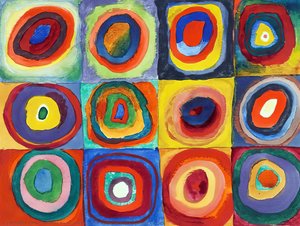
The period following his involvement with the influential artist group Der Blaue Reiter (The Blue Rider), which he co-founded in Munich in 1911, saw a further evolution in Kandinsky’s style. While earlier works often featured fluid, organic shapes, he began to explore geometric abstraction, focusing on the interplay of circles, triangles, and squares. “Several Circles” (140 x 140 cm) stands as a prime example of this phase – a dynamic composition where color and form interact in a harmonious yet energetic dance. He believed that colors possessed inherent psychological effects, capable of evoking specific feelings and sensations in the viewer. This conviction was deeply intertwined with his burgeoning interest in Theosophy, a spiritual movement emphasizing esoteric knowledge and universal brotherhood. As he delved deeper into these ideas, Kandinsky’s paintings became increasingly non-objective, shedding recognizable forms in favor of abstract compositions driven by an “inner necessity.” This wasn't simply about abandoning representation; it was about discovering a new visual language capable of expressing the intangible realms of emotion and spirituality. He sought to create a visual equivalent of music, where color and form harmonized to evoke profound emotional responses. He experimented with landscapes and portraits, demonstrating considerable skill but always feeling constrained by representational limitations. His conviction that colors possessed inherent psychological effects, capable of evoking specific feelings and sensations in the viewer. This conviction was deeply intertwined with his burgeoning interest in Theosophy, a spiritual movement emphasizing esoteric knowledge and universal brotherhood. As he delved deeper into these ideas, Kandinsky’s paintings became increasingly non-objective, shedding recognizable forms in favor of abstract compositions driven by an “inner necessity.” This wasn't simply about abandoning representation; it was about discovering a new visual language capable of expressing the intangible realms of emotion and spirituality. He sought to create a visual equivalent of music, where color and form harmonized to evoke profound emotional responses.Bauhaus Influence and Lasting Legacy
The outbreak of World War I forced Kandinsky's return to Russia in 1914, but following the Russian Revolution, he found himself increasingly at odds with the prevailing artistic climate. In 1920, he accepted a teaching position at the Bauhaus school in Germany, where he profoundly influenced generations of artists with his theories on color, form, and abstraction. The Bauhaus provided an ideal environment for Kandinsky to further develop his ideas and explore new creative avenues. He experimented with landscapes and portraits, demonstrating considerable skill but always feeling constrained by representational limitations. His conviction that colors possessed inherent psychological effects, capable of evoking specific feelings and sensations in the viewer. This conviction was deeply intertwined with his burgeoning interest in Theosophy, a spiritual movement emphasizing esoteric knowledge and universal brotherhood. As he delved deeper into these ideas, Kandinsky’s paintings became increasingly non-objective, shedding recognizable forms in favor of abstract compositions driven by an “inner necessity.” This wasn't simply about abandoning representation; it was about discovering a new visual language capable of expressing the intangible realms of emotion and spirituality. He sought to create a visual equivalent of music, where color and form harmonized to evoke profound emotional responses. He experimented with landscapes and portraits, demonstrating considerable skill but always feeling constrained by representational limitations. His conviction that colors possessed inherent psychological effects, capable of evoking specific feelings and sensations in the viewer. This conviction was deeply intertwined with his burgeoning interest in Theosophy, a spiritual movement emphasizing esoteric knowledge and universal brotherhood. As he delved deeper into these ideas, Kandinsky’s paintings became increasingly non-objective, shedding recognizable forms in favor of abstract compositions driven by an “inner necessity.” This wasn't simply about abandoning representation; it was about discovering a new visual language capable of expressing the intangible realms of emotion and spirituality. He sought to create a visual equivalent of music, where color and form harmonized to evoke profound emotional responses. Kandinsky’s exploration of color, form, and spirituality continues to inspire artists today, solidifying his place as one of the most important figures in 20th-century art history. He didn't just paint pictures; he painted emotions, ideas, and the very essence of the human spirit.
Vasilijus Kandinskis
1866 - 1944 , Rusija
Trumpa informacija apie kūrėją
- Artistic Movement Or Style: Abstrakti meno
- Artists Or Movements Influenced By This Artist: ['Abstrakti ekspresionizmas']
- Artists Who Influenced This Artist:
- Claude Monet
- Richard Wagner
- Date Of Birth: 1866
- Full Name: Wassily Wassilyevich Kandinsky
- Nationality: Rusijoje
- Notable Artworks: ['Murnau su aromatu']
- Place Of Birth: Maskova, Rusija
Susiję straipsniai

Top 10 Abstraktus Ekspresionizmas: Simboliai ir Grožio Paslaptys
Atraskite 10 legendinių abstraktus ekspresionizmo kūrinių! Pažinkite Pollocko, Rothko ir kitų genijų istorijas bei jų spalvingas meno interpretacijas. Puikios meninės reprodukcijos jūsų namams – OriginalUniqueArt.com

Geometrinės Abstrakcijos Šedevrai: 10 Kūrinių, Pakeitusių Meną | OriginalUniqueArt.com
Atraskite 10 geometrinės abstrakcijos šedevrų – nuo Mondriano iki Malevičiaus! Sužinokite apie Piet Mondrian, Kazimir Malevič ir kitus menininkus. Meno kūriniai jūsų interjerui | OriginalUniqueArt.com
Klasikinio Interjero Subalansavimas: Drąsi Abstrakčios Tapybos Pora Klasikiniuose ir Moderniuose Interjeruose
Atraskite, kaip drąsi abstrakčios tapybos integracija subalansuoja klasikiniame interjere! Meno ekspertai padės sukurti unikalų ir prabangų namų dizainą. Individualūs paveikslai pagal užsakymą – OriginalUniqueArt.com.

Kandinsky's Masterpieces: 25 Paintings That Define Abstract Art | OriginalUniqueArt
Journey through Wassily Kandinsky's 25 most iconic abstract paintings. Explore his revolutionary use of color, form & spiritual expressionism. Find museum-quality Kandinsky reproductions and elevate your home decor with OriginalUniqueArt.com. Discover all masterpieces on OriginalUniqueArt.com!

Post-Impressionizmo Deimantai: 10 Šedevrų Jūsų Namams
Atraskite 10 Post-Impresionizmo šedevrų! Van Gogas, Cézanne ir kiti genijai – jų kūriniai, istorijos bei spalvos. Įkvėpkite savo interjerui su OriginalUniqueArt.com aukščiausios kokybės reprodukcijomis. Išnagrinėkite visą kolekciją internete!