Perjungti į spausdinamus版作品
 Skaityti daugiau







































 Dėl meno kūrinių ar reprodukcijų, kurių bet kuri pusė yra didesnė nei 105 cm (apie 41 inch), rėmas bus siunčiamas kaip išskaidytas surinkimo rinkinys. Šis metodas užtikrina saugų pristatymą ir apsaugo nuo transportavimo metu galimos žalos.


Eiffel Tower – Robert Delaunay’s Pioneering Vision of Modernity
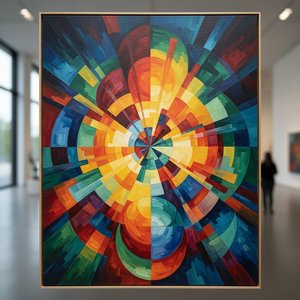
Robert Delaunay's "Eiffel Tower," completed in 1914, stands as a cornerstone of Orphism and Cubist aesthetics—a bold declaration that continues to resonate with audiences today. This artwork isn't merely a depiction of Paris’ iconic landmark; it’s an embodiment of the artistic fervor gripping Europe at the dawn of the twentieth century, reflecting the burgeoning fascination with abstraction and scientific breakthroughs concerning color and light. Delaunay, alongside Sonia Delaunay and fellow artists, sought to transcend representational art, prioritizing emotional expression through geometric forms and vibrant hues—a radical departure from established conventions.- Style & Technique: The painting exemplifies Cubist principles, albeit infused with the distinctive energy of Orphism. Delaunay employs a fragmented approach, dissecting the Eiffel Tower into angular planes and intersecting lines—a technique that challenges traditional perspective and invites viewers to actively engage in interpreting the artwork’s visual complexity.
- Color Palette: Dominating the canvas is a rich tapestry of warm tones – fiery reds, luminous oranges, and sunny yellows – juxtaposed against cooler blues, greens, and whites. This deliberate contrast captures the essence of a Parisian sunset while simultaneously conveying dynamism and modernity. Delaunay’s masterful use of flat areas of color echoes Cubist innovations, amplifying the artwork's visual impact.
- Composition & Perspective: The composition is meticulously crafted to create a sense of movement and depth. Overlapping geometric shapes—primarily rectangles and triangles—are strategically positioned to mimic the multifaceted nature of urban life and invite multiple viewpoints. Delaunay skillfully manipulates perspective, flattening it out to emphasize structural elements and heighten the artwork’s expressive power.
Historical Context – A Reflection of Scientific Innovation
Painted during a period marked by seismic shifts in artistic thought—influenced profoundly by scientific theories concerning color and light—"Eiffel Tower" reflects the broader intellectual landscape of its time. Delaunay’s exploration of chromatic harmony aligns with the groundbreaking research conducted by physicists like Michel Eugène Félix Plateau, who pioneered the concept of simultaneous contrast. The Eiffel Tower itself served as a tangible symbol of industrial progress and optimism, mirroring France's celebration of the centennial anniversary of the French Revolution.Symbolism & Emotional Resonance – Beyond Representation
More than just an architectural marvel, the Eiffel Tower embodies a deeper symbolic significance—representing Paris’ cultural heritage and France’s spirit of innovation. Delaunay’s fragmented portrayal captures not only the tower's grandeur but also its inherent vulnerability, conveying a subtle melancholic undertone that speaks to the anxieties surrounding rapid societal transformation. The artwork’s stylistic choices underscore the artist’s conviction that art should transcend mere imitation, prioritizing emotional impact and intellectual stimulation.Conclusion – An Enduring Legacy of Artistic Vision
Robert Delaunay's "Eiffel Tower" remains a testament to the transformative power of artistic experimentation—a masterpiece that continues to inspire collectors and interior designers alike. Its bold colors, dynamic composition, and Cubist technique encapsulate the spirit of an era defined by intellectual curiosity and aesthetic daring—a timeless reminder that art can illuminate our understanding of both the world around us and ourselves.Klausimai ir atsakymai
Atsižvelgiant į spalvų paletę, kur rekomenduojama eksponuoti kūrinį „Eiffel Tornas"]?
„Eiffel Tornas“ – Robertas Delonė Žemiški tonai spalvos dera su rekomenduojama erdvė: tai Popieriaus svetainė.
Kokia yra autorinės teisės situacijos priežastis kūriniam darbui „Eiffel Tornas“ – Robertas Delonė?
„Eiffel Tornas“, kurį sukūrė Robertas Delonė, yra yra viešosios erdvės dalis – jo autorinė teisė pasibaigusi. Autorinės teisės apsaugos terminai skaičiuojami nuo autoriaus mirties, o Robertas Delonė mirė 1941 m.
Ar „Eiffel Tornas“ – Robertas Delonė yra portretinė, peisžinio tipo ar kvadratinė kompozicija?
„Eiffel Tornas“ formatas yra Portretinis formatas. Tai padeda planuojant, kur būtų patalpinta reprodukcija.
 Peržiūrėti realaus dydžio版
 Pasidalinti
 Dalintis
 Išsamiau
 Vadovas

 Atsisiųsti
 Panašūs eksponatai
 Rentgeno spindulių nuotrauka
 Automatinė diorama
 Q&A
Q&A Statistika