Neoclassicism · 1786
Thomas Witter (John Ramage, 1786)
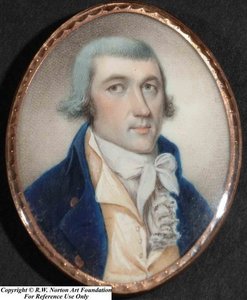
John Ramage (1748–1802) sukūrė Thomas Witter. Šis kūrinys datuojamas 1786 m. Šis kūrinys priklauso Neoclassicism kieruliui. Pagaminta naudojant Watercolor. Eksponatas saugomas Metropolitano meno muziejus Niujorkas, JAV. Matmenys – 4 × 4 cm.
- 1786
- Watercolor
- 4 × 4 cm
- Metropolitano meno muziejus, Niujorkas

 Peržiūrėti

 Rankinio darbo aliejinės imitacijos paveikslas
 Pasidalinti
 Dalintis
 Informacinė lLapelė


 Atsisiųsti
 Panašūs eksponatai
 Rentgeno spindulių nuotrauka
 Automatinė diorama
 Klausimai ir atsakymai

 Statistika
Thomas Witter, trumpai
- Pavadinimas
- Thomas Witter
- Autorius
- John Ramage (1748–1802)
- Autorius gimęs
- Dublinas, Irelandija
- Data
- 1786
- Technika
- Watercolor
- Dalių matmenys
- 4 × 4 cm
- Kur galima pamatyti
- Metropolitano meno muziejus, Niujorkas, JAV
- Judėjimas
- Neoclassicism
- Laikotarpis
- Early Modern
- Tema
- man, portrait, mustache, white hair, cravat, grayscale
Ką vaizduoja Thomas Witter?
Identification of the Portrait of Thomas Witter
The gaze of Thomas Witter meets the viewer through this intimate watercolor portrait, a work that captures a quiet moment of reflection. Painted by John Ramage in 1786, the piece presents a man caught in a state of contemplation. He appears as a gentleman of his era, his presence rendered with a delicate touch that suggests a life of dignity and perhaps a touch of melancholy. The portrait focuses closely on his head and shoulders, creating a sense of immediate, personal encounter.
This small-scale watercolor painting offers a glimpse into the character of the subject. Ramage, an artist known for his ability to capture individual presence, uses the medium to define the contours of Witter's face and the subtle textures of his attire. The man's white hair and prominent mustache are rendered with precision, framing a face that seems to hold a silent story. Every line and shade works to preserve the likeness of Thomas Witter, ensuring his image remains present and palpable.
Composition and Visual Elements
The portrait centers on the head and shoulders of the subject, all contained within the gentle curves of an oval frame. He gazes downward, his eyes cast toward something unseen, wearing an expression of quiet melancholy or deep contemplation. His white hair is styled with neat precision, and a prominent mustache defines his face. He wears a formal suit, the details of which are anchored by a tie or cravat wrapped carefully around his neck.
A grayscale palette governs the entire scene, moving through a full range of tones from the deepest blacks to the brightest whites. This monochromatic approach creates a sense of stillness. Soft, diffused lighting washes over the man, illuminating his features evenly and avoiding any harsh or jarring shadows. The light settles upon his face, revealing the subtle contours of his features and the texture of his clothing without disrupting the calm atmosphere of the moment.
Technique and Artistic Materials
The artist works within a delicate 4 x 4 cm space, utilizing watercolor on paper to build a quiet, grayscale world. Through the careful layering of gray paint washes, a sense of volume emerges from the flat surface. These tonal variations create a soft, diffused light that settles across the subject, building depth through subtle shifts in shadow rather than harsh lines. The monochromatic palette relies entirely on these gradations to define the form of the man's face and the structure of his attire.
Fine, deliberate lines define the character of the portrait. The artist uses precise strokes to render the details of the mustache and the subtle wrinkles of the skin, capturing a sense of lived experience. These same linear techniques extend to the clothing, where lines trace the heavy folds of the fabric. A tactile contrast exists between the different surfaces; the skin appears smooth under the light, while the texture of the clothing feels slightly more rugged and coarse.
Kuriame muziejuje eksponuojama karya Thomas Witter?
Metropolitano meno muziejus
Niujorkas, JAV
Metropolitano meno muziejaus kilmė ir istorija Metropolitano meno muziejus gimė iš vizijos, kurią dalijosi verslininkai, finansininkai bei išckiausi menininkai ir mąlotojai. Įsilaužus institucijai 1870 metais, ji pradėjo ieškoti nuolatinės vietos savo augančiai kolekcijai. Prieš įsikurę dabartinėje vietoje, muziejus trumpam apsenė vone West 14th gatvėje esančiame Douglas Mansion dvoriuose.


Thomas Witter dididraudžios kokybės vaizdai
Viešoji domenė: suregalis mirė 1802 m.
John Ramage, Thomas Witter (1786), Metropolitano meno muziejus. Viešoji domenė
Atsakimai į klausimus apie Thomas Witter
Kuriam muziejui priklauso originalus „Thomas Witter“?
Kūrinys „Thomas Witter“ – John Ramage rodomas Metropolitano meno muziejus, Niujorkas, JAV. Muziejaus informacija nuoroda į originalą, o ne į reprodukciją.
Kuriem metais buvo sukurta „Thomas Witter“ – John Ramage?
„Thomas Witter“ – John Ramage kūrybos metai – 1786.
Kokia technika panaudota kūriniui „Thomas Witter"]?
John Ramage kūriniui „Thomas Witter“ panaudojo Watercolor techniką. Ši technika apibrėžė originalaus kūrinio medžiaginę prigimtį.
Kokie yra originalaus „Thomas Witter“ matmenys?
Originalaus dydžio kūrinys „Thomas Witter“ yra 4 x 4 cm. Originalūs matmenys padeda lengviau išsirinkti tinkamą reprodukcijos dydį.
Kas yra „Thomas Witter“?
„Thomas Witter“ – John Ramage temos apima man, portrait, mustache, white hair, cravat, grayscale. Kartu jie apibendrina šio kūrinio tematiką.
Ar „Thomas Witter“ – John Ramage priklauso viešosios teisės domenui?
„Thomas Witter“ – John Ramage yra yra viešosios erdvės dalis – jo autorinė teisė pasibaigusi. Šis statusas nustato, kaip galima reprodukcijaus šio kūrinio vaizdą.
Kas sukūrė „Thomas Witter“?
„Thomas Witter“ priskiriamas John Ramage.
Kokio meno kryžmės dalis yra „Thomas Witter“ – John Ramage?
Kūrinio „Thomas Witter“ – John Ramage stilius – Neoclassicism. Ši klasifikacija leidžia šį darbą įtraukti į bendrą susijusių menininkų ir kūrinių kontekstą.
Kokio John Ramage kūrybos laikotarpio priklauso „Thomas Witter“?
John Ramage kūrybos enceklopedijoje kūrinys „Thomas Witter“ priskiriamas Mature Period laikotarpiui. Šis etapas leidžia palyginti jį su kitais šio autoriaus kūriniais.
Apie menininką John Ramage
1748–1802, Irelandija
John Ramage
Gyvenimas, jungiantis pasaulius: John Ramage istorija 1748 metais Dublino, Airijoje, gimęs John Ramage, gyveno neįtikėtinų permainų ir meninės atsidavimo laikotarpį – tai buvo kelionė iš aukštoringo Airijos auksininkystės pasaulio į pradedančiąsią Amerikos kolonijų meno sceną. Detalės apie jo ankstyvąjį šeimynikos gyvenimą lieka paslaptimi, tačiau žinoma, kad 1763 metais jis gavo oficialų mokymą Dublino menininkų draugijoje, taip laidindamas tvirtą piešimo ir tapybos technikų pagrindą, kuris tapo jo būsimų pastangų pamatu. Ramage karjeros pradžia buvo ypač įvairiapradė: jis meistriškai sujungė auksininko tikslumą su delicate miniaturisto meniu – tai tapo įrodymu apie jo prigimtą talentą detalėms ir dekoratyviniam menui. Šis ankstyvasis laikotarpis įsidiegsė jame ne tik techninį meistriškumą, bet ir aistrą amatiškumui, kuris apžymėsjo jo kūrybą visą gyvenimą.
Taip pat John Ramage darbai
 Major Greene, B.A1777
 Gilbert Van Cortlandt1785
 Governor George Clinton1785
 Portrait of a Gentleman1780
Esdai apie Thomas Witter
 25 Masterpieces by Jean-Antoine Watteau: The Essence of Rococo EleganceExplore 25 iconic Rococo masterpieces by Jean-Antoine Watteau. Discover the full collection online at OriginalUniqueArt.com.
 Monochromatic Form: Integrating Black, White, and Gray Abstract Art into Modern Architectural SpacesMaster the art of integrating monochromatic abstraction into modern architecture with expert curation. Elevate your space today.
 Masterpieces of Hyacinthe Rigaud: The Top 25 Portraits of a Baroque IconExplore 25 iconic Hyacinthe Rigaud masterpieces. From Baroque portraits to royal splendor, discover the full collection on OriginalUniqueAr…