German Expressionism
Friends (Emil Nolde)
Emil Nolde (1867–1956) sukūrė Friends. Šis kūrinys priklaulo German Expressionism kieruliui. Pagaminta naudojant Oil On Canvas.
- Oil On Canvas

 Peržiūrėti realaus dydžio版

 Rankinio darbo aliejinės imitacijos paveikslas
 Pasidalinti
 Dalintis
 Informacinė l lapelė


 Atsisiųsti
 Panašūs eksponatai
 Rentgeno spindulių nuotrauka
 Automatinė diorama
 问答

 Statistika
Friends, trumpai
- Pavadinimas
- Friends
- Autorius
- Emil Nolde (1867–1956)
- Dizainere/is gimęs
- Nolde, Danija
- Mediumas
- Oil On Canvas
- Judėjimas
- German Expressionism
- Laikotarpis
- Modern
- Tema
- landscape painting, german art scene, rural scenery, expressionist style, colorful palette”,, friendship theme”,
Ką vaizduoja Friends?
Identification of the Artwork and Artist
Friends is a work by the German painter and printmaker Emil Nolde. The piece focuses on the complexities of human connection, intimacy, and emotional vulnerability. Through a simplified and expressive visual language, the artist explores the fundamental themes of friendship or love.
Nolde, a prominent figure in the Expressionist movement and a member of the Die Brücke group, sought to move beyond mere surface representation. His approach prioritized the internal weight of a subject over literal likeness. In this work, the focus remains on the psychological depth of the figures, utilizing a directness that emphasizes feeling over anatomical precision.
Composition and Visual Elements
The composition is tightly cropped, focusing intensely on the faces and upper bodies of the individuals. The intertwined forms of the two figures dominate the frame, filling almost the entire space. This proximity creates a sense of intimacy, pressing the subjects almost directly against the picture plane. The figures occupy the foreground entirely, leaving little room for spatial recession.
The background remains minimal, providing no environmental context. This lack of detail ensures the viewer's attention remains fixed on the physical connection between the subjects. Organic shapes define the human forms, while loose, gestural lines contribute to a sense of movement and emotional intensity. The flattened perspective further emphasizes the closeness of the embrace, removing traditional depth in favor of immediate, tactile presence.
Technique and Material Application
Executed in oil, the work exhibits a rough, painterly texture. The application of pigment is direct, leaving visible brushstrokes across the surface. In certain areas, the paint is applied with enough thickness to suggest an impasto technique, adding a physical weight to the forms. This tactile approach emphasizes the materiality of the medium.
The linework is characterized by a loose, gestural quality rather than precision. Lines are frequently blurred and overlapping, which creates a sense of movement and visual tension. These indistinct boundaries contribute to a dynamic effect, prioritizing the sensation of the subject over anatomical or structural accuracy.
Color Palette and Lighting
The palette is grounded in earthy, muted tones. Dominant shades of brown, ochre, and grey establish a somber foundation for the composition. These neutral colors are interrupted by a striking red hue applied to a figure's hair or head covering, creating a singular point of visual intensity. Small accents of yellow appear in the background and around the faces of the figures, providing a subtle contrast to the darker, more subdued surroundings.
Lighting is diffused and uneven across the surface. There is no singular, identifiable light source; instead, the illumination creates a series of irregular shadows and highlights. This lack of uniform light emphasizes the contours of the faces and bodies, adding a sense of weight to the physical proximity of the subjects. The interplay of light and shadow contributes to the overall emotional density of the work.
Style and Artistic Expression
The work is characterized by a strong Expressionistic style, prioritizing emotional intensity over literal representation. Through the use of non-naturalistic colors and simplified forms, the artist moves away from academic realism toward a more subjective visual language. The composition relies on organic shapes that reflect the human form, creating a sense of physical and emotional closeness.
Facial features are suggested rather than realistically rendered, favoring abstraction to convey the internal state of the subjects. This approach utilizes simplified and somewhat abstracted shapes to emphasize the essence of the human connection. The resulting aesthetic is one of immediacy and raw feeling, where the distortion of form serves to heighten the psychological weight of the embrace.
Related Works by the Same Artist
Nolde’s exploration of human connection and psychological depth extends through various subjects, from religious narratives to landscape studies. His religious output includes Christ among the Children and the visceral 1909 work The Mocking of Christ. These pieces reflect a shift toward depicting the emotional weight of spiritual moments through non-naturalistic color and simplified forms.
The artist also engaged with the primal and the figurative in works such as Masks, executed about 1906-1907. His interest in the natural world and the atmospheric qualities of light is evident in Autumn Sea, painted about 1908, and in the composition of Two Women against a Blue Sky. Each work demonstrates a consistent preoccupation with using color as the primary substance of form.
Friends dididraudžios kokybės vaizdai
Viešoji domenė: suregalis mirė 1956 m.
Emil Nolde, Friends. Viešoji domenė.
Atsakimai į klausimus apie Friends
Kokia technika panaudota kūriniui „Friends"]?
„Friends“ technika – Oil On Canvas.
Ką vaizduoja „Friends“ – Emil Nolde?
„Friends“ – Emil Nolde vaizdeletas: landscape painting, german art scene, rural scenery, expressionist style, colorful palette”,, friendship theme”,, nolde’s landscapes”.
Ar „Friends“ yra viešosios teisės kūrinys?
Autorių teisių statusas kūriniui „Friends“ – Emil Nolde: kūrinys priklauso yra viešosios erdvės dalis – jo autorinė teisė pasibaigusi. Tai nulemia, ar galima laisvai reprodukciuoti šį vaizdą.
Kas yra „Friends“ kūrybos autorius?
„Friends“ priskiriamas Emil Nolde.
Kokiam meno stiliui priklauso „Friends“ – Emil Nolde?
Kūrinio „Friends“ – Emil Nolde stilius – German Expressionism. Ši klasifikacija leidžia šį darbą įtraukti į bendrą susijusių menininkų ir kūrinių kontekstą.
Kokio Emil Nolde kūrybos laikotarpio priklauso „Friends“?
„Friends“ atspindi Emil Nolde kūrybinį laikotarpį Early Modern.
Ar Emil Nolde kūrinys „Friends“ yra viešosios nuoslegos ir kodėl?
„Friends“ – Emil Nolde yra yra viešosios erdvės dalis – jo autorinė teisė pasibaigusi. Autorinės teisės galioja nuo mirties metų, kai šis kūrėjas mirė 1956 m.
Kokią vietą Emil Nolde kūrybos ešėlyje užima „Friends“?
„Friends“ kartu su kitais Emil Nolde kūriniais pasižymi German Expressionism stiliumi ir tamsiomis temomis: german expressionism, rural landscapes", friendship & nature, nolde's regional focus, "simple, emotive forms", spiritual undertones.
Ar „Friends“ yra būdingas tam, ką Emil Nolde paprastai kūrė?
Dažniausios Emil Nolde temos apima german expressionism, rural landscapes", friendship & nature, nolde's regional focus, "simple, emotive forms", spiritual undertones; kūrinys „Friends“ susitelkia į landscape painting, german art scene, rural scenery, expressionist style, colorful palette”,, friendship theme”,, nolde’s landscapes”.
Apie šį menininką, Emil Nolde
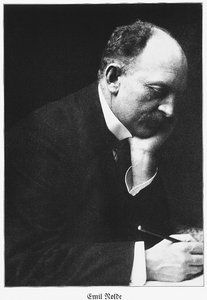
1867–1956, Danija
Emil Nolde
Emilio Nolde: Gyvenimas ir Palikimas Emilis Nolde, garsus vokiečių-danų tapytojas, gimė Hansas Emilis Hansenas rugpjūčio 7 dieną, 1867 metais Nolde kaime, Šlėsvigo-Holšteine (Vokietija). Jis kilęs iš šeimos, turinčios stiprius ryšius su kaimo gyvenimu ir religiniais įsitikinimais – veiksniai, kurie turėjo didelį poveikį jo meninei vizijai. Nepaisant pradinio tėvų pasipriešinimo, kurie norėjo, kad jis pasirinktų tradiciškesnę karjerą, Nolde ryžtingai siekė savo aistros meno. Pradžioje jis dirbo medžio drožėju ir baldų dekoratoriumi, o vėliau, sulaukęs trisdešimties metų, visiškai atsidėjo tapybai.
Taip pat Emil Nolde darbai
 Sunset
 Sea with Red Sky
 Couple on the beach1903
 Masks1911
Esdai apie Friends
 Norwegian artworks of the 1900sNorwegian Expressionism and the intense works of Edvard Munch, including The Scream and Anxiety, define this era. View the collection at Or…
 Nature’s Flow: How Organic Forms and Biomorphic Abstraction Bring Harmony to Modern Interior DesignDiscover how organic forms and biomorphic abstraction bring serenity to your home. Explore expert tips on integrating nature-inspired textu…
 Expressionism vs. New Objectivity: Emotion vs. Precision in German ArtMaster the tension between Expressionist emotion and New Objectivity precision. Explore the soul of German modern art now.