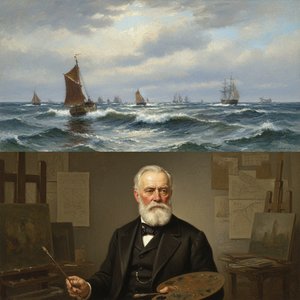
1809 - 1849

핵심 정보

  • Works on this site: 7
  • Also known as:
    • Wilh. Hendr. Schmidt
    • willem hendrik schmidt
  • Born: 1809, Rotterdam, Netherlands
  • Died: 1849
  • Copyright status: Public domain
  • Color intensity:
    • balanced
    • monochromatic
  • Top-ranked work: Portrait of an Old Lady

A Life Dedicated to Genre and Portraiture: The World of Willem Hendrik Schmidt

Willem Hendrik Schmidt, born in Rotterdam in 1809, was a Dutch painter who carved a niche for himself within the artistic landscape of the 19th century. Though not as widely celebrated as some of his contemporaries, Schmidt’s dedication to genre scenes and portraiture offers a fascinating glimpse into the everyday life and burgeoning middle class of his time. His journey began somewhat unconventionally; initially involved in his father's business, he felt an undeniable pull towards artistic expression, eventually abandoning commerce for the canvas in 1835. This decision marked the beginning of a career defined by meticulous detail, emotional resonance, and a growing mastery of both oil paint and lithography.

Early Training and Artistic Development

Schmidt’s formal training was multifaceted, reflecting his commitment to honing his skills across various disciplines. He first studied with Hendrik Schaaff in Leeuwarden, laying the foundational groundwork for his artistic endeavors. This was followed by periods of instruction under Jacobus Schoemaker Doyer in Amsterdam and, crucially, Willem Hendrik Schmidt Sr. in Delft – a potential relative whose influence remains somewhat obscured but undoubtedly shaped the young artist’s early style. From 1848 to 1852, he further refined his technique at the Royal Academy of Art in The Hague, an institution renowned for its rigorous standards and emphasis on realism. A subsequent sojourn to Paris and lessons with Charles Gleyre broadened his horizons, exposing him to new artistic currents and approaches that would subtly inform his later work.

Themes and Techniques: Capturing the Essence of Dutch Life

Schmidt’s oeuvre is characterized by a focus on genre scenes – depictions of everyday life, often featuring domestic interiors or intimate moments between family members. These paintings weren't merely observational; they were imbued with a quiet dignity and psychological depth. He possessed an exceptional ability to capture the subtle nuances of human emotion, rendering his subjects with remarkable sensitivity. “The Resuscitation of Jairus’s Daughter”, one of his most recognized works, exemplifies this talent – a poignant portrayal of faith, grief, and hope. Beyond genre scenes, Schmidt also excelled as a portraitist, creating likenesses that were not simply representations of physical appearance but rather insightful studies of character. His technique was marked by precision and attention to detail, employing a smooth brushstroke and a restrained palette that emphasized form and light. He wasn’t afraid to experiment with watercolor and lithography either, demonstrating versatility across different mediums.

Recognition and Legacy

Throughout his career, Schmidt garnered recognition for his artistic achievements. His appointment as a member of the Royal Academy in Amsterdam in 1837 signaled his growing reputation within the Dutch art world. He exhibited widely – not only in the Netherlands but also in France, England, and even the United States, broadening his reach and establishing himself on an international stage. In 1863, he was bestowed with the honor of being named a Knight in the Order of the Oak Crown, a testament to his contributions to Dutch art and culture. He married Catharina Swift in 1869 and settled in Scheveningen, continuing to paint and teach until his death in The Hague in 1904. Schmidt was an active member of both the Pulchri Studio and the Hollandsche Teekenmaatschappij, further solidifying his position within the artistic community. He also generously shared his knowledge with numerous students, including Christoffel Bisschop and Johannes Tavenraat, ensuring that his legacy would endure through subsequent generations of artists. While perhaps not a household name today, Willem Hendrik Schmidt’s work remains a valuable contribution to 19th-century Dutch painting, offering a compelling window into the social fabric and artistic sensibilities of his era.

퀴즈

각 질문의 정답은 하나뿐입니다.

질문 1:
In what city was Willem Hendrik Schmidt born?
질문 2:
What type of scenes did Willem Hendrik Schmidt excel in painting?
질문 3:
In what year did Willem Hendrik Schmidt become a member of the Royal Academy in Amsterdam?
질문 4:
Besides painting, what other art form did Willem Hendrik Schmidt prove to be skilled in?
질문 5:
What was the primary focus of Schmidt's painting later in his career?

Q&A

Willem Hendrik Schmidt 작가의 국적은 어디인가요?

Willem Hendrik Schmidt은(는) Netherlands 출신입니다.

Willem Hendrik Schmidt의 작품 중 몇 점을 둘러보실 수 있나요?

전체 작품 보기 페이지에서 Willem Hendrik Schmidt의 작품 작품 7점점을 만나보실 수 있습니다.

Willem Hendrik Schmidt의 작품을 팔레트별로 모아둔 곳은 어디인가요?

특정 색상 팔레트의 Willem Hendrik Schmidt 작품을 찾으시려면, 작가의 컬러 팔레트별로 보기 페이지를 이용해 보세요.

Willem Hendrik Schmidt의 작품을 색상별로 모아둔 곳은 어디인가요?

컬러 인덱스 페이지에서는 Willem Hendrik Schmidt의 작품들을 색상별로 모아 보실 수 있습니다.

Willem Hendrik Schmidt의 작품을 기법별로 모아볼 수 있는 곳은 어디인가요?

Willem Hendrik Schmidt의 작품은 작가 페이지인 모든 매체별에서 매체별로 둘러보실 수 있습니다.

Willem Hendrik Schmidt의 작품은 얼마나 인기가 있나요?

이 사이트에서 Willem Hendrik Schmidt의 작품에 관한 통계를 확인할 수 있는 방문 통계 페이지를 만나보세요.

Willem Hendrik Schmidt 작품의 연도별 타임라인이 있나요?

Willem Hendrik Schmidt의 작품을 연도별로 정리하여 보여주는 작품 연대기 페이지입니다.

키워드별로 분류된 Willem Hendrik Schmidt의 작품은 어디에서 볼 수 있나요?

Willem Hendrik Schmidt의 작품은 아티스트의 키워드별 탐색 페이지에서 키워드별로 찾아보실 수 있습니다. 각 키워드를 통해 관련 작품들을 모아 감상하실 수 있습니다.

Willem Hendrik Schmidt 작가 작품의 컬러 프로필은 어디에서 확인할 수 있나요?

Willem Hendrik Schmidt의 팔레트 지놈에서는 작가의 작품 세계를 구성하는 컬러 프로필을 확인하실 수 있습니다.