Vilmos Aba-Novák: A Pioneer of Monumental Hungarian Art
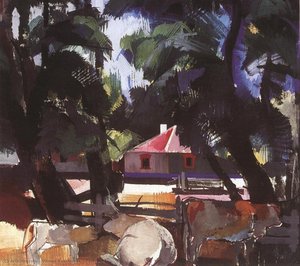
Vilmos Aba-Novák (1894 – 1941) stands as a pivotal figure in the development of modern art within Hungary, particularly renowned for his vibrant frescoes and genre scenes that captured the energy and spirit of village life, circus spectacle, and the bustling marketplaces of his era. Born into a family with artistic roots—his father, Gyula Novák, was a respected graphic artist—Aba-Novák’s journey as an artist was shaped by both formal training and a deeply ingrained fascination with the everyday world around him. His work transcends mere representation; it's imbued with a dynamic energy, a bold use of color, and a distinctly Hungarian sensibility that continues to resonate today.
Early Life and Artistic Beginnings
Born in Budapest on March 15th, 1894, Vilmos Aba-Novák’s early life was marked by an exposure to the visual arts. His father's profession instilled a love of drawing from a young age, and he began experimenting with artistic expression at just nine years old. He initially studied at the Budapest Art School until 1912, laying the groundwork for his future career. A pivotal moment arrived in 1912 when he adopted the surname “Aba-Novák,” a name that would become synonymous with his distinctive style. Following World War I, he briefly served in the Austro-Hungarian Army before dedicating himself fully to his artistic pursuits. His early influences were diverse, drawing from the burgeoning Expressionist movement and the Italian Novecento, both of which contributed significantly to the development of his unique visual language.
The Roman School and Monumental Frescoes
A significant turning point in Aba-Novák’s career came with a scholarship to study in Rome between 1928 and 1930. This period proved transformative, exposing him to the vibrant artistic scene of the Italian capital and solidifying his commitment to large-scale mural painting. He became part of what was known as the “Roman School” – a group of Hungarian artists who embraced monumental forms and bold color palettes inspired by classical Roman frescoes. Returning to Hungary, he quickly established himself as a leading figure in this movement, undertaking numerous prestigious commissions. His most celebrated works include the frescoes for the Roman Catholic Church in Jászszentandrás (1932), the Hosok Kapuja in Szeged (1936 – later whitewashed after 1945), and the elaborate murals within the Saint Stephen Mausoleum in Székesfehérvár (1937). These monumental paintings are characterized by their dynamic compositions, vibrant colors, and a palpable sense of movement—evoking the energy of a bustling marketplace or the excitement of a traveling circus.
Genre Scenes and Circus Spectacles
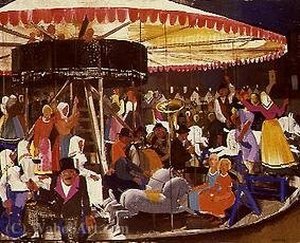
Beyond his monumental frescoes, Aba-Novák is equally celebrated for his captivating genre scenes. He possessed an extraordinary ability to capture the essence of everyday life—particularly the vibrant world of the village fair and the spectacle of the circus. His paintings, such as “Red’s Band” (1930), are filled with a sense of immediacy and spontaneity, depicting figures in dynamic poses and capturing the atmosphere of these lively events with remarkable skill. These works demonstrate his mastery of color and composition, creating scenes that are both visually arresting and emotionally engaging. The influence of artists like Picasso is evident in his stylized realism and expressive use of form.
Legacy and Historical Significance
Vilmos Aba-Novák’s career was tragically cut short by his untimely death on September 29th, 1941. Despite the challenges posed by political instability in Hungary during World War II, his work left an indelible mark on Hungarian art history. He is remembered as a pioneer of monumental painting and a master of genre scenes, whose vibrant colors and dynamic compositions continue to captivate audiences today. His legacy extends beyond individual artworks; he helped to establish a distinctly Hungarian modern style that blended influences from Expressionism, the Italian Novecento, and his own unique artistic vision. Aba-Novák’s paintings serve as a powerful testament to the vitality of everyday life and the enduring spirit of the Hungarian people.
질의응답
Vilmos Aba-Novak의 작품 중 몇 점을 둘러보실 수 있나요?
모든 작품 보기 페이지에서 Vilmos Aba-Novak의 작품 작품 104점점을 만나보실 수 있습니다.
키워드로 Vilmos Aba-Novak의 작품을 찾아볼 수 있나요?
Vilmos Aba-Novak의 작품은 아티스트의 키워드별로 페이지에서 키워드별로 찾아보실 수 있습니다. 각 키워드는 관련 작품들을 그룹화하여 보여줍니다.
Vilmos Aba-Novak 작가의 작품을 감상할 수 있는 가상 박물관에 방문할 수 있나요?
Vilmos Aba-Novak의 3D 뮤지엄는 작가의 작품들을 가상 3D 갤러리로 선보이는 페이지입니다.
Vilmos Aba-Novak 작가 작품의 컬러 프로필은 어디에서 확인할 수 있나요?
Vilmos Aba-Novak 작가 작품의 컬러 프로필은 작가의 팔레트 지놈 페이지에서 확인하실 수 있습니다.
Vilmos Aba-Novak 작가의 다른 활동명이나 알려진 이름이 있나요?
Vilmos Aba-Novak은(는) Novák Vilmos, Aba-Novák Vilmos라는 다른 이름으로도 알려져 있습니다.
Vilmos Aba-Novak은(는) 어느 시대에 활동했나요?
Vilmos Aba-Novak은(는) Modern 시대에 활동했습니다. 이 시기는 역사적 맥락에서 작가의 활동 위치를 보여줍니다.
Vilmos Aba-Novak의 작품을 기법별로 모아볼 수 있는 곳은 어디인가요?
모든 매체 페이지에서는 Vilmos Aba-Novak의 작품을 기법별로 모아볼 수 있습니다.
Vilmos Aba-Novak 작가는 어떤 사조에 참여했나요?
Vilmos Aba-Novak의 작품은 작가의 모든 사조 페이지에서 사조별로 둘러보실 수 있습니다.