

1


10월 2026 업데이트 · 인기 점수 기준 순위 (각 작품의 검색, 방문 및 주문 수) · 19점의 Erró 작품 (당사 카탈로그 기준)
요약하자면
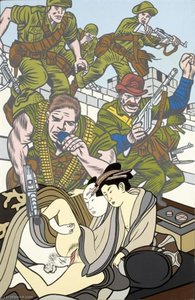
Erró가 남긴 모든 원작 중 가장 유명한 작품은 Marylin monroe입니다. 그 뒤를 이어 The final selection와 The battle of saporro가 뒤를 잇습니다. Erró의 작품 19점을 보유하고 있습니다. 갤러리는 세계가 가장 찬사하는 19점을 엄선하여 각 작품의 제작 연도, 소장 미술관 및 작품에 담긴 이야기를 함께 소개합니다.
이 페이지에 있는 작품을 가장 많이 소장하고 있는 1개의 미술관
| 소장 미술관 | 도시 | Erró의 작품 | 이 목록의 작품들 |
|---|---|---|---|
 슈테델 미술관 |
프랑크푸르트 | 1 | Deux-Magots |
이 컬렉션에 포함된 모든 Erró의 작품은 1958년에 제작되었습니다. 명성에 따라 순위별로 나열된 작품들을 만나보세요.
연도를 선택하여 원작을 확인해 보세요.

Marylin monroe. 다음은 The final selection와(과) The battle of saporro입니다.
Marylin monroe, The final selection, The battle of saporro, Baby rockefeller, Deux-Magots, A moi, Life gauguin, Pack of fun, Le journaliste 및 Pop queen. 위 순위는 각 작품의 제작 연도와 소장 박물관을 나타냅니다.
저희 카탈로그에는 Erró의 작품 19점이 있습니다.
대부분 슈테델 미술관 (프랑크푸르트)에 소장되어 있습니다. 위의 박물관 목록에서 전체 목록을 확인하실 수 있습니다.
이 페이지의 원작들을 기준으로 볼 때, Pop art
Born Gudmundur Gudmundsson in the quiet coastal town of Olafsvik, Iceland, in 1932, the artist known as erro stands as a singular and transformative figure within the landscape of modern art. His journey from the rugged landscapes of his homeland to the vibrant, avant-garde heart of Paris allowed him to forge a visual language that is as much about the subconscious as it is about the socio-political textures of the twentieth century. Erró’s work does not merely depict reality; it deconstructs and reassembles it, creating dreamlike realms where the boundaries between nature, technology, and human myth dissolve into a dense, evocative tapestry.
The foundations of his aesthetic were laid through an early fascination with the radical movements of the early twentieth century. Drawing profound inspiration from Dada and Surrealism—specifically the provocative philosophies of André Breton and Max Ernst—erró embraced the power of the unexpected. He viewed the canvas as a space for exploring the depths of the human psyche, utilizing abstraction to confront societal anxieties and reject the constraints of literal representation. This early intellectual formation instilled in him a lifelong commitment to using symbolism as a tool to challenge conventional perceptions of truth and reality.
As his career progressed, erró developed a highly distinctive technique characterized by the meticulous layering of imagery. He became a master of the collage, a medium that allowed him to synthesize disparate elements of popular culture, history, and nature into cohesive, often jarring, compositions. His work frequently features a striking juxtaposition of themes: the mechanical precision of airplane imagery set against the organic, whimsical presence of stylized frogs inhabiting primordial swamps. This tension between the industrial and the biological serves as a recurring motif, reflecting on the complexities of modern life and the encroachment of technology upon the natural world.
His artistic evolution was further shaped by his time in Paris during the late 1950s and early 1960s. As a participant in the "new figuration" movement, erró utilized a visual vocabulary drawn from everyday life, political events, and even the language of comic strips. This period saw him experimenting with the power of image-making itself, seeking to reveal the manipulative nature of media-constructed clichés. Through his use of collage, he could strip away the myths of consumer society, exposing the underlying structures of power and the manufactured nature of modern identity.
The significance of erró’s contribution to contemporary art is cemented by his presence in some of the world's most prestigious institutions. His inclusion in landmark exhibitions, such as the Tate Modern’s “World Goes Pop,” highlighted his role as a vital voice in an era of globalized visual culture. His ability to bridge the gap between the personal subconscious and the collective political experience has allowed his work to resonate far beyond the borders of Iceland or France.
Today, the works of erró continue to provoke deep contemplation. Whether through the dense, travel-inspired textures of “Collage for Planscape” or the vibrant, emotional abundance found in “Baby Rockefeller,” his art remains a testament to the transformative power of the imagination. He leaves behind a legacy that challenges us to look beneath the surface of the everyday, finding the surreal, the political, and the profound hidden within the layers of our shared reality.


