


1


10월 2026 업데이트 · 인기 점수 기준 순위 (각 작품의 검색, 방문 및 주문 수) · 36점의 Alan Davie 작품 (당사 카탈로그 기준)
요약하자면
갤러리가 선정한 Alan Davie의 대표작은 Woman Arranging Flowers (1945)입니다. Untitled Abstract와 Self Portrait with Brushes (1937)가 더해져 누구나 한눈에 알아볼 수 있는 완벽한 트리오를 완성합니다. Alan Davie의 작품 36점 중, 갤러리는 가장 유명한 36점을 아래와 같이 소개합니다. 각 작품은 제작 연도, 소장 미술관 및 작품의 특징을 포함한 독창적인 원작입니다.


 Joe's Magic Lantern1961
12
 Joe's Lucky Dip1961
13
 Keep Your Fingers Crossed1961
14
 Hopi Studies No.32, Opus 0.11731991 · University of Hertfordshire
15
 Hopi Studies No.30 (Big Blue) (Opus O.1171)1991
16
 Homage to an Earth Goddess No.61992
17
 Symbols in a Landscape1994 · The Pier Arts Centre
18
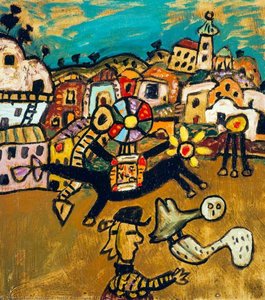 Village Witch (Opus O.1263)1994
19
 Magic Casket1997 · Scottish National Gallery of Modern Art
20
 Celtic Landscape (Dreamscape)1996 · The Pier Arts Centre
21
 Magic Landscape (Opus O.1337)1996
22
 The Alchemist's Mirror No.1 (Opus 1357)1997
23
 Cosmic Signals I2000
24
 Cosmic Signals No.72000
25
 The Golden Palace1999
26
 Magician's Mirror No.22000 · The Mercer Art Gallery
27
 Serpent's Idea of a Horse2000
28
 The Magician's Mirror No.3 (Opus 1450)2000
29
 Without Devices2004 · Pembroke College Oxford Jcr Art Collection
30
 Around and Around in the Pink캐나다 국립 미술관
31
 Kaleidoscope for a Parrot
32
 Prize for a Serpent
33
 Flowers on a TableThe Fleming Collection
34Prophet in a Tree, 1963피츠윌리엄 칼리지
35
 Double MonumentRobinson College
36
 Hallucination with Monster and Cock
이 페이지에 있는 작품을 가장 많이 소장하고 있는 8개의 미술관
| 소장 미술관 | 도시 | Alan Davie의 작품 | 이 목록의 작품들 |
|---|---|---|---|
 The Pier Arts Centre |
Stromness | 2 | Symbols in a Landscape, Celtic Landscape (Dreamscape) |
 University of Hertfordshire |
North Hatley | 1 | Hopi Studies No.32, Opus 0.1173 |
 Scottish National Gallery of Modern Art |
에든버러 | 1 | Magic Casket |
 The Mercer Art Gallery |
하로게이트 | 1 | Magician's Mirror No.2 |
 Pembroke College Oxford Jcr Art Collection |
Oxford | 1 | Without Devices |
 캐나다 국립 미술관 |
오타와 | 1 | Around and Around in the Pink |
 The Fleming Collection |
London | 1 | Flowers on a Table |
 피츠윌리엄 칼리지 |
Cambridge | 1 | Prophet in a Tree, 1963 |
그 시대를 정의하는 오리지널 작품을 만나보려면 연대를 선택하세요.


Woman Arranging Flowers (1945). 다음은 Untitled Abstract와(과) Self Portrait with Brushes (1937)입니다.
25세: Woman Arranging Flowers은(는) 1945년 작품이며, Alan Davie은(는) 1920년에 태어났습니다.
Woman Arranging Flowers, Untitled Abstract, Self Portrait with Brushes, The Saint, Entrance to a Paradise, Jingling Space, Ram Grip, Piggy Chain, Joy Bag No. 1 및 Entrance For A Red Temple No. 4. 위 순위는 각 작품의 제작 연도와 소장 박물관을 나타냅니다.
저희 카탈로그에는 1937년부터 2004년 사이의 Alan Davie 작가의 작품 36점이 수록되어 있습니다.
대부분 The Pier Arts Centre (Stromness), University of Hertfordshire (North Hatley) 및 Scottish National Gallery of Modern Art (에든버러)에 소장되어 있습니다. 위의 박물관 목록에서 전체 목록을 확인하실 수 있습니다.
1990s 동안: 이 페이지의 총 36점의 작품 중 10점이 해당 시기에 제작되었으며, 그중 Hopi Studies No.32, Opus 0.1173점입니다.
이 페이지에서 가장 오래된 작품은 Self Portrait with Brushes (1937)이며, 가장 최근 작품은 Without Devices (2004)입니다.
이 페이지의 원작들을 기준으로 볼 때, Abstract expressionism
Symbols in a Landscape 및 Celtic Landscape (Dreamscape): The Pier Arts Centre, Stromness은(는) 이 페이지에 있는 작품 중 2점을 소장하고 있습니다.