The Versatile Legacy of Thomas Eyre Macklin
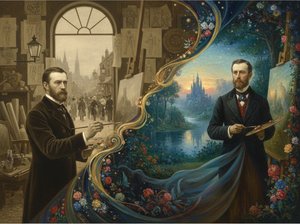
In the rich tapestry of British art history, few figures embody the transition from Victorian sentiment to modern elegance as gracefully as Thomas Eyre Macklin. Born on March 30, 1863, in the industrial and cultural heart of Newcastle upon Tyne, Macklin emerged from a world steeped in the meticulous observation of the late nineteenth century. His artistic journey was not merely a career but an eighty-year odyssey that saw him masterfully navigate the shifting tides of aesthetic movements, moving from the emotive depths of Romanticism to the streamlined sophistication of Art Deco. As a painter in oils and watercolor, illustrator, and sculptor, Macklin possessed a rare polymathic ability to translate the soul of the British landscape and the gravity of civic memory into enduring physical forms.
The foundations of Macklin’s talent were laid within the prestigious halls of the Royal Academy Schools and nurtured by an environment rich with artistic lineage. His early training was profoundly shaped by the influence of masters such as George Frederic Watts and William Ord Kendall. From Watts, Macklin inherited a fascination with symbolism and the spiritual weight of subject matter, a quality that would later infuse his landscapes with a sense of the sublime. This period of his life was characterized by a rigorous commitment to the Victorian ethos, where every brushstroke served to document the grandeur of nature and the dignity of the human form, often through delicate black-and-white illustrations that captured the imagination of readers across the United Kingdom.
A Visionary of Landscape and Form
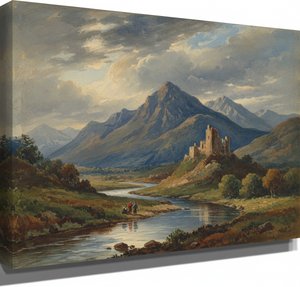
As his career matured, Macklin became a celebrated chronicler of the Northumberland countryside. His landscape paintings are far more than mere topographical records; they are atmospheric meditations on peace and permanence. In works such as ‘Whittle Mill’, created in 1904, one can witness his mastery of light and shadow. Through a palette of soft, muted tones and a keen eye for atmospheric perspective, he transformed scenes of riverbanks and bridges into tranquil sanctuaries. These paintings often featured the quiet rhythms of community life—a mother with her child or figures moving through a pastoral setting—imbued with an emotional resonance that invited the viewer to find stillness within the canvas.
However, Macklin’s creative spirit was never confined to the two-dimensional plane. He possessed a monumental drive that found expression in the heavy, tactile medium of sculpture. This facet of his work allowed him to engage with the public consciousness on a civic scale. His ability to design monuments for significant historical events brought a sense of permanence to the urban landscapes of Northern England. Notable achievements include:
- The South African War Memorial: A profound bronze tribute located in Newcastle Cathedral, which stands as a testament to his ability to embody Victorian ideals of patriotism and sacrifice.
- Civic Portraiture: His realistic oil paintings, such as ‘Portrait of an Alderman’, showcased his skill in capturing the character and social standing of the era's influential figures through rich textures and academic precision.
- Art Deco Innovations: In the twentieth century, Macklin successfully pivoted toward the burgeoning Art Deco movement, applying a new sense of geometric elegance and decorative flair to his sculptural commissions.
An Enduring Artistic Impression
The historical significance of Thomas Eyre Macklin lies in his role as a bridge between eras. He was an artist who could honor the traditions of the past while fearlessly embracing the stylistic revolutions of the future. Whether he was signing his work as T. Eyre Macklin or T.E. Macklin, his hand was recognizable for its ability to balance meticulous detail with expressive movement. His life, which concluded in 1943 in Budleigh Salterton, Devon, left behind a legacy that spans the breadth of British artistic evolution.
Today, collectors and scholars look to Macklin not just as a regional master of Newcastle, but as a significant figure whose work captures the very essence of a changing Britain. From the romanticized, misty hills of his early landscapes to the bold, structured monuments of his later years, Macklin’s oeuvre remains a vital window into the aesthetic soul of the late nineteenth and early twentieth centuries.
질의응답
Thomas Eyre Macklin의 작품 중 몇 점을 둘러보실 수 있나요?
모든 작품 보기 페이지에서 Thomas Eyre Macklin의 작품 작품 14점점을 만나보실 수 있습니다.
Thomas Eyre Macklin 작가는 어떤 사조에 참여했나요?
모든 사조 페이지에서는 Thomas Eyre Macklin의 작품을 예술 사조별로 모아 볼 수 있습니다.
Thomas Eyre Macklin의 작품을 색상별로 모아둔 곳은 어디인가요?
Thomas Eyre Macklin의 작품은 작가의 색상별 인덱스 페이지에서 색상별로 살펴보실 수 있습니다.
Thomas Eyre Macklin의 모든 작품은 어디에서 볼 수 있나요?
본 웹사이트에 등록된 Thomas Eyre Macklin의 모든 작품은 작가의 모든 작품 보기 페이지에서 확인하실 수 있습니다.
Thomas Eyre Macklin 작품의 연도별 타임라인이 있나요?
Thomas Eyre Macklin의 작품을 연도별로 정리하여 보여주는 작품 연대기 페이지입니다.
Thomas Eyre Macklin의 작품 중 조회수가 가장 높은 것은 무엇인가요?
Thomas Eyre Macklin의 통계 페이지에서는 본 웹사이트에 등록된 작가의 작품들을 바탕으로 산출된 통계 정보를 제공합니다.
Thomas Eyre Macklin은(는) 어느 시대에 활동했나요?
Thomas Eyre Macklin은(는) 19th Century 시대에 활동했습니다. 이 시기는 역사적 맥락에서 작가의 활동 위치를 보여줍니다.