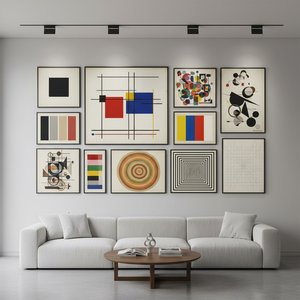
A Journey of Form and Color: The Life of Regina Aprijaskis
The life of Regina Aprijaskim is a fascinating tapestry woven from diverse cultural threads, stretching from the historic streets of Bordeaux to the vibrant landscapes of Peru and Bulgaria. Born in France in 1919, her early childhood was marked by movement; a brief, formative period spent in Lima, Peru, between the ages of five and ten, left an indelible mark on her artistic soul long before she ever picked up a brush. Following her family's return to Bulgaria, where she received a disciplined education under French monks, Aprijaskis eventually found her way back to the heart of South American modernism. This unique migratory path allowed her to synthesize European structural sensibilities with the rhythmic energy of Latin American art, creating a perspective that was both globally informed and deeply rooted in the Peruvian tradition.
Her formal artistic training began in the prestigious School of Fine Arts in Lima, where she immersed herself in the foundations of classical and figurative painting. Under the tutelage of masters such as Camillo Blas and José Sabogal, she mastered the nuances of form and the human figure, working on nude studies that demanded a rigorous understanding of anatomy and light. It was during this period that she forged significant connections with other luminaries of the era, including the celebrated Julia Codesido. These early years were characterized by a mastery of the figurative, yet beneath the surface of her academic training, a yearning for a more primal, structural language was beginning to take shape.
The Evolution Toward Geometric Abstraction
The true metamorphosis of Aprijaskis’s style occurred when her gaze turned toward the international avant-garde. Traveling to New York in the 1950s, she encountered the monumental presence of Mark Rothko and Barnett Newman. The profound emotional resonance of their color fields and the spiritual weight of their expansive canvases acted as a catalyst for her departure from figuration. This evolution was further solidified in the 1960s through her participation in the workshop of the abstract expressionist Theodoros Stamos. It was here that the seeds of geometric abstraction were sown, as she began to strip away the anecdotal elements of painting to focus on the pure, rationalist power of shape and line.
This transition culminated in her celebrated Paracas Series, which debuted at the Institute of Contemporary Art of Lima in 1968. This exhibition was a watershed moment, recognized by critics like Juan Acha for its vanguard spirit. Her work began to embody the principles of constructivism, utilizing bold, vibrant colors and precise geometric arrangements to create a sense of architectural balance. The paintings were no longer mere representations of reality but were instead self-contained universes of logic and light. As the critic Jorge Villacorta noted, her contributions represented one of the most solid proposals of geometric abstraction within the Peruvian visual arts landscape.
Legacy and Artistic Significance
The enduring legacy of Regina Aprijaskis lies in her ability to bridge the gap between the expressive freedom of abstract expressionism and the disciplined rigor of constructivist thought. Her work remains a cornerstone of modern Peruvian art, offering a sophisticated dialogue between movement and stillness. Through her use of:
- Geometric Abstraction: A commitment to the purity of form and the reduction of subject matter to its essential elements.
- Constructivist Principles: The creation of structured, balanced compositions that emphasize the physical reality of the canvas.
- Chromatic Vibrancy: An emotive use of color that breathes life into rigid shapes, preventing them from becoming static.
Today, her masterpieces are preserved in esteemed institutions such as the MAC-Lima Museum, serving as a testament to a life spent exploring the boundaries of perception. Aprijaskis did not merely adopt a style; she constructed a visual language that remains as vital and intellectually stimulating today as it was during the height of the mid-century modern movement.