The Luminous Legacy of Niccolò da Varallo
In the heart of the Italian Renaissance, where light and shadow began to dance with newfound realism, the name Niccolò da Varallo emerges as a master of brilliance. Born around 1425 in the rugged beauty of Varallo della Val d'Oro, Lombardy, his very lineage was steeped in the alchemy of color. As the son of Leonardo da Varallo, a skilled glassmaker, Niccolò inherited more than just a family name; he inherited a profound understanding of how light interacts with medium, a gift that would later define his revolutionary approach to stained glass and frescoes.
While much of his early life remains veiled in the mists of history, his artistic trajectory was undoubtedly shaped by the vibrant cultural currents of Milan. It is believed that he refined his craft under the tutelage of Maestro Giovanni Battista Sant'Anna, a prominent figure in Milanese painting. This mentorship provided Niccolò with a bridge between the meticulous, ornamental traditions of the Gothic era and the burgeoning humanism of the Renaissance. Through this training, he mastered the ability to weave complex theological narratives into visual tapestries that were as much about spiritual transcendence as they were about technical precision.
A Master of Light and Glass
Niccolò’s most enduring contribution to the art world lies in his breathtaking stained-glass commissions for the Milan Cathedral. In these works, he transcended the traditional boundaries of the medium, moving away from static, flat designs toward a more dynamic and emotive storytelling style. His panels are not merely windows but portals into the divine, characterized by a fusion of Venetian color palettes and Gothic geometric intricacy.
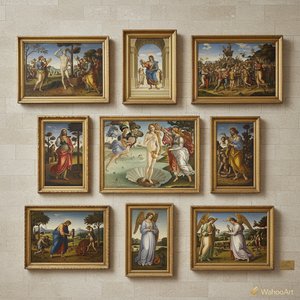
His mastery is perhaps most evident in his depictions of the life of Saint John of Damascus. Through these glass narratives, Niccolò captured moments of profound spiritual weight with an almost cinematic quality:
- The Ordination of Saint John of Damascus: In this stunning panel, Varallo utilizes the interplay of light to depict a pivotal moment in Byzantine theology, using color to evoke the sanctity of the ritual.
- Saint John of Damascus Receives the Prince: Here, the artist demonstrates his ability to render complex human interactions and regal dignity through the delicate manipulation of glass textures.
- The Miracle of the Reattached Hand: Perhaps one of his most captivating scenes, this panel depicts the miraculous reattachment of Saint John's hand, a feat of storytelling that uses vibrant hues to emphasize the divine intervention and the awe of the witnessing monks.
Historical Significance and Artistic Spirit
The work of Niccolò da Varallo represents a crucial evolutionary step in late medieval and early Renaissance art. He stood at the crossroads of two worlds, maintaining the decorative splendor of the Gothic tradition while embracing the emerging realism and emotional depth of the Renaissance. His ability to manipulate light—the very essence of stained glass—allowed him to create works that felt alive, breathing with the changing sunbeams that passed through the Milan Duomo.
Though his name may not carry the same immediate recognition as the giants of the High Renaissance, his influence on the decorative arts and ecclesiastical storytelling is immeasurable. He remains a testament to the power of craftsmanship, proving that when the precision of a glassmaker meets the soul of a painter, the result is an eternal glow that survives centuries of shadow.