미네 오쿠보의 초상화

미네 오쿠보 회화: 갤러리의 시선으로 선별한 가장 유명한 작품 72선

11월 2026 업데이트 · 인기 점수 기준 순위 (각 작품의 검색, 방문 및 주문 수) · 72점의 미네 오쿠보 작품 (당사 카탈로그 기준)

요약하자면

갤러리가 선정한 미네 오쿠보의 가장 유명한 작품은 (3 Women Going to Church) (1948)이며, 원작은 로스앤젤레스의 Japanese American National Museum에 전시되어 있습니다. Walking over muddy ground, Central Utah Relocation Project, Topaz, Utah, 1942-1944 (1944)와 Teaching art classes, Tanforan Assembly Center, San Bruno, California, 1942 (1944)가 더해져 누구나 한눈에 알아볼 수 있는 완벽한 트리오를 완성합니다. 미네 오쿠보의 작품 72점 중, 갤러리는 가장 유명한 72점을 아래와 같이 소개합니다. 각 작품은 제작 연도, 소장 미술관 및 작품의 특징을 포함한 독창적인 원작입니다.

1912 – 2001, 리버사이드 Social realism 최다 소장처: Japanese American National Museum

갤러리 베스트 10 미네 오쿠보 작품

1
(3 Women Going to Church) (1948) 의 미네 오쿠보

(3 Women Going to Church)

1948 · Gouache · Japanese American National Museum, 로스앤젤레스

Three women move toward the viewer, their bodies rendered as simplified, rectangular forms. They walk in a somber line, heads bowed under the weight of a quiet gravity. In their hands, they hold books, small anchors of faith against the surrounding bleakness. The figures are heavy with a sense of shared purpose, their rounded features catching subtle highlights amidst a landscape of muted blues and browns.

2
Walking over muddy ground, Central Utah Relocation Project, Topaz, Utah, 1942-1944 (1944) 의 미네 오쿠보

Walking over muddy ground, Central Utah Relocation Project, Topaz, Utah, 1942-1944

1944 · Drawing · Japanese American National Museum, 로스앤젤레스

Miné Okubo’s “Walking Over Muddy Ground, Central Utah Relocation Project, Topaz, Utah, 1942-1944” isn't merely a depiction of a landscape; it’s a distilled essence of hardship, determination, and the quiet dignity of a people displaced. Rendered in stark black and white, the drawing captures a pivotal moment within the Topaz War Relocation Center—a microcosm of the larger narrative of Japanese American internment during World War II. The image immediately draws…

3
Teaching art classes, Tanforan Assembly Center, San Bruno, California, 1942 (1944) 의 미네 오쿠보

Teaching art classes, Tanforan Assembly Center, San Bruno, California, 1942

1944 · Ink On Paper · Japanese American National Museum, 로스앤젤레스

In this work, titled Teaching art classes, Tanforan Assembly Center, San Bruno, California, 1942, the artist Miné Okubo captures a quiet, instructional moment within the confines of a relocation center. Created in 1944, the piece offers a view into the daily life of Japanese Americans during the wartime era. It is a document of a specific time and place, recorded through the eyes of someone who lived through the experience…

4
Posting of Civilian Exclusion Order/Evacuation Order No. 19, Berkeley, California, 1942 (1944) 의 미네 오쿠보

Posting of Civilian Exclusion Order/Evacuation Order No. 19, Berkeley, California, 1942

1944 · Acrylic On Canvas · Japanese American National Museum, 로스앤젤레스

Miné Okubo's "Posting of Civilian Exclusion Order/Evacuation Order No. 19, Berkeley, California, 1942" isn’t merely a historical document rendered in ink and paper; it’s a visceral embodiment of fear, uncertainty, and the profound disruption inflicted upon Japanese Americans during World War II. Created in 1942, amidst the escalating anxieties of wartime America, this powerful black-and-white drawing captures a pivotal moment – the public announcement of an evacuation order that would…

5
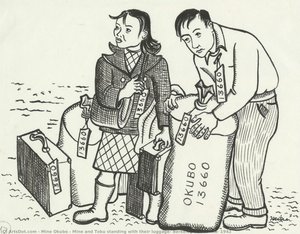
Mine and Toku standing with their luggage, Berkeley, California, 1942 (1944) 의 미네 오쿠보

Mine and Toku standing with their luggage, Berkeley, California, 1942

1944 · Acrylic On Paper · Japanese American National Museum, 로스앤젤레스

Miné Okubo's "Mine and Toku Standing with Their Luggage, Berkeley, California, 1942" isn’t merely a photograph; it’s a distilled essence of experience, a poignant snapshot frozen in time during a profoundly unsettling chapter of American history. Created in 1944, shortly after the internment of Japanese Americans following Pearl Harbor, this deceptively simple drawing offers an intimate and deeply affecting glimpse into the lives of two individuals – Miné and her…

6
Community toilets, Tanforan Assembly Center, San Bruno, California, 1942 (1944) 의 미네 오쿠보

Community toilets, Tanforan Assembly Center, San Bruno, California, 1942

1944 · Ink On Paper · Japanese American National Museum, 로스앤젤레스

Miné Okubo's "Community Toilets, Tanforan Assembly Center, San Bruno, California, 1942" is far more than a simple depiction of a utilitarian space. It’s a poignant and profoundly moving testament to the everyday realities faced by Japanese Americans unjustly incarcerated during World War II. Rendered in stark black ink on white paper, the artwork transcends its subject matter to become a powerful symbol of loss, dignity, and quiet resilience within a…

7
Mine and Toku arrive in their barrack, Central Utah Relocation Project, Topaz, Utah, 1942 (1944) 의 미네 오쿠보

Mine and Toku arrive in their barrack, Central Utah Relocation Project, Topaz, Utah, 1942

1944 · Acrylic On Canvas · Japanese American National Museum, 로스앤젤레스

Miné Okubo's "Mine and Toku arrive in their barrack, Central Utah Relocation Project, Topaz, Utah, 1942" isn’t merely a drawing; it’s a distilled essence of trauma, displacement, and the quiet dignity of survival. Created during her forced incarceration at the Topaz War Relocation Center in 1942, this stark black-and-white image offers an intimate glimpse into a profoundly unsettling chapter of American history – the unjust internment of Japanese Americans during…

8
Eating lunch while awaiting departure inside the Civil Control Station, Berkeley, California, 1942 (1944) 의 미네 오쿠보

Eating lunch while awaiting departure inside the Civil Control Station, Berkeley, California, 1942

1944 · Acrylic On Canvas · Japanese American National Museum, 로스앤젤레스

Miné Okubo's "Eating Lunch while awaiting departure inside the Civil Control Station, Berkeley, California, 1942" isn't merely a depiction of a scene; it’s a distilled essence of wartime anxiety and the profound human cost of forced displacement. Created during a period of immense upheaval – the incarceration of Japanese Americans following Pearl Harbor – this black-and-white pen and ink drawing transcends its documentary origins to become a poignant meditation on…

9
Medical exam in laundry building, Central Utah Relocation Project, Topaz, Utah, 1942 (1944) 의 미네 오쿠보

Medical exam in laundry building, Central Utah Relocation Project, Topaz, Utah, 1942

1944 · Ink · Japanese American National Museum, 로스앤젤레스

The scene unfolds within the stark confines of a laundry building at the Topaz War Relocation Center. Here, in "Medical exam in laundry building, Central Utah Relocation Project, Topaz, Utah, 1942," the artist Miné Okubo captures a moment of quiet, clinical scrutiny. The air feels heavy with the weight of the surrounding enclosure, a space where the routine of a medical examination meets the lived reality of the Topaz camp.…

10
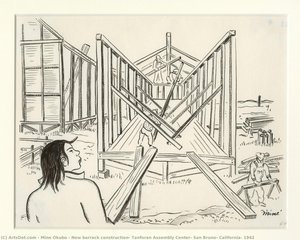
New bachelor dorms at Barrack 14, Tanforan Assembly Center, San Bruno, California, 1942 (1944) 의 미네 오쿠보

New bachelor dorms at Barrack 14, Tanforan Assembly Center, San Bruno, California, 1942

1944 · Acrylic On Canvas · Japanese American National Museum, 로스앤젤레스

Within the stark, geometric confines of the Tanforan Assembly Center during World War II, Miné Okubo captured a poignant and enduring moment – “New Bachelor Dorms at Barrack 14.” This deceptively simple ink-on-paper illustration transcends mere documentation; it’s a testament to human dignity amidst displacement, a quiet observation of daily life within the shadow of internment. Created in 1942-1944, during a period of immense upheaval for Japanese Americans, Okubo's work…

11위부터 72위까지의 미네 오쿠보 작품

11Army blanket distribution, Central Utah Relocation Project, Topaz, Utah, 1942 (1944) 의 미네 오쿠보Army blanket distribution, Central Utah Relocation Project, Topaz, Utah, 19421944 · Japanese American National Museum 12Obtaining drinking water, Central Utah Relocation Project, Topaz, Utah, 1942-1944 (1944) 의 미네 오쿠보Obtaining drinking water, Central Utah Relocation Project, Topaz, Utah, 1942-19441944 · Japanese American National Museum 13Working at the Topaz Times, Central Utah Relocation Project, Topaz, Utah, 1942 (1944) 의 미네 오쿠보Working at the Topaz Times, Central Utah Relocation Project, Topaz, Utah, 19421944 · Japanese American National Museum 14Teacher and students in classroom, Central Utah Relocation Project, Topaz, Utah, 1942-1944 (1944) 의 미네 오쿠보Teacher and students in classroom, Central Utah Relocation Project, Topaz, Utah, 1942-19441944 · Japanese American National Museum 15Waiting in line to receive vaccinations, Tanforan Assembly Center, San Bruno, California, 1942 (1944) 의 미네 오쿠보Waiting in line to receive vaccinations, Tanforan Assembly Center, San Bruno, California, 19421944 · Japanese American National Museum 16Mosquitos and flies in the barracks, Central Utah Relocation Project, Topaz, Utah, 1942-1944 (1944) 의 미네 오쿠보Mosquitos and flies in the barracks, Central Utah Relocation Project, Topaz, Utah, 1942-19441944 · Japanese American National Museum 17Observing camp activities from a rooftop, Tanforan Assembly Center, San Bruno, California, 1942 (1944) 의 미네 오쿠보Observing camp activities from a rooftop, Tanforan Assembly Center, San Bruno, California, 19421944 · Japanese American National Museum 18Bus ride to Central Utah Relocation Project, Topaz, Utah, 1942 (1944) 의 미네 오쿠보Bus ride to Central Utah Relocation Project, Topaz, Utah, 19421944 · Japanese American National Museum 19Listening to radio announcement of bombing of Pearl Harbor, with brother Toku, Berkeley, California, 1941 (1944) 의 미네 오쿠보Listening to radio announcement of bombing of Pearl Harbor, with brother Toku, Berkeley, California, 19411944 · Japanese American National Museum 20Registering at the Civil Control Station at Pilgrim Hall of the First Congregational Church, Berkeley, California, 1942 (1944) 의 미네 오쿠보Registering at the Civil Control Station at Pilgrim Hall of the First Congregational Church, Berkeley, California, 19421944 · Japanese American National Museum 21Arrival at Tanforan Assembly Center, San Bruno, California, 1942 (1944) 의 미네 오쿠보Arrival at Tanforan Assembly Center, San Bruno, California, 19421944 · Japanese American National Museum 22Waiting in line for supper, Tanforan Assembly Center, San Bruno, California, 1942 (1944) 의 미네 오쿠보Waiting in line for supper, Tanforan Assembly Center, San Bruno, California, 19421944 · Japanese American National Museum 23Induction at Central Utah Relocation Project, Topaz, Utah, 1942 (1944) 의 미네 오쿠보Induction at Central Utah Relocation Project, Topaz, Utah, 19421944 · Japanese American National Museum 24[Untitled] (1977) 의 미네 오쿠보[Untitled]1977 · Japanese American National Museum 25New barrack construction, Tanforan Assembly Center, San Bruno, California, 1942 (1944) 의 미네 오쿠보New barrack construction, Tanforan Assembly Center, San Bruno, California, 19421944 · Japanese American National Museum 26Arrival of evacuees from Hawaii, Central Utah Relocation Project, Topaz, Utah, 1942-1944 (1944) 의 미네 오쿠보Arrival of evacuees from Hawaii, Central Utah Relocation Project, Topaz, Utah, 1942-19441944 · Japanese American National Museum 27Carrying mattresses to the barrack, Central Utah Relocation Project, Topaz, Utah, 1942 (1944) 의 미네 오쿠보Carrying mattresses to the barrack, Central Utah Relocation Project, Topaz, Utah, 19421944 · Japanese American National Museum 28Eating in the mess hall, Central Utah Relocation Project, Topaz, Utah, 1942-1944 (1944) 의 미네 오쿠보Eating in the mess hall, Central Utah Relocation Project, Topaz, Utah, 1942-19441944 · Japanese American National Museum 29Mine with open newspaper, surrounded by anti-Japanese slogans, Berkeley, California, 1941 (1944) 의 미네 오쿠보Mine with open newspaper, surrounded by anti-Japanese slogans, Berkeley, California, 19411944 · Japanese American National Museum 30Scavenging lumber to build furniture, Central Utah Relocation Project, Topaz, Utah, 1942 (1944) 의 미네 오쿠보Scavenging lumber to build furniture, Central Utah Relocation Project, Topaz, Utah, 19421944 · Japanese American National Museum 31Landscaping with trees, Central Utah Relocation Project, Topaz, Utah, 1942-1944 (1944) 의 미네 오쿠보Landscaping with trees, Central Utah Relocation Project, Topaz, Utah, 1942-19441944 · Japanese American National Museum 32Snowball fight, Central Utah Relocation Project, Topaz, Utah, 1942-1944 (1944) 의 미네 오쿠보Snowball fight, Central Utah Relocation Project, Topaz, Utah, 1942-19441944 · Japanese American National Museum 33Families preparing for evacuation, Berkeley, California, 1942 (1944) 의 미네 오쿠보Families preparing for evacuation, Berkeley, California, 19421944 · Japanese American National Museum 34First night at Tanforan Assembly Center, San Bruno, California, 1942 (1944) 의 미네 오쿠보First night at Tanforan Assembly Center, San Bruno, California, 19421944 · Japanese American National Museum 35Mine and Toku assemble cots, Tanforan Assembly Center, San Bruno, California, 1942 (1944) 의 미네 오쿠보Mine and Toku assemble cots, Tanforan Assembly Center, San Bruno, California, 19421944 · Japanese American National Museum 36Awaiting registration at the Civil Control Station at Pilgrim Hall of the First Congregational Church, Berkeley, California, 1942 (1944) 의 미네 오쿠보Awaiting registration at the Civil Control Station at Pilgrim Hall of the First Congregational Church, Berkeley, California, 19421944 · Japanese American National Museum 37Waiting to disembark from the bus at Tanforan Assembly Center, San Bruno, California, 1942 (1944) 의 미네 오쿠보Waiting to disembark from the bus at Tanforan Assembly Center, San Bruno, California, 19421944 · Japanese American National Museum 38Dining with friends in Berkeley, California, ca.1939-1941 (1944) 의 미네 오쿠보Dining with friends in Berkeley, California, ca.1939-19411944 · Japanese American National Museum 39Mine at train station in Berne, Switzerland, 1939 (1944) 의 미네 오쿠보Mine at train station in Berne, Switzerland, 19391944 · Japanese American National Museum 40Arrival at Central Utah Relocation Project, Topaz, Utah, 1942 (1944) 의 미네 오쿠보Arrival at Central Utah Relocation Project, Topaz, Utah, 19421944 · Japanese American National Museum 41[Untitled] (1978) 의 미네 오쿠보[Untitled]1978 · Japanese American National Museum 42Interior view of Mine and Toku (1944) 의 미네 오쿠보Interior view of Mine and Toku1944 · Japanese American National Museum 43Luggage delivery truck, Tanforan Assembly Center, San Bruno, California, 1942 (1944) 의 미네 오쿠보Luggage delivery truck, Tanforan Assembly Center, San Bruno, California, 19421944 · Japanese American National Museum 44Mine and Toku are shown to their barrack, Tanforan Assembly Center, San Bruno, California, 1942 (1944) 의 미네 오쿠보Mine and Toku are shown to their barrack, Tanforan Assembly Center, San Bruno, California, 19421944 · Japanese American National Museum 45Unfinished camp construction, Central Utah Relocation Project, Topaz, Utah, 1942 (1944) 의 미네 오쿠보Unfinished camp construction, Central Utah Relocation Project, Topaz, Utah, 19421944 · Japanese American National Museum 46Mine reads newspaper announcing war declaration against Japan, Berkeley, California, 1941 (1944) 의 미네 오쿠보Mine reads newspaper announcing war declaration against Japan, Berkeley, California, 19411944 · Japanese American National Museum 47Walking with guide to Barrack 16, Room 50, Tanforan Assembly Center, San Bruno, California, 1942 (1944) 의 미네 오쿠보Walking with guide to Barrack 16, Room 50, Tanforan Assembly Center, San Bruno, California, 19421944 · Japanese American National Museum 48[Untitled] (1978) 의 미네 오쿠보[Untitled]1978 · Japanese American National Museum 49Interior of Mine and Toku (1944) 의 미네 오쿠보Interior of Mine and Toku1944 · Japanese American National Museum 50[Untitled] (1970) 의 미네 오쿠보[Untitled]1970 · Japanese American National Museum 51Receiving hostile looks while traveling by bus, Berkeley, California, 1941-42 (1944) 의 미네 오쿠보Receiving hostile looks while traveling by bus, Berkeley, California, 1941-421944 · Japanese American National Museum 52Mine and Toku preparing for departure, Berkeley, California, 1942 (1944) 의 미네 오쿠보Mine and Toku preparing for departure, Berkeley, California, 19421944 · Japanese American National Museum 53Returning home for curfew, Berkeley, California, 1942 (1944) 의 미네 오쿠보Returning home for curfew, Berkeley, California, 19421944 · Japanese American National Museum 54Mail-order clothing from Sears Roebuck, Central Utah Relocation Project, Topaz, Utah, 1942-1944 (1944) 의 미네 오쿠보Mail-order clothing from Sears Roebuck, Central Utah Relocation Project, Topaz, Utah, 1942-19441944 · Japanese American National Museum 55[Untitled] (1969) 의 미네 오쿠보[Untitled]1969 · Japanese American National Museum 56[Untitled] (1968) 의 미네 오쿠보[Untitled]1968 · Japanese American National Museum 57Rocky Ladies ? (1977) 의 미네 오쿠보Rocky Ladies ?1977 · Japanese American National Museum 58Bachelor (1944) 의 미네 오쿠보Bachelor1944 · Japanese American National Museum 59[Untitled] (1969) 의 미네 오쿠보[Untitled]1969 · Japanese American National Museum 60[Untitled] (1974) 의 미네 오쿠보[Untitled]1974 · Japanese American National Museum 61Victory gardens, Central Utah Relocation Project, Topaz, Utah, 1942-1944 (1944) 의 미네 오쿠보Victory gardens, Central Utah Relocation Project, Topaz, Utah, 1942-19441944 · Japanese American National Museum 62Trimming grass inside living quarters, Tanforan Assembly Center, San Bruno, California, 1942 (1944) 의 미네 오쿠보Trimming grass inside living quarters, Tanforan Assembly Center, San Bruno, California, 19421944 · Japanese American National Museum 63Departure postings at the Civil Control Station, Berkeley, California, 1942 (1944) 의 미네 오쿠보Departure postings at the Civil Control Station, Berkeley, California, 19421944 · Japanese American National Museum 64Medical exam at Tanforan Assembly Center, San Bruno, California, 1942 (1944) 의 미네 오쿠보Medical exam at Tanforan Assembly Center, San Bruno, California, 19421944 · Japanese American National Museum 65Mine and Toku sweep the stall, Tanforan Assembly Center, San Bruno, California, 1942 (1944) 의 미네 오쿠보Mine and Toku sweep the stall, Tanforan Assembly Center, San Bruno, California, 19421944 · Japanese American National Museum 66Inspection of evacuees for contraband, Tanforan Assembly Center, San Bruno, California, 1942 (1944) 의 미네 오쿠보Inspection of evacuees for contraband, Tanforan Assembly Center, San Bruno, California, 19421944 · Japanese American National Museum 67Relocation notification, Tanforan Assembly Center, San Bruno, California, 1942 (1944) 의 미네 오쿠보Relocation notification, Tanforan Assembly Center, San Bruno, California, 19421944 · Japanese American National Museum 68Receiving room assignments at Tanforan Assembly Center, San Bruno, California, 1942 (1944) 의 미네 오쿠보Receiving room assignments at Tanforan Assembly Center, San Bruno, California, 19421944 · Japanese American National Museum 69Waiting to use the washrooms, Central Utah Relocation Project, Topaz, Utah, 1942-1944 (1944) 의 미네 오쿠보Waiting to use the washrooms, Central Utah Relocation Project, Topaz, Utah, 1942-19441944 · Japanese American National Museum 70Rest stop with military police, Nevada, 1942 (1944) 의 미네 오쿠보Rest stop with military police, Nevada, 19421944 · Japanese American National Museum 71무제표 (1978) 의 미네 오쿠보무제표1978 · Japanese American National Museum 72Shopping at the canteen, Tanforan Assembly Center, San Bruno, California, 1942 (1944) 의 미네 오쿠보Shopping at the canteen, Tanforan Assembly Center, San Bruno, California, 19421944 · Japanese American National Museum

미네 오쿠보의 시대별 명작

미네 오쿠보의 시선을 사로잡은 주제들

이 오리지널 작품들에서 가장 자주 등장하는 네 가지 주제와 그 정수를 보여주는 대표작들.

미네 오쿠보의 원작을 소장하고 있는 미술관

이 페이지에 있는 작품을 가장 많이 소장하고 있는 1개의 미술관

소장 미술관 도시 미네 오쿠보의 작품 이 목록의 작품들
Japanese American National Museum, 로스앤젤레스Japanese American National Museum 로스앤젤레스 72 (3 Women Going to Church), Walking over muddy ground, Central Utah Relocation Project, Topaz, Utah, 1942-1944, Teaching art classes, Tanforan Assembly Center, San Bruno, California, 1942

미네 오쿠보, 10년마다 탄생한 대표작 한 점

연대별 작품 수

그 시대를 정의하는 오리지널 작품을 만나보려면 연대를 선택하세요.

미네 오쿠보의 작품: 갤러리의 해답

미네 오쿠보의 작품 중 가장 유명한 작품은 무엇인가요?정답 확인하기

(3 Women Going to Church) (1948), Japanese American National Museum, 로스앤젤레스. 다음은 Walking over muddy ground, Central Utah Relocation Project, Topaz, Utah, 1942-1944 (1944)와 Teaching art classes, Tanforan Assembly Center, San Bruno, California, 1942 (1944)입니다.

미네 오쿠보이(가) (3 Women Going to Church)을(를) 완성했을 당시의 나이는 몇 살이었나요?정답 확인하기

36세: (3 Women Going to Church)은(는) 1948년 작품이며, 미네 오쿠보은(는) 1912년에 태어났습니다.

미네 오쿠보의 대표작 10점은 무엇인가요?정답 확인하기

(3 Women Going to Church), Walking over muddy ground, Central Utah Relocation Project, Topaz, Utah, 1942-1944, Teaching art classes, Tanforan Assembly Center, San Bruno, California, 1942, Posting of Civilian Exclusion Order/Evacuation Order No. 19, Berkeley, California, 1942, Mine and Toku standing with their luggage, Berkeley, California, 1942, Community toilets, Tanforan Assembly Center, San Bruno, California, 1942, Mine and Toku arrive in their barrack, Central Utah Relocation Project, Topaz, Utah, 1942, Eating lunch while awaiting departure inside the Civil Control Station, Berkeley, California, 1942, Medical exam in laundry building, Central Utah Relocation Project, Topaz, Utah, 1942 및 New bachelor dorms at Barrack 14, Tanforan Assembly Center, San Bruno, California, 1942. 위 순위는 각 작품의 제작 연도와 소장 박물관을 나타냅니다.

미네 오쿠보의 작품은 몇 점인가요?정답 확인하기

저희 카탈로그에는 1944년부터 1978년 사이의 미네 오쿠보 작가의 작품 72점이 수록되어 있습니다.

미네 오쿠보의 가장 유명한 원작들은 어디에 전시되어 있을까요?정답 확인하기

대부분 Japanese American National Museum (로스앤젤레스)에 소장되어 있습니다. 위의 박물관 목록에서 전체 목록을 확인하실 수 있습니다.

미네 오쿠보의 가장 유명한 작품들은 언제 제작되었나요?정답 확인하기

1940s 동안: 이 페이지의 총 72점의 작품 중 62점이 해당 시기에 제작되었으며, 그중 (3 Women Going to Church)점입니다.

미네 오쿠보의 초기 및 후기 대표작은 무엇인가요?정답 확인하기

이 페이지에서 가장 오래된 작품은 Walking over muddy ground, Central Utah Relocation Project, Topaz, Utah, 1942-1944 (1944)이며, 가장 최근 작품은 [Untitled] (1978)입니다.

미네 오쿠보 작가가 가장 자주 다룬 주제는 무엇인가요?정답 확인하기

이 페이지의 72점의 작품에 걸쳐 있는 Resilience (37), Observation (21) 및 Japanese american (16)

미네 오쿠보 작가가 가장 많이 사용한 매체는 무엇인가요?정답 확인하기

이 페이지의 총 72점의 작품 중 34점의 Acrylic On Canvas

미네 오쿠보은(는) 어떤 미술 사조에 속해 있나요?정답 확인하기

이 페이지의 원작들을 기준으로 볼 때, Social realism

Japanese American National Museum이(가) 소장하고 있는 미네 오쿠보의 원작은 무엇인가요?정답 확인하기

(3 Women Going to Church), Walking over muddy ground, Central Utah Relocation Project, Topaz, Utah, 1942-1944 및 Teaching art classes, Tanforan Assembly Center, San Bruno, California, 1942: Japanese American National Museum, 로스앤젤레스은(는) 이 페이지에 있는 작품 중 72점을 소장하고 있습니다.

미네 오쿠보: 작가

회복력으로 새겨진 삶: 미네 오쿠보의 예술

1912년 캘리포니아 리버사이드에서 태어난 미네 오쿠보는 그녀의 삶이 미국 역사의 중대하고 고통스러운 장과 불가분의 관계를 맺게 된 예술가였습니다. 그녀의 이야기는 단순히 예술적 재능에 관한 것이 아니라, 깊은 용기, 흔들림 없는 관찰력, 그리고 증인으로서의 예술의 힘에 관한 것입니다. 창의성을 중요시했던 가정에서 받은 초기 격려—어머니는 숙련된 서예가였고 아버지는 학자였습니다—를 바탕으로 오쿠보는 정규 교육의 길을 걸으며 캘리포니아 대학교 버클리를 졸업했고, 이후 예술적 지평을 넓히기 위해 1938년 유럽으로 향했습니다. 이 공부 기간은 제2차 세계대전이라는 다가오는 그림자에 의해 갑작스럽게 중단되었고, 전 세계적인 긴장이 최고조에 달했을 때 그녀를 미국으로 돌아오게 했습니다. 그녀는 이 귀향이 계속되는 예술적 탐구로 이어질 것이라고는 상상도 못 했으며, 대신 강제 수용과 그녀의 삶과 예술 모두를 정의하게 될 경험을 맞이하게 되었습니다.

증언하기: 벽 안의 예술

진주만 공습은 오쿠보의 삶의 궤적을, 그리고 셀 수 없이 많은 다른 일본계 미국인들의 삶의 궤적을 돌이킬 수 없이 바꾸어 놓았습니다. 1942년, 그녀와 오빠 벤지는 고향에서 쫓겨나 트랜포란 집회 센터라는 개조된 경마장에 부당하게 감금되었고, 그곳은 유타주의 더 영구적인 토파즈 전쟁 수용소로 이송되기 전의 임시 구금 시설이었습니다. 바로 이 가시철망으로 둘러싸인 공간, 먼지와 절망 속에서 오쿠보는 자신의 가장 중요한 예술적 작업을 시작했습니다. 주변 현실을 기록해야 한다는 거의 강박적인 필요에 이끌려, 그녀는 캠프 생활의 놀라운 시각적 기록을 만들기 시작했습니다—펜과 잉크, 수채화, 목탄으로 세심하게 그려낸 2,000점이 넘는 드로잉과 스케치들입니다. 이것들은 거창한 역사화나 이상화된 초상화가 아니었습니다. 그것들은 혼잡한 생활 공간, 관료적인 절차, 걱정과 체념이 새겨진 얼굴들, 그리고 깊은 역경 속의 고요한 존엄의 순간들 등 일상의 존재에 대한 날것 그대로의 정직한 묘사였습니다. 그녀는 빨랫줄에 걸린 빨래, 먼지 속에서 노는 아이들, 식당에서 제공되는 식사 같은 평범한 세부 사항들을 포착하여, 그것들을 회복력과 시민적 자유의 침식에 대한 강력한 진술로 변모시켰습니다. 오쿠보의 예술은 단순한 개인적인 반응이 아니었습니다. 그것은 저항의 행위였고, 침묵하거나 지워지기를 거부하는 의지였습니다.

시민 13660: 비인간화와 희망에 대한 증언

1944년 토파즈에서 풀려난 후, 오쿠보는 자신의 경험을 기념비적인 예술 및 문학 작품인 시민 13660에 녹여냈습니다. 1946년에 출판된 이 책은 그녀의 드로잉 198점과 가슴 아픈 글로 구성되어 있습니다. 제목 자체는 깊은 상징성을 지니고 있으며, 수용 시스템 내에서 자신에게 할당되었던 번호를 언급합니다—그녀와 수많은 사람들이 겪었던 비인간화 과정을 날카롭게 일깨워줍니다. 시민 13660은 단순히 고통의 연대기가 아니었습니다. 그것은 역경에 직면한 인간 정신에 대한 미묘한 묘사였습니다. 오쿠보는 모욕과 부당함을 묘사하는 것을 주저하지 않았지만, 공동체, 유머, 그리고 조용한 힘의 순간들 또한 포착했습니다. 이 드로잉들은 그 직접성, 감정적 깊이, 그리고 선과 그림자의 능숙한 사용으로 특징지어집니다. 이 책은 곧 일본계 미국인 수용 경험을 기록하는 중요한 작품이 되었으며, 많은 사람들이 외면하려 했던 미국 역사의 어두운 장면에 흔들림 없는 시선을 제공했습니다.

이어지는 유산: 사회적 논평으로서의 예술

전쟁 이후, 오쿠보는 뉴욕으로 거처를 옮겨 자신의 예술 경력을 이어갔습니다. 잡지와 책을 위한 프리랜서 일러스트레이터로 활동하고 벽화 프로젝트를 수행했습니다. 그녀는 전쟁 중 작품을 규정했던 사회 정의와 인간 존엄성의 주제들을 완전히 포기하지는 않았지만, 그녀의 스타일은 시간이 지남에 따라 진화했습니다. 그녀는 다양한 매체와 기법을 탐구했지만, 언제나 사실주의와 정직한 관찰에 대한 헌신을 유지했습니다. 오쿠보의 예술적 영향은 다양했으며, 사회 문제를 그리고 일상생활을 흔들림 없는 정확성으로 묘사하는 데 중점을 두었던 사회적 사실주의 운동과 인간 고통에 대한 강력한 묘사로 유명했던 카테 콜비츠와 같은 예술가들에게서 영감을 얻었습니다. 그녀의 경력 전반에 걸쳐, 미국 미술과 문화에 대한 그녀의 공헌의 중요성을 인정받아 국립예술기금 등으로부터 수많은 상과 인정을 받았습니다. 미네 오쿠보는 2001년에 세상을 떠났지만, 오늘날까지도 울려 퍼지는 유산을 남겼습니다. 그녀의 작품은 시민적 자유의 취약성, 편견과 차별에 대한 경계심의 중요성, 그리고 증언하고, 부당함에 도전하며, 희망을 고취하는 예술의 지속적인 힘에 대한 강력한 상기제 역할을 합니다. 그녀의 드로잉들은 단순한 역사적 기록물이 아닙니다. 그것들은 잉크와 수채화로 새겨진 깊이 인간적인 이야기들이며, 우리에게 과거의 실수를 기억하고, 배우고, 결코 반복하지 말라고 요구합니다.