


1

The Musician
The Musician

11월 2026 업데이트 · 인기 점수 기준 순위 (각 작품의 검색, 방문 및 주문 수) · 37점의 루트비히 도이치 작품 (당사 카탈로그 기준)
요약하자면
The Musician은(는) 루트비히 도이치의 작품 중 가장 많은 관심을 받는 회화입니다. 그다음 시선은 In The Mosque와 The Inspection (1883)로 향합니다. 우리 카탈로그에 수록된 루트비히 도이치의 작품 37점 중, 가장 유명한 36점을 소개합니다. 각 작품은 제작 연도, 소장 박물관, 그리고 시대를 초월해 사랑받는 이유와 함께 독창적인 원작으로 제시됩니다.
The Musician

In this oil on canvas, we find ourselves within a space of profound stillness. A man stands at the center of the composition, his hands raised in a gesture of prayer, draped in a long robe and a green turban that provides a singular point of color against the warm, earthy tones of the room. Around him, the architecture speaks of a deep, patterned history. The walls are adorned with…

The Inspection is an Orientalist oil on panel painting by Ludwig Deutsch. Created about 1883, the work captures a solitary Black man in a moment of quiet, focused intensity. He leans toward a dark, rounded object held in both hands, his attention fixed upon its surface. The scene is a study of stillness and the weight of a single, meticulous task.

is an oil on canvas work by Ludwig Deutsch, executed in 1893. The painting presents a Nubian palace guard, rendered with a level of detail that suggests the use of a magnifying glass to achieve such precision. Every link in the figure's chainmail is individually articulated, contributing to the work's intense focus on material accuracy.

The Tribute emerges from the brush of Ludwig Deutsch, a painter who captures a specific, suspended moment of ritual. This oil on panel painting presents a scene of formal ceremony, frozen in time. It dates to about 1900, a period when the artist's focus turned toward the intricate details of the East. The work exists as a physical presence, rendered through the meticulous application of oil on a wooden panel.

The Chess Players is an Orientalist oil on panel painting by Ludwig Deutsch. Created in 1904, this work captures a quiet moment of concentration between two men. They are dressed in traditional Middle Eastern attire, seated together in an intimate setting. The scene is categorized by the themes of men and games.

The Morning Prayer is an Orientalist oil on panel painting created by Ludwig Deutsch. This work dates to 1906. The piece is held in the public domain. The subject matter focuses on a single male figure with a dark beard, positioned in the right mid-ground of an architecturally ornate interior. He is depicted kneeling in prayer with his hands raised in supplication.

The painting titled The Deutsch Smoker features a man seated on a bench in a setting that reflects late 19th or early 20th-century life. The subject is dressed in traditional Middle Eastern attire, including a long robe and a turban. He holds a hookah pipe, appearing relaxed in a space characterized by stone floors and intricate blue and white tile work. To his right, an open doorway reveals another individual…


 d Guard with a Zither Player in an Interior
12
 The Learned
13
 The Arab Guard
14
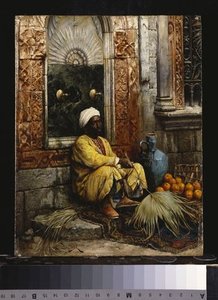 The Orange Seller
15
 The answer
16
 The Sultan's Daughter
17
 The Guards Of The Harem
18
 Moor At Prayer
19
 An Arab Schoolmaster
20
 An Arab With His Servant
21
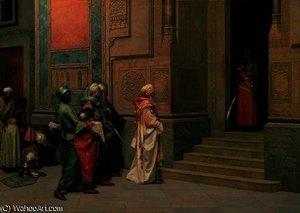 Outside the Palace
22
 Mädchenporträt
23
 The Scribe,
24
 Mosque Interior
25
 Le Maitre
26
 An Arab Family Outside A Village
27
 The_scribe_deutsch
28
 The Palace Guard detail
29
 The Sahleb Vendor And The Chess Game
30
 _mausoleum
31
 The Scribe And The Smoker
32
 El Azhar Arab University Of Cairo
33
 The Furniture Maker Painting
34
 A Nubian Guard And The Palace Guard
35
 The chess game
36
 The Sahleb Vendor, Cairo
이 오리지널 작품들에서 가장 자주 등장하는 네 가지 주제와 그 정수를 보여주는 대표작들.
24년의 긴 여정, 1883년부터 1906년까지: 루트비히 도이치의 가장 유명한 원작들을 연도별로 만나보세요.
연도를 선택하여 원작을 확인해 보세요.
The Inspection is an Orientalist oil on panel painting by Ludwig Deutsch. Created about 1883, the work captures a solitary Black man in a moment of quiet, focused intensity. He leans toward a dark, rounded object held in both hands, his attention fixed upon its surface. The scene is a study of stillness and the weight of a single, meticulous task.
The Tribute emerges from the brush of Ludwig Deutsch, a painter who captures a specific, suspended moment of ritual. This oil on panel painting presents a scene of formal ceremony, frozen in time. It dates to about 1900, a period when the artist's focus turned toward the intricate details of the East. The work exists as a physical presence, rendered through the meticulous application of oil on a wooden panel.
The Chess Players is an Orientalist oil on panel painting by Ludwig Deutsch. Created in 1904, this work captures a quiet moment of concentration between two men. They are dressed in traditional Middle Eastern attire, seated together in an intimate setting. The scene is categorized by the themes of men and games.
The Morning Prayer is an Orientalist oil on panel painting created by Ludwig Deutsch. This work dates to 1906. The piece is held in the public domain. The subject matter focuses on a single male figure with a dark beard, positioned in the right mid-ground of an architecturally ornate interior. He is depicted kneeling in prayer with his hands raised in supplication.
The Musician. 다음은 In The Mosque와(과) The Inspection (1883)입니다.
The Musician, In The Mosque, The Inspection, The Palace Guard, The Tribute, The Chess Players, The Morning Prayer, The Deutsch Smoker, The Smoker 및 The Harem Guard. 위 순위는 각 작품의 제작 연도와 소장 박물관을 나타냅니다.
저희 카탈로그에는 1883년부터 1906년 사이의 루트비히 도이치 작가의 작품 37점이 수록되어 있습니다.
이 페이지에서 가장 오래된 작품은 The Inspection (1883)이며, 가장 최근 작품은 The Morning Prayer (1906)입니다.
이 페이지의 36점의 작품에 걸쳐 있는 Man (4), Turban (4) 및 Architecture (3)
이 페이지의 총 36점의 작품 중 4점의 Oil On Canvas
이 페이지의 원작들을 기준으로 볼 때, Orientalist
Ludwig Deutsch remains one of the most captivating figures of the 19th-century Orientalist movement, an artist whose brush possessed a singular ability to transport the viewer across continents. Born in Vienna into a well-established Jewish family, the son of the financier Ignaz Deutsch, his early life was rooted in the cultural heart of Austria. His artistic journey began with rigorous formal training at the Academy of Fine Arts Vienna, where he studied under the tutelage of Anselm Feuerbach. This academic foundation provided him with the technical precision that would later become his hallmark, allowing him to master the complexities of light, texture, and form long before he turned his gaze toward the exotic landscapes of the East.
In 1878, Deutsch made a pivotal move to Paris, a decision that would fundamentally reshape his artistic identity. It was in this vibrant metropolitan center that he moved away from his Viennese roots and began to align himself with a circle of painters who were captivated by the allure of the Orient. Through friendships with artists such as Rudolf Ernst, Jean Discart, and Arthur von Ferraris, Deutsch found his true calling. While much of his work was meticulously composed within the confines of his studio on the Rue Le Pelletier in Paris, his soul was deeply connected to the distant lands he visited. His documented journeys to Egypt between 1885 and 1898 served as a profound wellspring of inspiration, providing him with the authentic visual vocabulary needed to breathe life into his canvases.
What distinguishes the work of Ludwig Deutsch from many of his contemporaries is the extraordinary level of meticulousness he applied to every surface. He did not merely paint scenes; he constructed worlds. His fascination lay in the intricate ornamentation, the heavy textures of woven textiles, and the architectural grandeur of the Islamic-Egyptian world. To Deutsch, detail was the central character of his narrative. A single painting might feature a breathtaking array of:
This dedication to realism allowed him to capture the unique quality of North African light—a warm, evocative glow that dances across surfaces and creates a sense of profound atmosphere. Whether depicting a solitary scholar in The Learned or the quiet tension within The Harem Guard, his work evokes a sense of stillness and reverence. His ability to blend the academic precision of European training with the vibrant, exotic aesthetics of the Middle East created a subgenre of Orientalism that felt both deeply researched and emotionally resonant.
As his career progressed, Deutsch’s identity became increasingly intertwined with his adopted home. In 1919, he became a French citizen, eventually writing his name as Louis Deutsch. This transition mirrored the evolution of his art, which had moved from the classical traditions of Vienna to a specialized mastery of the Orientalist style. Though the details of his personal life remain somewhat obscure, his artistic legacy is undeniably clear through the enduring impact of his highly detailed, academic compositions.
The historical significance of Ludwig Deutsch lies in his role as a bridge between the European academic tradition and the romanticized fascination with the East. He avoided the mere caricature often found in colonial-era art, opting instead for a profound respect for the material culture and aesthetic beauty of the regions he depicted. Through his eyes, the viewer is invited to witness a vanished era of splendor, preserved forever through the meticulous application of oil on canvas.


