A Legacy of Line and Light: The Life of Léon-René Pescheret
The story of Leon René Pescheret is one of profound movement, spanning continents and artistic disciplines to create a visual language that defined an era. Born in the London suburb of Chiswick in 1892 to French parents, his early life was steeped in a unique cultural duality. The son of a chef who served Queen Victoria, Pescheret’s upbringing provided him with a foundation of classical elegance and international perspective. His formal artistic training began in the prestigious halls of the Royal College of Engraving in Kensington under the guidance of Malcolm Osborne, and later at the Battersea Polytechnic. These formative years in England instilled in him a rigorous respect for the precision of line, a trait that would become the heartbeat of his later masterpieces.
The trajectory of his life shifted dramatically in 1910 when his family moved to Washington, D.C., following his father's appointment as chef to the British Ambassador. This transition to America, coupled with his service in the United States Army during World War I, forged a resilient spirit that would eventually lead him to become a cornerstone of the American mid-century aesthetic. By the 1920s, Pescheret had immersed himself in the vibrant art scene of Chicago, studying interior design under the renowned French muralist Albert François Fleury at the Art Institute of Chicago. This period marked his evolution from a student of classical principles to a designer capable of navigating the complexities of modern architecture and decorative arts.
The Mastery of Color Etching and Architectural Vision
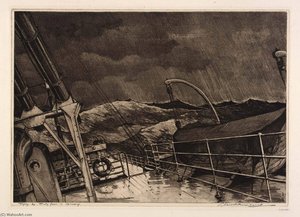
While Pescheret’s talents were manifold—ranging from architectural design to delicate watercolor landscapes—it was his revolutionary approach to Color Etching that secured his place in art history. In the late 1920s, he began experimenting with the etching plate, but it was his journey back to Europe in 1934 that truly transformed his technique. Seeking to master the infusion of hue into printmaking, he became the private pupil of Roger Hebbelinck, the celebrated color etcher to the court of Belgium. This apprenticeship allowed Pescheret to bridge the gap between the stark, monochromatic traditions of the past and the vibrant, optimistic energy of the Art Deco movement.
His mastery lay in a delicate equilibrium; he possessed the ability to combine intricate, precise linework with subtle, luminous color washes. This technique allowed him to capture the dynamism of the modern world—from the futuristic cityscapes he envisioned for Chicago’s 1934 World's Fair to the serene, atmospheric beauty of coastal scenes. His work often reflected the grandeur of his architectural training, utilizing a sense of structure and scale that mirrored the Beaux Arts and Art Deco buildings he designed. Whether through the sharp edges of a cityscape or the soft gradients of a sunset, Pescheret’s prints breathed with a life that was both structured and ethereal.
A Permanent Impression on American Art
In 1936, Pescheret established his permanent creative sanctuary in Whitewater, Wisconsin, where he opened an art studio and gallery in the historic Halverson Home. For over three decades, this space served as a crucible for his creativity, allowing him to produce a vast body of work that ranged from architectural illustrations to deeply personal landscapes. His commitment to his craft was unwavering, and his influence extended far beyond the borders of Wisconsin, reaching collectors and institutions such as the Smithsonian American Art Museum and the National Gallery of Art.
The historical significance of Leon René Pescheret lies in his role as a bridge between European tradition and American modernism. He did not merely observe the changing tides of art; he actively participated in shaping them through his innovations in printmaking and his architectural contributions. His life, characterized by a restless pursuit of beauty and technical perfection, remains a testament to the enduring power of the artist's vision. Through his etchings, we continue to glimpse a world of elegance, precision, and color that continues to resonate with the spirit of an era defined by progress and grace.