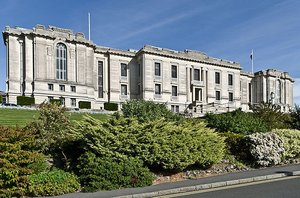
John Finnie의 초상화

갤러리 엄선, 가장 유명한 John Finnie 작품 15선

11월 2026 업데이트 · 인기 점수 기준 순위 (각 작품의 검색, 방문 및 주문 수) · 22점의 John Finnie 작품 (당사 카탈로그 기준)

요약하자면

John Finnie가 남긴 모든 원작 중 가장 유명한 작품은 리버풀의 워커 아트 갤러리에 소장된 Snowdon from Capel Curig (1870)입니다. 그 뒤를 이어 A Member of the Naval Reserve (1862)와 Gathering Wild Flowers (1865)가 뒤를 잇습니다. John Finnie의 작품 22점을 보유하고 있습니다. 갤러리는 세계가 가장 찬사하는 15점을 엄선하여 각 작품의 제작 연도, 소장 미술관 및 작품에 담긴 이야기를 함께 소개합니다.

1829 – 1907, Aberdeen 최다 소장처: 워커 아트 갤러리

John Finnie의 베스트 작품 10선: 갤러리 선정

1
Snowdon from Capel Curig (1870) 의 John Finnie

Snowdon from Capel Curig

1870 · Oil On Canvas · 워커 아트 갤러리, 리버풀

The mountains rise from the earth with a heavy, silent permanence. In this 1870 oil on canvas, the peaks of Snowdon loom over the valley, their surfaces textured by the damp breath of the sky. Below the rugged heights, a body of water rests in the foreground, mirroring the stillness of the surrounding hills. Trees are scattered across the landscape, their dark forms anchoring the composition against the shifting light…

2
A Member of the Naval Reserve (1862) 의 John Finnie

A Member of the Naval Reserve

1862 · Oil On Canvas

In "A Member of the Naval Reserve", John Finnie presents a quiet, centered study of a young boy positioned against a vast coastal backdrop. The boy is the focal point of the composition, standing upon a beach with a sense of stillness. He is dressed in red clothing, specifically a shirt and trousers, and wears a brown hat. In his hands, he holds a long pole and a fishing net,…

3
Gathering Wild Flowers (1865) 의 John Finnie

Gathering Wild Flowers

1865 · Oil · Wolverhampton Art Gallery, 울버햄튼

Sunlight filters through a dense canopy, casting dappled patterns across a forest floor where time seems to slow. A woman and a child move through this verdant sanctuary, their presence a gentle part of the landscape rather than a disruption of it. The trees rise high, their branches creating a vertical rhythm that draws the eye upward into the shifting light. Every leaf and twig feels heavy with the moisture…

4
Sunshine and Cloud, View near Capel Curig (1876) 의 John Finnie

Sunshine and Cloud, View near Capel Curig

1876 · Oil On Canvas · 워커 아트 갤러리, 리버풀

In this work, titled Sunshine and Cloud, View near Capel Curig, the artist John Finnie presents a quiet, picturesque landscape inspired by the Welsh countryside. Painted about 1875–1876, the scene captures a specific moment of light and atmosphere within the Snowdonia region. It is a study of the natural world, focusing on the interplay between the land and the sky.

5
Moel Siabod, from Capel Curig (1860) 의 John Finnie

Moel Siabod, from Capel Curig

1860 · Oil

Moel Siabod, from Capel Curig is a landscape painting by the Scottish artist John Finnie. Executed about 1860, the work captures a rugged mountainous terrain characterized by the geological features of the Snowdonia region. A river flows through the center of the composition, cutting through the valley floor.

6
Maids of All Work (1865) 의 John Finnie

Maids of All Work

1865 · Oil On Canvas · The Geffrye, 런던

The oil on canvas titled Maids of All Work is a work by the artist John Finnie. Created between 1864 and 1865, this piece measures 58 x 42.7 cm. It resides within the collection of the Museum of the Home.

7
Sunset at Pangbourne (1878) 의 John Finnie

Sunset at Pangbourne

1878 · Oil On Canvas

The evening light settles over the river in Sunset at Pangbourne, a work by the artist John Finnie. This oil on canvas captures a specific moment of transition, where the day begins to yield to the approaching dusk. The scene unfolds across a wide horizontal plane, measuring 90 x 151 cm, allowing the viewer to witness the quiet movement of the water and the sky in a singular, expansive view.

8
The Meeting of the Mersey and the Weaver (1874) 의 John Finnie

The Meeting of the Mersey and the Weaver

1874 · Oil On Canvas

The Meeting of the Mersey and the Weaver is an oil on canvas by the Scottish landscape painter and engraver John Finnie. Executed around 1874, the work captures a specific geographical confluence through the artist's characteristic attention to light and tonal depth.

9
The Heart of Nature (1898) 의 John Finnie

The Heart of Nature

1898 · Oil On Canvas · 워커 아트 갤러리, 리버풀

is an oil on canvas by the Scottish artist John Finnie. Executed around 1898, the work reflects the artist's long-standing engagement with the landscape traditions of the United Kingdom. Finnie, born in Aberdeen, developed a technical precision through his early training in japanning and his later mastery of mezzotint engraving, qualities that inform the handling of this large-scale composition.

10
The Close of a Stormy Day, Vale of Clwyd (1893) 의 John Finnie

The Close of a Stormy Day, Vale of Clwyd

1893 · Oil On Canvas · 워커 아트 갤러리, 리버풀

The Close of a Stormy Day, Vale of Clwyd is an oil on canvas by the Scottish landscape painter and engraver John Finnie. Created about 1893, the work belongs to a period in which the artist had established a profound connection to the Welsh terrain, particularly the regions surrounding Snowdonia.

John Finnie 컬렉션이 계속됩니다, 11부터 15까지

John Finnie의 시대별 명작

John Finnie의 시선을 사로잡은 주제들

이 오리지널 작품들에서 가장 자주 등장하는 네 가지 주제와 그 정수를 보여주는 대표작들.

John Finnie의 원작을 소장하고 있는 미술관

이 페이지에 있는 작품을 가장 많이 소장하고 있는 5개의 미술관

소장 미술관 도시 John Finnie의 작품 이 목록의 작품들
워커 아트 갤러리, 리버풀워커 아트 갤러리 리버풀 5 Snowdon from Capel Curig, Sunshine and Cloud, View near Capel Curig, The Heart of Nature
Wolverhampton Art Gallery, 울버햄튼Wolverhampton Art Gallery 울버햄튼 1 Gathering Wild Flowers
The Geffrye, 런던The Geffrye 런던 1 Maids of All Work
Llyfrgell Genedlaethol Cymru / The National Library of Wales, 애베리스토이쓰Llyfrgell Genedlaethol Cymru / The National Library of Wales 애베리스토이쓰 1 The Little Orme
Williamson Art Gallery - Museum, 버컨헤드Williamson Art Gallery - Museum 버컨헤드 1 Landscape

John Finnie의 시대별 걸작: 시대를 정의하는 오리지널 작품들

연대별 작품 수

그 시대를 정의하는 오리지널 작품을 만나보려면 연대를 선택하세요.

John Finnie의 작품에 관한 컬렉터들의 질문

John Finnie의 가장 대표적인 작품은 무엇인가요?정답 확인하기

Snowdon from Capel Curig (1870), 워커 아트 갤러리, 리버풀. 다음은 A Member of the Naval Reserve (1862)와 Gathering Wild Flowers (1865)입니다.

Snowdon from Capel Curig이(가) 제작되었을 당시 John Finnie의 나이는 몇 살이었나요?정답 확인하기

41세: Snowdon from Capel Curig은(는) 1870년 작품이며, John Finnie은(는) 1829년에 태어났습니다.

John Finnie의 가장 유명한 작품 10가지는 무엇인가요?정답 확인하기

Snowdon from Capel Curig, A Member of the Naval Reserve, Gathering Wild Flowers, Sunshine and Cloud, View near Capel Curig, Moel Siabod, from Capel Curig, Maids of All Work, Sunset at Pangbourne, The Meeting of the Mersey and the Weaver, The Heart of Nature 및 The Close of a Stormy Day, Vale of Clwyd. 위 순위는 각 작품의 제작 연도와 소장 박물관을 나타냅니다.

John Finnie 작가가 남긴 작품은 몇 점인가요?정답 확인하기

저희 카탈로그에는 1860년부터 1907년 사이의 John Finnie 작가의 작품 22점이 수록되어 있습니다.

John Finnie의 걸작은 어느 박물관에 전시되어 있나요?정답 확인하기

대부분 워커 아트 갤러리 (리버풀), Wolverhampton Art Gallery (울버햄튼) 및 The Geffrye (런던)에 소장되어 있습니다. 위의 박물관 목록에서 전체 목록을 확인하실 수 있습니다.

John Finnie의 가장 유명한 작품들은 어느 연도에 그려졌나요?정답 확인하기

1870s 동안: 이 페이지의 총 15점의 작품 중 5점이 해당 시기에 제작되었으며, 그중 Snowdon from Capel Curig점입니다.

John Finnie의 첫 번째와 마지막 유명 원작은 무엇인가요?정답 확인하기

이 페이지에서 가장 오래된 작품은 Moel Siabod, from Capel Curig (1860)이며, 가장 최근 작품은 The River (1907)입니다.

John Finnie 작가가 가장 자주 선택한 주제는 무엇인가요?정답 확인하기

이 페이지의 15점의 작품에 걸쳐 있는 Trees (6), Sky (6) 및 Landscape (6)

John Finnie 작가가 가장 많이 사용한 기법은 무엇인가요?정답 확인하기

이 페이지의 총 15점의 작품 중 10점의 Oil On Canvas

워커 아트 갤러리에는 어떤 John Finnie의 작품이 전시되어 있나요?정답 확인하기

Snowdon from Capel Curig, Sunshine and Cloud, View near Capel Curig 및 The Heart of Nature: 워커 아트 갤러리, 리버풀은(는) 이 페이지에 있는 작품 중 5점을 소장하고 있습니다.

John Finnie: 생애와 작품 세계

A Legacy of Light and Line: The Life of John Finnie

The history of British landscape art is enriched by the meticulous hand of John Finnie, a master whose work bridged the gap between the rugged realism of the Victorian era and the delicate precision of fine engraving. Born in Aberdeen in 1829, Finnie’s early life was steeped in the industrious spirit of Scotland. Before he became a celebrated figure in the London and Liverpool art scenes, his formative years were spent mastering the intricate craft of japanning—a process that required an extraordinary level of patience and attention to detail. This foundational discipline would later manifest in his unparalleled ability to capture the subtle textures of nature, from the damp moss of a Welsh valley to the atmospheric haze of a coastal storm.

Finnie’s artistic evolution was propelled by formal training in Edinburgh and Newcastle, most notably under the guidance of William Bell Scott at the School of Design. It was here that he immersed himself in the burgeoning realist movement, honing his skills in etching and developing a profound sensitivity to light. By 1853, Finnie had relocated to London, where his talent for mezzotint engraving began to garner significant acclaim. His ability to manipulate tonal depth through the mezzotint process allowed him to create prints of extraordinary emotional resonance, capturing the quiet majesty of the British landscape with a softness that felt almost tactile.

The Master of Welsh Landscapes and Educational Leadership

While his roots were Scottish, Finnie’s heart found a profound connection to the landscapes of Wales. Upon moving to Towyn in northern Wales, he became an observer of the sublime, particularly within the breathtaking terrain of Snowdonia. His paintings of the Capel Curig area, including the iconic peaks of Snowdon, are characterized by an unwavering dedication to accuracy and an evocative use of color. Whether through the sweeping vistas of his oil paintings or the intricate shadows of his engravings, Finnie sought to translate the raw, elemental beauty of the Welsh mountains into a visual language that spoke to the Romantic sensibilities of his time.

Beyond his personal creative output, Finnie played a monumental role in the institutional development of British art. For over four decades, from 1855 until his retirement in 1896, he served as the Headmaster of the Liverpool Mechanics Institute and School of Art. In this capacity, he was not merely an artist but a mentor, shaping the pedagogical landscape of the region and fostering a vibrant community of creators. His leadership extended to various prestigious organizations, including:

  • The Royal Academy: Where he was a frequent and respected exhibitor.
  • The Artists’ Club: Serving as President and promoting collaborative artistic discourse.
  • The Liverpool Sketching Club: Where he helped cultivate the local landscape tradition.
  • The Royal Society of Painters, Etchers, and Engravers: Demonstrating his mastery of printmaking.

Artistic Significance and Enduring Impression

The significance of John Finnie lies in his dual identity as both a painter of light and an engraver of shadow. His work serves as a vital historical record of the 19th-century British landscape, capturing a sense of place that is both geographically precise and deeply poetic. In works such as 'Gathering Wild Flowers' or his atmospheric coastal scenes like 'A Member of the Naval Reserve', one finds a seamless blend of technical mastery and emotional depth. He possessed the rare ability to make the viewer feel the temperature of the air and the stillness of the forest.

Today, Finnie’s legacy is preserved in the permanent collections of major institutions, including the Walker Art Gallery in Liverpool and the Portsmouth Museum. His contributions to the art of mezzotint engraving remain a benchmark for excellence in the medium, ensuring that his name remains synonymous with the golden age of British landscape realism. Through his eyes, the rugged beauty of Wales and the industrious spirit of his era continue to breathe with a life that transcends the passage of time.