Jan Wyck의 초상화

Jan Wyck 회화: 갤러리의 시선으로 선별한 가장 유명한 작품 45선

11월 2026 업데이트 · 인기 점수 기준 순위 (각 작품의 검색, 방문 및 주문 수) · 45점의 Jan Wyck 작품 (당사 카탈로그 기준)

요약하자면

갤러리가 선정한 Jan Wyck의 가장 유명한 작품은 William III (1650-1702) on Horseback (1695)이며, 원작은 런던의 로열 컬렉션에 전시되어 있습니다. Hare Hunting (1690)와 King William III (1650–1702) (1700)가 더해져 누구나 한눈에 알아볼 수 있는 완벽한 트리오를 완성합니다. Jan Wyck의 작품 45점 중, 갤러리는 가장 유명한 45점을 아래와 같이 소개합니다. 각 작품은 제작 연도, 소장 미술관 및 작품의 특징을 포함한 독창적인 원작입니다.

1640 – 1700, Haarlem Baroque 최다 소장처: 아일랜드 국립 미술관

갤러리 베스트 10 Jan Wyck 작품

1
William III (1650-1702) on Horseback (1695) 의 Jan Wyck

William III (1650-1702) on Horseback

1695 · Oil On Canvas · 로열 컬렉션, 런던

The air feels heavy with the scent of damp earth and the metallic tang of impending conflict. High above, a turbulent sky churns with bruised, heavy clouds, casting a dramatic light that slices through the gloom to illuminate a singular, powerful figure. William III sits atop a massive white horse, its muscles coiled and straining in a dynamic levade. The animal’s strength is palpable, a living force of nature caught…

2
Hare Hunting (1690) 의 Jan Wyck

Hare Hunting

1690 · Oil On Canvas · 예일 영국 미술관, 뉴헤이븐

The chase unfolds in Hare Hunting, a work that captures the sudden, frantic energy of a pursuit. Painted by Jan Wyck, the scene places the viewer directly into a landscape where the nobility of the hunt meets the raw movement of the chase. The air feels thick with the urgency of the moment, as horses and hounds push through the terrain in pursuit of their quarry.

3
King William III (1650–1702) (1700) 의 Jan Wyck

King William III (1650–1702)

1700 · Oil On Canvas · Castle Ward

A single figure commands the space, anchored by the heavy stillness of polished steel. King William III stands in a confident contrapposto pose, his body a pillar of authority amidst a sea of shadow. The light catches the sharp, metallic edges of his plate armor, casting a bright sheen across his chest and the delicate, intricate folds of a white lace cravat. A red sash cuts through the darkness, a…

4
William III Landing at Brixham, Torbay (1688) 의 Jan Wyck

William III Landing at Brixham, Torbay

1688 · Oil On Canvas · 국립 해양 박물관, 런던

The scene unfolds in the immediate aftermath of a monumental arrival. In "William III Landing at Brixham, Torbay," Jan Wyck captures the precise moment of Prince William of Orange's landing in Torbay on 5 November 1688. The air feels heavy with the weight of impending change as the Prince descends toward the English shore. He does not arrive in quiet solitude; instead, he brings with him a massive force of…

6
Landscape with a Stag Hunt (1674) 의 Jan Wyck

Landscape with a Stag Hunt

1674 · Oil On Canvas · 로열 컬렉션, 런던

Landscape with a Stag Hunt is an oil painting by Jan Wyck, created about 1674. The canvas captures a dramatic hunting scene set within a vast, atmospheric wilderness. In the lower left, small figures of hunters on horseback move through the terrain. The mid-ground holds animals in motion, caught in the sudden energy of the chase.

8
The Battle of the Boyne (1693) 의 Jan Wyck

The Battle of the Boyne

1693 · Oil On Canvas · 아일랜드 국립 미술관, 더블린

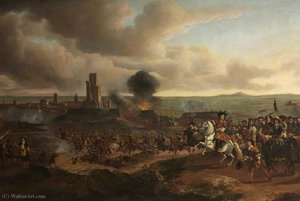
The air thickens with the scent of gunpowder and the heavy musk of horses in The Battle of the Boyne. This expansive oil on canvas, painted by Jan Wyck, captures a moment of immense scale and historical weight. The work stretches across a vast surface, measuring 223.0 x 386.5cm, pulling the viewer into a wide, panoramic landscape where the chaos of war unfolds. It is a scene of movement and…

9
A Hawking Party (1690) 의 Jan Wyck

A Hawking Party

1690 · Oil On Canvas · 예일 영국 미술관, 뉴헤이븐

The scene unfolds in A Hawking Party, a lively composition by the Dutch painter Jan Wyck. Created about 1690, the work captures a moment of aristocratic pursuit amidst an expansive, atmospheric countryside. We find ourselves watching a dynamic gathering where riders and dogs move through a landscape of earthy ochre and deep greens, all set under a vast, shifting sky. The air feels heavy with the soft light of a…

10
Extensive Landscape (1694) 의 Jan Wyck

Extensive Landscape

1694 · Oil

The oil painting titled Extensive Landscape was executed by the artist Jan Wyck. This work dates from about 1694. The composition presents a large-scale view of a natural environment, featuring a river, various trees, and mountains situated in the background. In the foreground, several figures are depicted engaging in activities such as riding horses and interacting with one another.

11위부터 45위까지의 Jan Wyck 작품

11King William III at the Siege of Namur 의 Jan WyckKing William III at the Siege of Namur아일랜드 국립 미술관 12King William III (William of Orange) (1650–1702) at the Second Seige of Namur, 2 July – 1 September 1695 의 Jan WyckKing William III (William of Orange) (1650–1702) at the Second Seige of Namur, 2 July – 1 September 1695Mount Stewart 13Equestrian Portrait of King William III 의 Jan WyckEquestrian Portrait of King William III 14A battle scene 의 Jan WyckA battle scene바르샤바 국립 박물관 15The Battle of the Boyne 의 Jan WyckThe Battle of the Boyne 16Battle scene 의 Jan WyckBattle scene 17Major-General Randolph Egerton 의 Jan WyckMajor-General Randolph Egerton 18Portrait of a Gentleman with a Roan Charger 의 Jan WyckPortrait of a Gentleman with a Roan Charger 19After the Combat 의 Jan WyckAfter the Combat아일랜드 국립 미술관 20Cavalry Combat 의 Jan WyckCavalry Combat아일랜드 국립 미술관 21Stag Hunt 의 Jan WyckStag HuntTe Whare O Rehua Sarjeant Gallery 22A cavalry skirmish 의 Jan WyckA cavalry skirmish 23Landscape with Haymakers 의 Jan WyckLandscape with Haymakers 24The Battle of Lepanto, 7 October (1571) 의 Jan WyckThe Battle of Lepanto, 7 October (1571) 25William III (1650–1702), and His Army at the Siege of Namur, 1695 의 Jan WyckWilliam III (1650–1702), and His Army at the Siege of Namur, 1695 26View of Windsor Castle from the South 의 Jan WyckView of Windsor Castle from the SouthAnglesey Abbey 27A Pointer in a Landscape 의 Jan WyckA Pointer in a Landscape 28A Battlepiece, of Christians against Turks 의 Jan WyckA Battlepiece, of Christians against TurksHam House 29William III Landing at Brixham, Torbay, 5 November 의 Jan WyckWilliam III Landing at Brixham, Torbay, 5 November국립 해양 박물관 30King William III 의 Jan WyckKing William III 31A stag hunt 의 Jan WyckA stag hunt 32James Scott, Duke of Monmouth and Buccleuch 의 Jan WyckJames Scott, Duke of Monmouth and BuccleuchNational Portrait Gallery 33Hawking party 의 Jan WyckHawking party 34A stag hunt 의 Jan WyckA stag hunt 35King William III (1650–1702) giving Orders in the Field 의 Jan WyckKing William III (1650–1702) giving Orders in the Field 36William III and Prince George of Denmark at the Battle of the Boyne 의 Jan WyckWilliam III and Prince George of Denmark at the Battle of the Boyne 37A Landscape with Horsemen, Including a Falconer 의 Jan WyckA Landscape with Horsemen, Including a FalconerLytes Cary 38Gilbert Coventry, Later 4th Earl of Coventry, in the Hunting Field 의 Jan WyckGilbert Coventry, Later 4th Earl of Coventry, in the Hunting FieldAntony House 39An Imaginary Winter Scene with People Amusing Themselves upon a Frozen River with Tents and a Sleigh 의 Jan WyckAn Imaginary Winter Scene with People Amusing Themselves upon a Frozen River with Tents and a Sleigh 40A Dutch Mastiff with Dunham Massey in the Background 의 Jan WyckA Dutch Mastiff with Dunham Massey in the BackgroundDunham Massey Hall 41Hunting Scene 의 Jan WyckHunting Scene 42A Cavalry Battle Scene 의 Jan WyckA Cavalry Battle Scene 43Prince rupert 의 Jan WyckPrince rupert 44'Swallow' and Old William, Groom to Sir T. S. Bonnet 의 Jan Wyck'Swallow' and Old William, Groom to Sir T. S. Bonnet 45King William III 의 Jan WyckKing William III

Jan Wyck의 시대별 명작

Jan Wyck의 시선을 사로잡은 주제들

이 오리지널 작품들에서 가장 자주 등장하는 네 가지 주제와 그 정수를 보여주는 대표작들.

Jan Wyck의 원작을 소장하고 있는 미술관

이 페이지에 있는 작품을 가장 많이 소장하고 있는 8개의 미술관

소장 미술관 도시 Jan Wyck의 작품 이 목록의 작품들
아일랜드 국립 미술관, 더블린아일랜드 국립 미술관 더블린 4 The Battle of the Boyne, King William III at the Siege of Namur, After the Combat
로열 컬렉션, 런던로열 컬렉션 런던 3 William III (1650-1702) on Horseback, Landscape with a Stag Hunt, The French Army crossing the Rhine, 12 June 1672
예일 영국 미술관, 뉴헤이븐예일 영국 미술관 뉴헤이븐 3 Hare Hunting, Heron Hawking below Stirling Castle, A Hawking Party
국립 해양 박물관, 런던국립 해양 박물관 런던 2 William III Landing at Brixham, Torbay, William III Landing at Brixham, Torbay, 5 November
Castle WardCastle Ward 1 King William III (1650–1702)
Mount Stewart, 뉴타운워즈Mount Stewart 뉴타운워즈 1 King William III (William of Orange) (1650–1702) at the Second Seige of Namur, 2 July – 1 September 1695
바르샤바 국립 박물관, 바르샤바바르샤바 국립 박물관 바르샤바 1 A battle scene
Te Whare O Rehua Sarjeant GalleryTe Whare O Rehua Sarjeant Gallery 1 Stag Hunt

Jan Wyck, 10년마다 탄생한 대표작 한 점

연대별 작품 수

그 시대를 정의하는 오리지널 작품을 만나보려면 연대를 선택하세요.

Jan Wyck의 작품: 갤러리의 해답

Jan Wyck의 작품 중 가장 유명한 작품은 무엇인가요?정답 확인하기

William III (1650-1702) on Horseback (1695), 로열 컬렉션, 런던. 다음은 Hare Hunting (1690)와 King William III (1650–1702) (1700)입니다.

Jan Wyck이(가) William III (1650-1702) on Horseback을(를) 완성했을 당시의 나이는 몇 살이었나요?정답 확인하기

55세: William III (1650-1702) on Horseback은(는) 1695년 작품이며, Jan Wyck은(는) 1640년에 태어났습니다.

Jan Wyck의 대표작 10점은 무엇인가요?정답 확인하기

William III (1650-1702) on Horseback, Hare Hunting, King William III (1650–1702), William III Landing at Brixham, Torbay, Heron Hawking below Stirling Castle, Landscape with a Stag Hunt, The French Army crossing the Rhine, 12 June 1672, The Battle of the Boyne, A Hawking Party 및 Extensive Landscape. 위 순위는 각 작품의 제작 연도와 소장 박물관을 나타냅니다.

Jan Wyck의 작품은 몇 점인가요?정답 확인하기

저희 카탈로그에는 1674년부터 1700년 사이의 Jan Wyck 작가의 작품 45점이 수록되어 있습니다.

Jan Wyck의 가장 유명한 원작들은 어디에 전시되어 있을까요?정답 확인하기

대부분 아일랜드 국립 미술관 (더블린), 로열 컬렉션 (런던) 및 예일 영국 미술관 (뉴헤이븐)에 소장되어 있습니다. 위의 박물관 목록에서 전체 목록을 확인하실 수 있습니다.

Jan Wyck의 가장 유명한 작품들은 언제 제작되었나요?정답 확인하기

1690s 동안: 이 페이지의 총 45점의 작품 중 6점이 해당 시기에 제작되었으며, 그중 William III (1650-1702) on Horseback점입니다.

Jan Wyck의 초기 및 후기 대표작은 무엇인가요?정답 확인하기

이 페이지에서 가장 오래된 작품은 Landscape with a Stag Hunt (1674)이며, 가장 최근 작품은 King William III (1650–1702) (1700)입니다.

Jan Wyck 작가가 가장 자주 다룬 주제는 무엇인가요?정답 확인하기

이 페이지의 45점의 작품에 걸쳐 있는 Horse (12), Sky (11) 및 Man (9)

Jan Wyck 작가가 가장 많이 사용한 매체는 무엇인가요?정답 확인하기

이 페이지의 총 45점의 작품 중 22점의 Oil On Canvas

Jan Wyck은(는) 어떤 미술 사조에 속해 있나요?정답 확인하기

이 페이지의 원작들을 기준으로 볼 때, Baroque

아일랜드 국립 미술관이(가) 소장하고 있는 Jan Wyck의 원작은 무엇인가요?정답 확인하기

The Battle of the Boyne, King William III at the Siege of Namur 및 After the Combat: 아일랜드 국립 미술관, 더블린은(는) 이 페이지에 있는 작품 중 4점을 소장하고 있습니다.

Jan Wyck: 작가

Jan Wyck: The Painter Who Brought Battle to Life

Born in Haarlem, Netherlands, in 1652, Jan Wyck emerged as a pivotal figure in the burgeoning world of European art during the late 17th century. His legacy isn’t defined by grand, solitary masterpieces but rather by an astonishing body of over 150 works—primarily dynamic military scenes, evocative landscapes, and striking equestrian portraits—that fundamentally shifted the way warfare was depicted on canvas. Wyck's influence extended far beyond his native Netherlands; he played a crucial role in establishing British art as a force to be reckoned with, introducing a distinctly Dutch sensibility that profoundly impacted generations of British artists.

Wyck’s early life remains somewhat shrouded in mystery, largely due to the limited documentation available. He was the son of Thomas Wyck, another painter who had spent considerable time honing his craft in Italy, absorbing the influence of the Italianate style evident in some of his father's works. It is believed that Jan received his initial artistic training from his father, though precise details are scarce. The family’s relocation to England during the reign of Charles II—likely around 1664—marked a turning point, setting the stage for Wyck’s enduring contribution to British art history. This move coincided with a period of significant cultural exchange between Britain and the Low Countries, fueled by the Restoration and a renewed interest in classical learning and artistic styles.

A Royal Patron and Continental Influence

Wyck's arrival in England proved remarkably fortuitous. He quickly gained recognition for his skill and versatility, securing patronage from influential figures like the Duke of Ormond and, later, William III himself. His ability to capture the chaos and drama of battle—a subject largely dominated by French artists at the time—was particularly valued. Wyck’s work wasn't simply a record of military events; he imbued his scenes with a palpable sense of immediacy and realism, drawing inspiration from both Dutch and Flemish traditions. He skillfully blended elements of Baroque dynamism with a keen eye for detail, meticulously rendering the textures of armor, the glint of steel, and the expressions of soldiers caught in the heat of conflict.

The influence of Dirk Maas, another prominent Low Countries artist working in England, is readily apparent in Wyck’s early work. However, Wyck quickly developed his own distinctive style—characterized by a vibrant palette, dramatic lighting, and an unparalleled ability to capture the energy and movement of his subjects. He wasn't content with simply depicting battles from a distant perspective; instead, he sought to immerse the viewer directly into the fray, highlighting individual soldiers, their weapons, and the unfolding drama with remarkable precision.

The Battle Painter’s Vision

Wyck’s most significant contribution lies in his innovative approach to battlefield depictions. While many artists of the era favored a bird's-eye view, offering a strategic overview of troop formations, Wyck chose to focus on the individual experiences of soldiers—their bravery, their fear, and their desperate struggle for survival. He meticulously rendered details such as flourishing sabres, firing muskets, flaring horses’ nostrils, and the billowing smoke from cannons, creating a visceral sense of realism that was unprecedented in military art. This shift towards a more intimate and emotionally resonant portrayal of battle profoundly influenced subsequent generations of British artists.

His work on the Battle of the Boyne, for example, stands as a testament to his artistic vision. While accounts of the battle itself are plentiful, Wyck’s painting captures not just the tactical maneuvers but also the human cost—the exhausted faces of soldiers, the fallen comrades, and the palpable sense of uncertainty that permeated the ranks. Similarly, his depictions of the siege of Derry vividly convey the resilience of the besieged city and the determination of its defenders.

A Family Man and a Lasting Legacy

Beyond his artistic achievements, Wyck’s personal life offers glimpses into the realities of 17th-century England. He married twice—first to an unknown woman, then to Anne Skinner in 1676, with whom he had four children who tragically all died young. His third marriage brought him a Dutch wife, Elizabeth Holomberg, and two sons and a daughter, further solidifying his family life in Mortlake. Despite the personal tragedies that punctuated his life, Wyck remained dedicated to his craft, continuing to produce works under royal patronage until his death in 1702.

Jan Wyck’s legacy extends far beyond the individual paintings he created. He played a crucial role in fostering artistic exchange between Britain and the Low Countries, introducing new techniques and perspectives that enriched British art history. His innovative approach to battlefield depictions—his focus on individual soldiers and his masterful rendering of detail—established him as a pioneer in military art, leaving an indelible mark on the development of both Dutch and British painting traditions. Today, his works are treasured for their historical significance, artistic merit, and the captivating stories they tell of courage, conflict, and the human spirit.