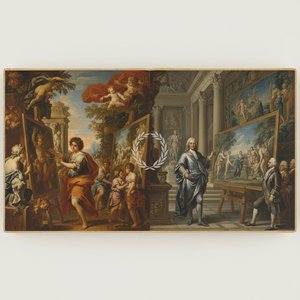
Filippo Lauri (1623–1694): Painter of Light and Landscape
Filippo Lauri (August 25, 1623 – December 12, 1694) stands as a prominent figure within the Roman Baroque artistic landscape. Though largely overshadowed by contemporaries like Caravaggio and Bernini, Lauri’s distinctive style—characterized by luminous color palettes and masterful depictions of serene landscapes interwoven with mythological narratives—earned him recognition and enduring admiration.
Born in Rome to Balthasar Lauwers, a Flemish landscape painter who had emigrated from Antwerp under the patronage of Paul Bril, Lauri’s artistic lineage instilled in him an early appreciation for atmospheric perspective and tonal modulation. His formative years were spent studying under his father and subsequently with Francesco Lauri, whose own brother, Andrea Sacchi—a celebrated artist himself—served as a crucial mentor.
Joining the Accademia di San Luca in 1654 marked a pivotal moment in Lauri’s career. This prestigious institution fostered intellectual discourse and artistic experimentation, propelling him to positions of leadership where he championed innovation and oversaw the training of future generations of painters. Notably, Lauri collaborated closely with Filippo Gagliardi on “Celebrations for Christine of Sweden at Palazzo Barberini,” a monumental canvas that vividly captures the grandeur and theatricality of Baroque court celebrations.
Lauri’s artistic output spanned numerous genres, including religious paintings—particularly depictions of saints and biblical scenes—and landscapes imbued with classical ideals. He possessed an exceptional talent for capturing the subtle nuances of light and shadow, a technique honed through his collaborations with Claude Lorraine, whose influence is evident in Lauri's tranquil compositions.
His prolific output included numerous engravings, demonstrating his understanding of printmaking techniques and expanding the reach of his artistic vision. Lauri’s legacy resides not only in his individual masterpieces but also in his role as a catalyst for artistic development within Rome—a testament to his enduring contribution to the Baroque aesthetic.
Notable Works
- "Venus & Adonis": An oil painting showcasing Lauri's masterful use of chiaroscuro and classical beauty, capturing the mythological tale with dramatic lighting. Located at Palazzo Braschi (formerly Barberini Palace).
- "Sleeping Venus": Another captivating landscape scene featuring Diana and Endymion, demonstrating Lauri’s ability to convey emotion through serene imagery.
- "The Agony in the Garden": A powerful depiction of Christ's Passion, reflecting Lauri’s artistic sensitivity and technical prowess.
Influence & Artistic Style
Lauri’s style distinguishes itself through its emphasis on luminous color palettes—particularly blues and golds—and a meticulous attention to detail in landscape compositions. He skillfully employed atmospheric perspective, creating depth and realism that mirrored the artistic conventions of his time. His works embody the ideals of Renaissance Italy blended with Baroque dynamism.
Historical Significance
Filippo Lauri’s contribution to Roman art history is significant as he represents a crucial link between Flemish landscape painting traditions and the burgeoning Baroque aesthetic in Rome. He upheld the Accademia di San Luca's role as a center for artistic excellence, shaping the future of Roman painting.