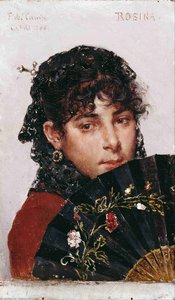
Federico del Campo: The Luminous Vedute of a Global Wanderer
Born in the vibrant atmosphere of Lima, Peru, in 1837, Federico del Campo emerged as a master of light and perspective whose canvases bridged the gap between South American origins and European refinement. While his roots were firmly planted in the soil of Peru, his artistic soul was shaped by the grand traditions of the Old World. His early life, though marked by the departure from his native land at a young age, set the stage for a nomadic journey of immense creative discovery. Supported by Peruvian diplomats, del Campo sought formal training that would eventually lead him to the prestigious Real Academia de Bellas Artes de San Fernando in Madrid. It was within these hallowed halls, around 1865, that he began to refine the technical precision that would later become his hallmark, establishing connections with fellow painters that would influence his trajectory for decades to come.
The true metamorphosis of del Campo’s style occurred as he traversed the cultural epicenters of Europe. His travels through France allowed him to absorb the burgeoning innovations of the Parisian art scene, but it was his arrival in Italy that ignited his most enduring passion. Immersed in the breathtaking landscapes of Naples, Capri, and Rome, he began to develop a mastery over atmospheric perspective. However, it was Venice that became his spiritual and professional home. Settling there in 1880, he joined a prestigious community of expatriate artists, including the legendary Mariano Fortuny and Martín Rico y Ortega. This period marked his ascent as one of the leading vedute painters of the 19th century, a specialist in capturing the "view" with such evocative detail that his works became highly sought after by the era's most affluent travelers.
A Symphony of Light and Architecture
Del Campo’s technique was a sophisticated marriage of precision and impressionistic flair. Unlike many who focused solely on architectural rigidity, he possessed a rare ability to breathe life into stone and water. He often worked alongside Martín Rico, and together they mastered the art of responding to the international market's hunger for Venetian splendor. His approach was characterized by an impressionist plein-air sensibility when rendering the shimmering reflections of canals and the soft play of light on ripples, yet this was always anchored by a meticulous execution of architectural forms. Whether depicting the grand scale of the Doge's Palace or the intimate, sun-drenched corners of a side canal, his brushwork captured the very essence of luminosity.
The demand for his work was nothing short of extraordinary, particularly among English aristocrats and merchants. His ability to translate the golden, melancholic light of Venice onto canvas created a sense of nostalgia that resonated deeply with the Victorian and Edwardian sensibilities. This commercial success eventually led him to London in 1893, where he catered to an elite clientele. One of his most significant historical milestones occurred during the World's Columbian Exposition in Chicago in 1893, where a special exhibition organized by the dealer Arthur Tooth introduced his breathtaking vistas to the American public, cementing his status as a global figure in the art world.
Legacy and Artistic Significance
The historical significance of Federico del Campo lies in his role as a cultural conduit. He took the spirit of the 19th-century traveler and distilled it into permanent, emotive masterpieces. His oeuvre serves as a visual record of a bygone era of European elegance, captured through the eyes of a Peruvian master. Even as he moved between the bustling streets of London and the serene canals of Venice, his work maintained a consistent thread of technical excellence and emotional depth.
To reflect on his enduring impact, one might consider the following elements of his artistic identity:
- Mastery of the Vedute Tradition: He successfully revitalized the tradition of city views, making it accessible and emotive for a modern international audience.
- Technical Versatility: His unique ability to blend precise architectural rendering with the fluid, light-filled techniques of plein-air painting.
- Global Reach: From his beginnings in Lima to his triumphs in Madrid, Venice, London, and Chicago, he created a universal language of beauty.
- Atmospheric Storytelling: Beyond mere documentation, his paintings evoke the specific moods—the warmth of a summer afternoon or the quiet solitude of a misty morning—of the locations he depicted.