Early Life and Artistic Foundations
Ewart Johns, born in Barry, Glamorgan, Wales in 1923 and passing away in 2013, was a British artist whose prolific career spanned over six decades. His journey began at Cardiff College of Art, where he received formative training under the guidance of
Ceri Richards—a pivotal figure in Welsh
modernism known for his expressive style and bold use of color. This early exposure instilled in Johns a deep appreciation for artistic experimentation and a willingness to push boundaries. However, Johns’ intellectual curiosity extended beyond the purely visual realm; he pursued further studies at St John’s College, Cambridge, earning a First-Class Honours degree in Geography. This seemingly disparate academic pursuit would prove profoundly influential on his later work, particularly his explorations of urban design and
landscape painting. The grounding in geography provided a unique lens through which to view and interpret the world, shaping his artistic vision with an understanding of spatial relationships and environmental context.
A Dual Path: Academia and Artistic Practice
Johns uniquely balanced a distinguished academic career with a vibrant life as a freelance artist. From 1948 until 1971, he lectured in the Department of Geography at Exeter University, specializing in urban design—a field where his artistic sensibility and geographical knowledge converged seamlessly. He published extensively on British townscapes, demonstrating a keen analytical mind alongside his creative talents. In 1972, Johns took on the role of founding head of the Department of Visual Arts at Lancaster University, an endeavor that allowed him to nurture and shape arts education in Britain for many years. Despite these demanding academic commitments, he maintained a consistent artistic output, exhibiting widely across the UK and internationally. Solo shows at the Grabowski Gallery in London, beginning in 1961, and a major retrospective in 1981—held jointly at the University College of Wales, Cardiff, and Lancaster University—provided significant platforms for showcasing his evolving style and deepening critical engagement with his work.
Evolution of Style: From Cubism to Luminous Abstraction
Johns’ artistic development was marked by a continuous process of exploration and refinement. His early works often reflected the influence of
Cubism, characterized by structural concerns and a subdued palette. These pieces reveal a fascination with form and fragmentation, hinting at an underlying desire to deconstruct and reimagine reality. Over time, however, Johns moved away from these rigid structures, embracing freer compositions and a more vibrant use of color. His work became increasingly focused on the expressive potential of the
human figure and landscape, imbued with a sense of energy and
emotional depth. A period spent in the United States in 1969-70 further broadened his artistic horizons, exposing him to contemporary movements that he skillfully integrated into his own practice. In his later years, as his eyesight began to deteriorate, Johns turned to wood sculpture—a medium that allowed him to continue exploring visual concepts through tactile means and a renewed focus on form.
Themes and Influences
Throughout his career, Ewart Johns’ work was characterized by a strong emphasis on line and color, often delving into the complexities of human experience and the natural world. His paintings frequently feature figures—often women—depicted in evocative settings, suggesting narratives that are open to interpretation. The landscapes he created were not merely representations of physical places but rather emotional responses to them, imbued with a sense of atmosphere and personal meaning. While Johns drew inspiration from various 20th-century artistic movements, his work resisted easy categorization. He possessed a distinctive voice—a unique blend of intellectual rigor, artistic sensitivity, and
emotional depth—that set him apart from his contemporaries. His collaborative spirit was also evident in projects like the video documentation of his
creative process undertaken with Exeter University’s Psychology Department, revealing a desire to understand the psychological underpinnings of artistic creation.
Legacy and Historical Significance
Ewart Johns' contribution to
British art extends beyond his own prolific output. As an educator, he played a vital role in shaping generations of artists, fostering creativity and critical thinking at Lancaster University and beyond. His work continues to be exhibited and studied today, offering valuable insights into the development of modern
British painting. The preservation of his legacy is largely thanks to the dedication of his family—his son Nick Johns and grandson Philip Johns maintain his website and archive, ensuring that his art remains accessible to a wider audience. While specific details regarding close artistic peers are less documented, Johns’ influence on the broader art scene is undeniable. He was a versatile artist who seamlessly blended academic inquiry with creative expression, leaving behind a body of work that is both intellectually stimulating and emotionally resonant—a testament to his enduring fascination with form, color, and the
human condition. His paintings offer a captivating glimpse into the mind of an artist deeply engaged with the world around him, making him a significant figure in the history of modern
British art.


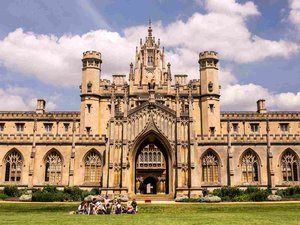 세인트 존스 칼리지
 University of Exeter Museum