A Life Between Cities
Edmond Theodor Van Hove entered the world in Bruges on June 7, 1851. As the eighth child of Jan Van Hove and Isabella Hooghuys, his early years were rooted in the traditions of his Belgian home. In 1871, he moved to Paris to study at the École des Beaux-Arts, a period that would shape his technical foundation. This time in France provided him with the skills to later return to Belgium and establish himself within the local art community.
His life was marked by a series of movements between the great centers of Belgian culture. After returning to Bruges in 1875, he eventually took up a position at the Academy there in 1890. His path later led him to Antwerp in 1899, then to Ghent in 1902, before he finally returned to his birthplace in 1910. Each city left its mark on his surroundings and his work.
The Language of Symbols
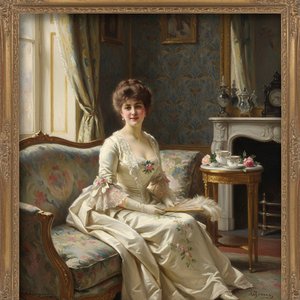
Van Hove found his voice through symbolic figure painting. He often turned his attention to religious scenes, historical narratives, and allegorical subjects. His portraits frequently focused on the delicate features of children, capturing a specific sense of innocence. Many of his religious works were set within the familiar streets and landscapes of Bruges as it appeared during his lifetime.
One of his most significant achievements was the creation of De Drie Zustersteden in 1898. This work consists of three wooden panels, each measuring 70 by 53 cm, and features gold-painted borders decorated with fruit-adorned columns. Through this triptych, he personified three cities as young women:
- Gent die Dappere: Represented by a figure leaning on a sword, with the towers of Sint-Niklaaskerk, Sint-Baafs, and the belfort rising behind her.
- Brugge die Schoone: A figure gazing dreamily toward a view of her own city.
- Antwerpen die Weelderige: A girl holding the landjuweel, set against the backdrop of the Schelde river.
Legacy and Recognition
The influence of Van Hove extended to the next generation of painters, as he taught students such as Achille Van Sassenbrouck and Karel Laloo. His presence in the Belgian art scene was felt through his academic appointments and his participation in exhibitions like the Salon de Paris. His work remains held in important collections, including the Groeningemuseum, which houses a self-portrait from 1879 and a triptych representing Historia, Tempus, and Legenda.