Berto di Giovanni의 초상화

갤러리 엄선, 가장 유명한 Berto di Giovanni 작품 21선

11월 2026 업데이트 · 인기 점수 기준 순위 (각 작품의 검색, 방문 및 주문 수) · 29점의 Berto di Giovanni 작품 (당사 카탈로그 기준)

요약하자면

Berto di Giovanni가 남긴 모든 원작 중 가장 유명한 작품은 뉴욕의 메트로폴리탄 미술관에 소장된 Girl with Cherries (1491)입니다. 그 뒤를 이어 The Virgin and Child Enthroned (1506)와 The Madonna with Child, Saint John and an angel (1510)가 뒤를 잇습니다. Berto di Giovanni의 작품 29점을 보유하고 있습니다. 갤러리는 세계가 가장 찬사하는 21점을 엄선하여 각 작품의 제작 연도, 소장 미술관 및 작품에 담긴 이야기를 함께 소개합니다.

1475 – 1529, Perugia 최다 소장처: 루브르 박물관

Berto di Giovanni의 베스트 작품 10선: 갤러리 선정

1
Girl with Cherries (1491) 의 Berto di Giovanni

Girl with Cherries

1491 · Oil · 메트로폴리탄 미술관, 뉴욕

The composition is carefully balanced, positioning the woman as the central focal point against a dark, understated background. This deliberate use of shadow ensures that the viewer's attention remains fixed upon her presence and the objects she holds. She is depicted with long red hair that falls in loose waves, framing a face characterized by a serene and somewhat secretive expression. A wreath of ground ivy, adorned with tiny blue…

2
The Virgin and Child Enthroned (1506) 의 Berto di Giovanni

The Virgin and Child Enthroned

1506 · Tempera On Panel · 로열 컬렉션, 런던

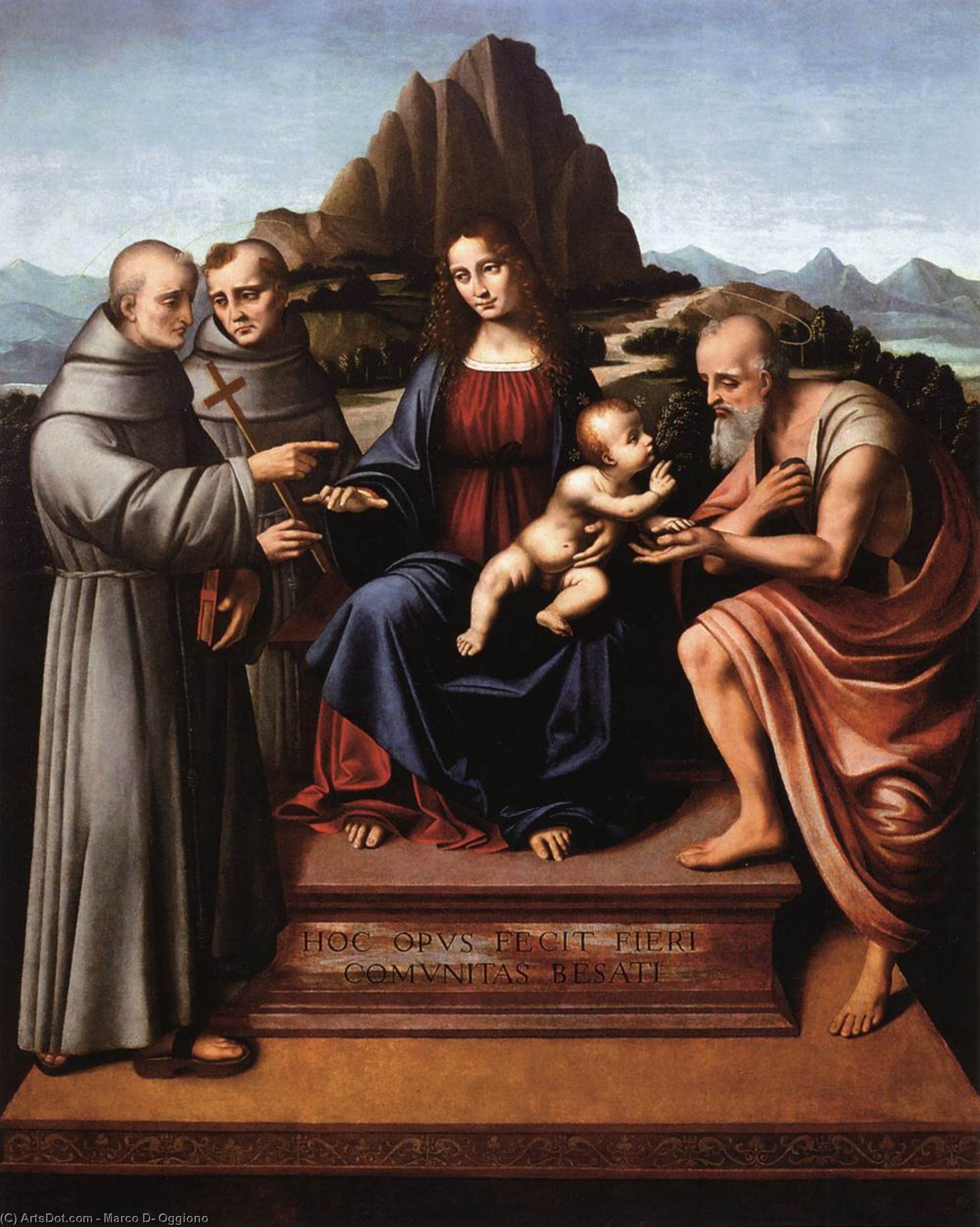
In The Virgin and Child Enthroned by Berto di Giovanni, the arrangement follows a strict pyramidal structure. The Madonna and Child occupy the central position, seated upon a rigid architectural throne that provides a sense of permanence to the sacred scene. Above them, four angels are captured in flight, while below, a balanced group of four saints stands in quiet observance. This hierarchy includes a Pope or Bishop, John the…

3
The Madonna with Child, Saint John and an angel (1510) 의 Berto di Giovanni

The Madonna with Child, Saint John and an angel

1510 · Oil On Panel · 스포르자 성, 밀라노

In this intimate panel from 1510, we find ourselves drawn into a secluded, rocky grotto where the light seems to emerge from within the scene itself. The Virgin Mary sits at the heart of a triangular composition, her presence anchoring the space as she cradles the Christ child. To her side, the young Saint John the Baptist holds a small cross, a subtle reminder of the path ahead, while angels…

4
Portrait of a Man aged 20 ('The Archinto Portrait') (1494) 의 Berto di Giovanni

Portrait of a Man aged 20 ('The Archinto Portrait')

1494 · Oil

The man stares directly at us, his presence heavy and immediate against a void of absolute black. He is young, perhaps twenty, with blonde hair that catches a soft, unseen light. A beard and mustache frame a face that holds a quiet, steady intensity. He wears a blue shirt, the fabric rendered with a subtle weight, and a tie knotted into a bow rests at his throat. In his hand,…

5
Francesco Maria Sforza (1491–1512), 'Il Duchetto' (1493) 의 Berto di Giovanni

Francesco Maria Sforza (1491–1512), 'Il Duchetto'

1493 · Oil · 브리스틀 박물관 - 아트 갤러리, 브리스톨

In this intimate portrait from 1493, we encounter a young boy, known as 'Il Duchetto', whose presence commands the space through a quiet, steady gaze. He is dressed in a rich red outfit, accented with meticulous gold trim that catches the light against a dark, receding background. The child holds a bird in his hand, a delicate detail that draws the eye toward the intersection of soft skin and fine…

6
Virgin and Child before a Landscape (1515) 의 Berto di Giovanni

Virgin and Child before a Landscape

1515 · Oil On Panel

The painting titled Virgin and Child before a Landscape is a work by Berto di Giovanni. Created in 1515, the piece captures a quiet moment of maternal connection. The Virgin Mary holds her child in her arms, a central figure of devotion set against a distant horizon.

7
Virgin and Child Enthroned with Saints (1524) 의 Berto di Giovanni

Virgin and Child Enthroned with Saints

1524 · Tempera On Panel · Museo Diocesano, 밀라노

The painting titled Virgin and Child Enthroned with Saints was executed by the artist Berto di Giovanni. This work is dated 1506. It belongs to the High Renaissance and the Lombard school, representing a period of significant stylistic development in Northern Italy. The piece is currently held at the Royal Collection in London.

8
LA VIERGE ALLAITANT L'ENFANT JESUS 의 Berto di Giovanni

LA VIERGE ALLAITANT L'ENFANT JESUS

Tempera On Panel · 루브르 박물관, 파리

The composition is organized around a pyramidal structure, with the Virgin's head positioned at the apex. She is situated slightly off-center to the left of the vertical axis. The infant Jesus is held within her arms, oriented so that he faces the viewer directly. The two figures are arranged in a gentle curve, a placement that emphasizes the physical connection between mother and child.

10
The Madonna and Child with Saint John the Evangelist and Saint John the Baptist (1520) 의 Berto di Giovanni

The Madonna and Child with Saint John the Evangelist and Saint John the Baptist

1520

From the church of San Sepolcro, where it was taken in the second half of the eighteenth century, after the destruction of its original home in San Mattia alla Moneta (Piazza Cordusio), the triptych shows the Madonna and Child with Saint John the Evangelist and Saint John the Baptist in an arcade in the open. The construction cannot but recall the beautiful sacristy with paintings by Bergognone in Santa Maria…

Berto di Giovanni 컬렉션이 계속됩니다, 11부터 21까지

Berto di Giovanni의 시선을 사로잡은 주제들

이 오리지널 작품들에서 가장 자주 등장하는 네 가지 주제와 그 정수를 보여주는 대표작들.

Berto di Giovanni의 원작을 소장하고 있는 미술관

이 페이지에 있는 작품을 가장 많이 소장하고 있는 8개의 미술관

소장 미술관 도시 Berto di Giovanni의 작품 이 목록의 작품들
루브르 박물관, 파리루브르 박물관 파리 2 LA VIERGE ALLAITANT L'ENFANT JESUS, LA SAINTE FAMILLE AVEC SAINTE ELISABETH, SAINT JOACHIM ET LE PETIT SAINT JEAN BAPTISTE
메트로폴리탄 미술관, 뉴욕메트로폴리탄 미술관 뉴욕 1 Girl with Cherries
로열 컬렉션, 런던로열 컬렉션 런던 1 The Virgin and Child Enthroned
스포르자 성, 밀라노스포르자 성 밀라노 1 The Madonna with Child, Saint John and an angel
브리스틀 박물관 - 아트 갤러리, 브리스톨브리스틀 박물관 - 아트 갤러리 브리스톨 1 Francesco Maria Sforza (1491–1512), 'Il Duchetto'
Museo Diocesano, 밀라노Museo Diocesano 밀라노 1 Virgin and Child Enthroned with Saints
콩데 미술관, 샹티이콩데 미술관 샹티이 1 SAINTE BARBE
Auckland Art Gallery Toi o Tāmaki, 오클랜드Auckland Art Gallery Toi o Tāmaki 오클랜드 1 Madonna and Child.

Berto di Giovanni의 시대별 걸작: 시대를 정의하는 오리지널 작품들

연대별 작품 수

그 시대를 정의하는 오리지널 작품을 만나보려면 연대를 선택하세요.

Berto di Giovanni의 작품에 관한 컬렉터들의 질문

Berto di Giovanni의 가장 대표적인 작품은 무엇인가요?정답 확인하기

Girl with Cherries (1491), 메트로폴리탄 미술관, 뉴욕. 다음은 The Virgin and Child Enthroned (1506)와 The Madonna with Child, Saint John and an angel (1510)입니다.

Girl with Cherries이(가) 제작되었을 당시 Berto di Giovanni의 나이는 몇 살이었나요?정답 확인하기

16세: Girl with Cherries은(는) 1491년 작품이며, Berto di Giovanni은(는) 1475년에 태어났습니다.

Berto di Giovanni의 가장 유명한 작품 10가지는 무엇인가요?정답 확인하기

Girl with Cherries, The Virgin and Child Enthroned, The Madonna with Child, Saint John and an angel, Portrait of a Man aged 20 ('The Archinto Portrait'), Francesco Maria Sforza (1491–1512), 'Il Duchetto', Virgin and Child before a Landscape, Virgin and Child Enthroned with Saints, LA VIERGE ALLAITANT L'ENFANT JESUS, SAINTE BARBE 및 The Madonna and Child with Saint John the Evangelist and Saint John the Baptist. 위 순위는 각 작품의 제작 연도와 소장 박물관을 나타냅니다.

Berto di Giovanni 작가가 남긴 작품은 몇 점인가요?정답 확인하기

저희 카탈로그에는 1491년부터 1524년 사이의 Berto di Giovanni 작가의 작품 29점이 수록되어 있습니다.

Berto di Giovanni의 걸작은 어느 박물관에 전시되어 있나요?정답 확인하기

대부분 루브르 박물관 (파리), 메트로폴리탄 미술관 (뉴욕) 및 로열 컬렉션 (런던)에 소장되어 있습니다. 위의 박물관 목록에서 전체 목록을 확인하실 수 있습니다.

Berto di Giovanni의 가장 유명한 작품들은 어느 연도에 그려졌나요?정답 확인하기

1490s 동안: 이 페이지의 총 21점의 작품 중 3점이 해당 시기에 제작되었으며, 그중 Girl with Cherries점입니다.

Berto di Giovanni의 첫 번째와 마지막 유명 원작은 무엇인가요?정답 확인하기

이 페이지에서 가장 오래된 작품은 Girl with Cherries (1491)이며, 가장 최근 작품은 Virgin and Child Enthroned with Saints (1524)입니다.

Berto di Giovanni 작가가 가장 자주 선택한 주제는 무엇인가요?정답 확인하기

이 페이지의 21점의 작품에 걸쳐 있는 Child (5), Woman (4) 및 Throne (2)

Berto di Giovanni 작가가 가장 많이 사용한 기법은 무엇인가요?정답 확인하기

이 페이지의 총 21점의 작품 중 3점의 Oil

루브르 박물관에는 어떤 Berto di Giovanni의 작품이 전시되어 있나요?정답 확인하기

LA VIERGE ALLAITANT L'ENFANT JESUS 및 LA SAINTE FAMILLE AVEC SAINTE ELISABETH, SAINT JOACHIM ET LE PETIT SAINT JEAN BAPTISTE: 루브르 박물관, 파리은(는) 이 페이지에 있는 작품 중 2점을 소장하고 있습니다.

Berto di Giovanni: 생애와 작품 세계

A Legacy Carved in the Shadow of a Genius

The history of the Italian Renaissance is often told through the lens of singular, incomparable titans, yet the true richness of the era lies in the brilliant circle of masters who breathed life into the shadows cast by giants. Marco d’Oggiono stands as one of the most significant figures within this luminous orbit. Born around 1475 in the picturesque town of Oggiono, nestled in the hills of Brescia, his life and artistry were inextricably woven into the fabric of Lombard painting. While history frequently centers on the revolutionary breakthroughs of Leonardo da Vinci, it is through the meticulous hand and devoted spirit of d’Oggiono that much of the Leonardesque aesthetic was preserved, refined, and disseminated throughout Northern Italy.

D’Oggiono’s artistic journey began with a foundation of rigorous classical discipline. Early evidence suggests he received an exceptional education under the influence of Andrea Mantegna, a master whose workshop emphasized anatomical precision, a command of perspective, and a profound humanist intellect. This early exposure to the Mantegnesque style instilled in d’ Oggiono a lifelong dedication to structural clarity and a reverence for the scientific observation of nature. These formative years prepared him for his most defining chapter: his prolonged and intimate association with Leonardo da Vinci.

The Master’s Apprentice and the Art of Mimicry

To study under Leonardo was not merely to learn a technique, but to undergo a transformation in perception. D’Oggiono became one of the most trusted collaborators in Leonardo’s circle, tasked with responsibilities that required both immense technical skill and an intuitive understanding of sfumato—the delicate, smoky blurring of edges that gives Leonardo's subjects their haunting, lifelike quality. His role often involved the painstaking replication of Leonardo’s masterpieces, such as Saint Jerome in His Study and the Virgin Annunciation.

These were not mere exercises in imitation; they were profound acts of artistic translation. Through these copies, d’Oggiono internalized the master's philosophy of blending scientific realism with spiritual depth. His work serves as a vital bridge, capturing the essence of Leonardo’s innovations and making them accessible to the broader Lombard school. In his hands, the soft transitions of light and shadow and the subtle, enigmatic expressions characteristic of the Leonardesque style found a secondary, equally devoted voice.

A Lasting Impression on Lombard Renaissance

As his career progressed, d’Oggiono developed a recognizable style that, while deeply indebted to his mentor, possessed its own quiet, contemplative grace. His oeuvre is characterized by a serene beauty and a focus on devotional subjects, particularly Madonnas and portraits that exude a sense of tranquil piety. The significance of his contribution extends far beyond the technical execution of his paintings; he was a key architect in the spread of the High Renaissance aesthetic across the Lombardy region.

The historical importance of Marco d’Oggiono can be summarized through several enduring contributions to the art world:

  • Preservation of Technique: His meticulous copies provided an invaluable record of Leonardo da Vinci's evolving methods and compositional strategies.
  • Stylistic Diffusion: He played a crucial role in disseminating the sophisticated Leonardesque language to other contemporary painters in Northern Italy.
  • Mastery of Atmosphere: He successfully adapted the complex use of light and shadow to create works of profound emotional and spiritual resonance.
  • Bridge Between Eras: His work represents the seamless transition from the rigorous, linear traditions of Mantegna to the atmospheric, humanistic heights of the High Renaissance.

Though he passed away around 1530, leaving behind a legacy that remains a cornerstone of Lombard art history, d’Oggiono’s influence persists. He remains a testament to the power of the artistic lineage—a painter who did not seek to eclipse the sun of his master, but rather to capture its warmth and spread it across the canvas of an entire generation.