Benjamin Duterrau의 초상화

Benjamin Duterrau 회화: 갤러리의 시선으로 선별한 가장 유명한 작품 5선

11월 2026 업데이트 · 인기 점수 기준 순위 (각 작품의 검색, 방문 및 주문 수) · 6점의 Benjamin Duterrau 작품 (당사 카탈로그 기준)

요약하자면

갤러리가 선정한 Benjamin Duterrau의 가장 유명한 작품은 Woureddy, a wild native of Brune Island (1835)이며, 원작은 캔버라의 National Portrait Gallery에 전시되어 있습니다. Truggernana, a native of southern part of V.D. Land (1835)와 Mr Robinson's first interview with Timmy (1840)가 더해져 누구나 한눈에 알아볼 수 있는 완벽한 트리오를 완성합니다. Benjamin Duterrau의 작품 6점 중, 갤러리는 가장 유명한 5점을 아래와 같이 소개합니다. 각 작품은 제작 연도, 소장 미술관 및 작품의 특징을 포함한 독창적인 원작입니다.

1768 – 1851, London 최다 소장처: National Portrait Gallery

갤러리 베스트 10 Benjamin Duterrau 작품

2
Truggernana, a native of southern part of V.D. Land (1835) 의 Benjamin Duterrau

Truggernana, a native of southern part of V.D. Land

1835 · Ink On Paper · National Portrait Gallery, 캔버라

The ink meets the paper with a quiet, deliberate precision, capturing a moment of profound stillness. A figure emerges from the pale expanse of the page, rendered in the meticulous lines of a pen and ink drawing. This is Truggernana, a woman of the Nuennone people, her presence felt through the delicate hatching and the careful weight of every stroke. She exists in a space that feels both intimate and…

3
Mr Robinson's first interview with Timmy (1840) 의 Benjamin Duterrau

Mr Robinson's first interview with Timmy

1840 · Oil On Canvas · 호주 국립 미술관, 캔버라

The painting depicts a formal meeting between a European man and several Indigenous men under a heavy, overcast sky. In the foreground, the two primary figures are engaged in a handshake, a gesture that anchors the composition. The European man wears a dark, heavy coat over a shirt with white and blue stripes. His skin tone and the skin of the Indigenous men are rendered in deep browns and earthy…

5
Timmy, a Tasmanian Aboriginal, throwing a spear (1838) 의 Benjamin Duterrau

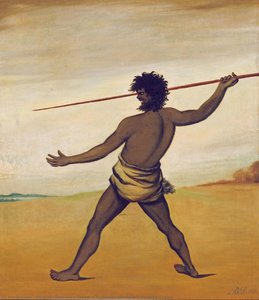
Timmy, a Tasmanian Aboriginal, throwing a spear

1838 · Oil On Canvas · 사우스오스트레일리아 미술관, 애들레이드

In this 1838 oil painting, titled Timmy, a Tasmanian Aboriginal, throwing a spear, we encounter a singular moment of focused intensity. The artist, Benjamin Duterrau, captures a solitary Tasmanian Aboriginal man at the precise instant of action. There is a palpable sense of muscular tension in the figure, frozen in the middle of a throw. It is a quiet, heavy moment that speaks to the skill and survival required by…

Benjamin Duterrau의 시선을 사로잡은 주제들

이 오리지널 작품들에서 가장 자주 등장하는 네 가지 주제와 그 정수를 보여주는 대표작들.

Benjamin Duterrau의 원작을 소장하고 있는 미술관

이 페이지에 있는 작품을 가장 많이 소장하고 있는 3개의 미술관

소장 미술관 도시 Benjamin Duterrau의 작품 이 목록의 작품들
National Portrait Gallery, 캔버라National Portrait Gallery 캔버라 2 Woureddy, a wild native of Brune Island, Truggernana, a native of southern part of V.D. Land
사우스오스트레일리아 미술관, 애들레이드사우스오스트레일리아 미술관 애들레이드 2 Jack, a Tasmanian Aboriginal, holding a club, Timmy, a Tasmanian Aboriginal, throwing a spear
호주 국립 미술관, 캔버라호주 국립 미술관 캔버라 1 Mr Robinson's first interview with Timmy

Benjamin Duterrau, 매년 선보이는 대표작

7년 동안, 1835년부터 1841년까지, Benjamin Duterrau의 연대기적 경력을 이 페이지에서 확인해 보세요. 가장 유명한 원작들을 통해 연도별로 정리된 짧은 여정을 만나보실 수 있습니다.

연도별 작품 수

연도를 선택하여 원작을 확인해 보세요.

Benjamin Duterrau의 작품: 갤러리의 해답

Benjamin Duterrau의 작품 중 가장 유명한 작품은 무엇인가요?정답 확인하기

Woureddy, a wild native of Brune Island (1835), National Portrait Gallery, 캔버라. 다음은 Truggernana, a native of southern part of V.D. Land (1835)와 Mr Robinson's first interview with Timmy (1840)입니다.

Benjamin Duterrau이(가) Woureddy, a wild native of Brune Island을(를) 완성했을 당시의 나이는 몇 살이었나요?정답 확인하기

67세: Woureddy, a wild native of Brune Island은(는) 1835년 작품이며, Benjamin Duterrau은(는) 1768년에 태어났습니다.

Benjamin Duterrau의 작품은 몇 점인가요?정답 확인하기

저희 카탈로그에는 1835년부터 1841년 사이의 Benjamin Duterrau 작가의 작품 6점이 수록되어 있습니다.

Benjamin Duterrau의 가장 유명한 원작들은 어디에 전시되어 있을까요?정답 확인하기

대부분 National Portrait Gallery (캔버라), 사우스오스트레일리아 미술관 (애들레이드) 및 호주 국립 미술관 (캔버라)에 소장되어 있습니다. 위의 박물관 목록에서 전체 목록을 확인하실 수 있습니다.

Benjamin Duterrau의 가장 유명한 작품들은 언제 제작되었나요?정답 확인하기

1835 동안: 이 페이지의 총 5점의 작품 중 2점이 해당 시기에 제작되었으며, 그중 Woureddy, a wild native of Brune Island점입니다.

Benjamin Duterrau의 초기 및 후기 대표작은 무엇인가요?정답 확인하기

이 페이지에서 가장 오래된 작품은 Woureddy, a wild native of Brune Island (1835)이며, 가장 최근 작품은 Jack, a Tasmanian Aboriginal, holding a club (1841)입니다.

Benjamin Duterrau 작가가 가장 자주 다룬 주제는 무엇인가요?정답 확인하기

이 페이지의 5점의 작품에 걸쳐 있는 Man (3), Indigenous australia (2) 및 Cloudy sky (2)

Benjamin Duterrau 작가가 가장 많이 사용한 매체는 무엇인가요?정답 확인하기

이 페이지의 총 5점의 작품 중 3점의 Oil On Canvas

National Portrait Gallery이(가) 소장하고 있는 Benjamin Duterrau의 원작은 무엇인가요?정답 확인하기

Woureddy, a wild native of Brune Island 및 Truggernana, a native of southern part of V.D. Land: National Portrait Gallery, 캔버라은(는) 이 페이지에 있는 작품 중 2점을 소장하고 있습니다.

Benjamin Duterrau: 작가

A Life Between Two Hemispheres

Benjamin Duterrau arrived in Van Diemen's Land in August 1832, a man of sixty-five years who had already seen the bustling streets of London and the rigorous training of an English apprenticeship. Born in Soho to Anglo-French parents, his early life was shaped by the precision of an engraver’s craft and the artistic shadows of masters like Thomas Gainsborough and William Hogarth. He did not seek a quiet retirement in the colonies; instead, he brought with him a drive to lecture on the civilizing influence of art at the Hobart Mechanics' Hall only months after his arrival.

His transition from the established art circles of England to the rugged landscape of Tasmania was marked by a singular purpose. While many migrants sought fortune through trade, Duterrau sought to document a world in flux. He settled in Hobart, establishing a studio where he could apply the meticulous observation learned in London to the faces and environments of a new territory. His work as a painter, etcher, and sculptor allowed him to capture the nuances of a society undergoing profound colonial shifts.

The Documentation of a Vanishing People

Duterrau’s most significant contribution lies in his sensitive treatment of the Indigenous Tasmanian population. Working alongside figures such as George Augustus Robinson, he found himself positioned at the intersection of colonial expansion and the survival of Aboriginal culture. He did not merely paint subjects; he recorded individuals with a level of dignity that was rare for the 1830s. His etchings and portraits of Aboriginal men and women provided a visual record of people whose lives were being irrevocably altered by settlement.

His technical approach often relied on a realistic style, prioritizing ethnographic accuracy. In works such as his depiction of "Timmy, a Tasmanian Aboriginal, throwing a spear," he utilized layered brushstrokes to build physical presence and texture. He possessed a particular skill for capturing the tension of a moment, such as the muscular focus of a hunter or the quiet strength in a sitter's expression. These portraits remain vital historical documents for those studying the Nuennone and other tribes of the region.

Historical Weight and Artistic Legacy

The scale of Duterrau’s ambition is perhaps best seen in his larger-scale historical compositions. His painting "The Conciliation" (1840) depicts a formal meeting between European colonists and Aboriginal chiefs, utilizing light and color to convey the gravity of the encounter. This work was intended as a study for an even more expansive project titled "A National Picture," an epic canvas that remains lost to history. Despite the disappearance of his largest intended works, his presence in the Tasmanian colonial narrative is firmly established through his surviving sketches and etchings.

Duterrau’s life ended in Hobart in 1851, leaving behind a body of work that functions as both art and archive. His legacy is found in the collections of the Tasmanian Museum and Art Gallery, where his depictions of the landscape and its original inhabitants continue to provide insight into the nineteenth century. He remains a figure who used the tools of an engraver and painter to illuminate the human dimension of Australian colonization.