Angelo da Siena: A Renaissance Visionary
In the vibrant, shifting landscape of the late fifteenth-century Italian Renaissance, few figures capture the era's profound transition from medieval tradition to humanist innovation quite like Angelo da Siena. Known also by his more formal designation, Angelo di Pietro del Macagnino da Siena, this master emerged as a singular voice in the artistic dialogue of Ferrara and beyond. While biographical fragments remain as elusive as shadows in a fresco, his presence is undeniably etched into the stone and pigment of history. His life was deeply rooted in an artistic lineage; born into a family of creators, specifically the son of Pietro da Siena, Angelo was immersed from birth in a world where technical mastery and creative expression were the very fabric of existence.
The development of his unique style was likely shaped by the rigorous traditions of his upbringing and the influential mentorship of Gian Angelo Criscuolo. As a prominent sculptor and artist serving the court of Borso d'Este, Criscuolo provided Angelo with a foundation in sculptural precision—a quality that would later breathe life into his two-dimensional works. This intersection of sculpture and painting allowed Angelo to approach the canvas with an acute understanding of volume, weight, and anatomical presence, ensuring that his figures possessed a tangible, physical reality that resonated with the burgeoning interest in humanism.
The Grandeur of Ferrara
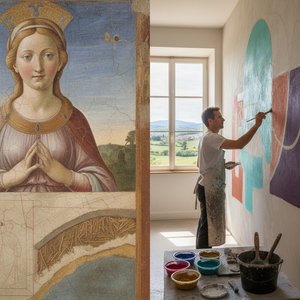
Angelo’s most enduring legacy is inextricably linked to the magnificent Palazzo Ducale in Ferrara. It was within these hallowed halls, particularly in the Chapel of Saint Teresa and the Chapel of Saint Mary Magdalene, that his genius truly flourished under the prestigious patronage of Borso d'Este. These monumental frescoes represent a watershed moment in Renaissance art, where the artist’s command over perspective and color theory reached new heights of sophistication. His work did not merely decorate walls; it transformed spaces into windows of spiritual and physical depth.
The technical brilliance of these frescoes is characterized by:
- Masterful Perspective: An advanced use of illusionistic painting that sought to dissolve the boundary between the viewer and the sacred narrative.
- Dramatic Composition: A sophisticated arrangement of figures that guides the eye through complex religious stories with emotional intensity.
- Color Theory: A rich, emotive palette used to evoke the divine atmosphere essential to Renaissance devotional art.
There is a profound historical weight to his achievements, particularly regarding the whispers of influence from Michelangelo. It is noted that Michelangelo himself visited Ferrara during the period of Angelo's most significant endeavors, and the parallels in their approach to spatial realism and the monumental human form suggest a shared artistic spirit. Through his ability to marry the sculptural solidity of his training with the fluid grace of narrative painting, Angelo da Siena secured his place as a vital architect of the Renaissance visual language.
질의응답
Angelo Da Siena의 모든 작품을 어디에서 볼 수 있나요?
본 웹사이트에 등록된 Angelo Da Siena의 모든 작품은 작가의 모든 작품 보기 페이지에서 확인하실 수 있습니다.
특정 매체로 분류된 Angelo Da Siena의 모든 작품을 어떻게 찾을 수 있나요?
특정 매체로 제작된 Angelo Da Siena의 모든 작품을 확인하시려면, 작가의 모든 매체 페이지를 이용해 주세요.
Angelo Da Siena의 작품을 분위기별로 모아둔 곳은 어디인가요?
아티스트의 무드 룸 페이지에서는 Angelo Da Siena의 작품들을 분위기에 따라 큐레이션된 형태로 만나보실 수 있습니다.
Angelo Da Siena의 작품을 컬러 팔레트별로 둘러볼 수 있나요?
컬러 팔레트별 페이지에서는 Angelo Da Siena의 작품들을 색상 팔레트별로 모아볼 수 있습니다.
Angelo Da Siena의 작품 세계는 시간이 흐름에 따라 어떻게 변화했나요?
Angelo Da Siena의 연대기는 작가의 활동 시기별로 분류된 작품들을 연대순으로 보여주는 스크롤 방식의 타임라인입니다.
특정 주제에 따른 Angelo Da Siena의 작품을 어떻게 찾을 수 있나요?
특정 주제의 Angelo Da Siena 작품을 찾으려면 키워드별로 작품이 분류된 작가의 키워드별로 페이지를 이용해 보세요.
Angelo Da Siena의 작품 중 몇 점을 둘러보실 수 있나요?
모든 작품 보기 페이지에서 Angelo Da Siena의 작품 작품 1점점을 만나보실 수 있습니다.