The Philosophy of Permanence: Why Classic Masterpieces Endure
 Old Master
In art history, "Old Master" (or "old master") refers to any painter of skill who worked in Europe before about 1800, or a painting by such an artist. An "old master print" is an original print (for example an engraving, woodcut, or etching) made by ...
To enter the presence of a true masterpiece is to step outside the frantic, ephemeral pulse of the modern age and into a realm of profound stillness. While trends in decor and digital media flicker and fade with the seasons, the Great Masters—those titans who defined the Renaissance, the Baroque, and the Neoclassical eras—offer something far more precious: permanence. Collecting such works is not merely an act of acquisition; it is an pursuit of the eternal. When we gaze upon a canvas that has survived centuries, we are participating in a silent, grand dialogue with history itself.
The endurance of these works lies in their ability to capture universal truths through the mastery of disegno and color. A painting by Nicolas Poussin, for instance, does not seek to dazz and dazzle with superficial drama, but rather to establish a sanctuary of order and intellectual clarity. By adhering to the immutable laws of geometry and the stoic dignity of the human spirit, such works provide an anchor in an increasingly fragmented world. This is why the elite collector seeks not just beauty, but substance—a piece of art that possesses the weight of moral virtue and the grace of a structured universe.
Ultimately, the allure of the classic lies in its capacity to transcend its original context. A portrait from a bygone century still captures a recognizable flicker of human emotion; a landscape from the Hudson River School still evokes the sublime power of nature. These works act as mirrors, reflecting our own enduring joys and struggles back at us across the vast expanse of time.
Curating the Eternal: Selecting Eras from Neoclassicism to Impressionism
 The Old, Old Story
A Glimpse into an Idyllic Past John William Godward’s *The Old, Old Story* transports viewers to a serene world of classical beauty and aristocratic leisure. The painting depicts a woman gracefully reclining on a marble bench within a portico overloo...
The journey of a curator begins with the selection of an era, a decision that dictates the emotional temperature of a space. For those drawn to the structured elegance of Neoclassicism, the focus remains on symmetry, clarity, and the idealized beauty of antiquity. One might find themselves captivated by the works of John William Godward, whose paintings, such as The Old, Old Story, transport the viewer to an idyllic, aristocratic past. In his hands, marble textures and sun-drenched porticos become stages for a serene, contemplative repose, offering a sense of tranquility that is increasingly rare in contemporary life.
Conversely, moving toward the 19th century invites a shift from the intellectual to the sensory. The Impressionist masters—Monet, Renoir, and Degas—introduced a revolution of light and atmosphere. Here, the collector seeks the ephemeral: the way sunlight dances upon a grainstack or the soft, luminous glow of a ballet dancer’s skin. This era offers a different kind of luxury, one rooted in the celebration of movement and the fleeting beauty of a single moment. To curate a collection that spans these eras is to weave a tapestry of human experience, blending the rigorous logic of the Baroque with the ethereal light of the Impressionist movement.
Whether one gravitates toward the heavy, monumental figures of the French Baroque or the delicate, water-colored dreams of the late 19th century, the goal remains the same: to select works that resonate with a personal sense of historical truth. A well-curated collection does not merely display art; it tells a story of cultural evolution and aesthetic devotion.
The Collector's Eye: Evaluating Technique, Provenance, and Composition
 Mastering the Classics: The 25 Greatest Paintings by Nicolas Poussin
Introduction To step into the world of Nicolas Poussin is to leave the chaos of the present behind and enter a realm of profound order, intellectual clarity, and timeless grace. As one of the most influential architects of the French Baroque, Poussin...
For the discerning eye, the value of a masterpiece is found in the meticulous details that lie beneath the surface. True connoisseurship requires an appreciation for technical prowess—the ability to distinguish between a mere image and a work of profound craftsmanship. One must look for the visible vitality of the brushstroke, the depth of the tonal range, and the artist's command over texture. In high-quality oil reproductions, this is evidenced by the tactile presence of impasto, where the paint itself rises from the cotton canvas to create a three-dimensional dialogue with light.
Composition serves as the skeletal structure of greatness. A master like Poussin utilized composition as a strategist, placing every gesture and architectural element with mathematical precision to guide the viewer’s eye through a philosophical narrative. As a collector, one must evaluate how the balance of weight, the use of negative space, and the interplay of light and shadow contribute to the work's overall equilibrium. It is this structural integrity that allows a painting to command a room, regardless of its physical scale.
Beyond the canvas, the concept of provenance and authenticity remains paramount. While the acquisition of an original Old Master is a feat of immense rarity, the modern collector finds profound value in museum-grade reproductions that honor these traditions. The integrity of the process—the use of fine oils, the application of Damar varnish for protection, and the dedication of artists trained in prestigious academies—ensures that the spirit of the original is preserved. To collect is to respect the lineage of the hand that held the brush.
Integrating Grandeur: Harmonizing Masterpieces with Modern Interiors
 Museum of Fine Arts
The D’Amour Museum of Fine Arts: A Tapestry of European Grandeur and American Vision Nestled within the vibrant heart of Springfield, Massachusetts, the Michele and Donald D’Amour Museum of Fine Arts stands as a testament to the enduring power of art...
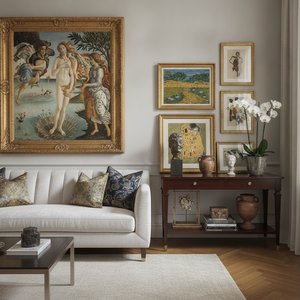
The challenge of the modern collector lies in the seamless integration of historical grandeur within contemporary architectural settings. A masterpiece should never feel like an intruder; rather, it should act as the soul of the room. In large-scale residential projects or luxury hospitality environments, art serves as a focal point that defines the character of the space. For instance, utilizing multi-panel group sets can transform a wide, minimalist wall into a dynamic architectural feature, where colors and brushstrokes flow seamlessly across several canvases to create a cohesive, modern aesthetic.
Integration also requires a sophisticated understanding of color and scale. A bold, dramatic work from the Baroque period may require a room with substantial architectural weight, such as deep moldings or dark wood finishes, to prevent it from feeling overwhelmed. Conversely, the light-drenched palettes of Impressionism pair exquisitely with airy, modern spaces characterized by natural light and neutral tones. For those seeking to recreate even more ambitious historical elements, large-format murals and ceiling frescoes can transform a standard hotel suite into a space reminiscent of a Renaissance palace.
Furthermore, the ability to "remix" history offers an unparalleled opportunity for customization. The modern collector is no longer bound strictly by what exists in museums; they can commission works that bridge eras—perhaps requesting a personal portrait to be executed in the luminous style of Monet or the structured elegance of a Neoclassical master. This bespoke approach allows art to become a personalized extension of the interior design, harmonizing historical reverence with contemporary luxury.
Preserving the Legacy: The Art of Long-Term Collection Management
 Dongyang Co., Ltd.
The Enduring Legacy of Dongyang Co., Ltd.: Masters of Reproduction and Tradition Dongyang Co., Ltd. represents a fascinating, yet often overlooked, cornerstone in the world of art appreciation and accessibility. While not a single artist in the tradi...
A collection is a living legacy, and its longevity depends upon a commitment to scientific preservation. To protect such significant investments, one must understand the chemistry of art. The use of high-quality materials—such as flexible gesso to prevent cracking and specific oils like safflower to ensure whites do not yellow—is essential for works intended to last generations. Every painting should be finished with a protective coat of varnish, shielding the surface from the insidious effects of dust, moisture, and atmospheric pollutants.
Environmental stewardship is equally critical. Collectors must be mindful of light exposure, as prolonged direct sunlight can degrade even the most stable pigments. The use of acid-free matting and proper framing with solid wood—whether in gold leaf, espresso, or natural finishes—creates a necessary buffer between the artwork and its environment. For those managing large-scale acquisitions, ensuring that stretcher bars are properly braced to prevent warping is a vital technical consideration for long-term stability.
Ultimately, the management of a collection is an act of stewardship. Whether through the careful rotation of pieces, the acquisition of professional appraisals, or the implementation of rigorous climate controls, the collector ensures that these windows into the past remain clear for the future. By treating art not just as decor, but as a precious heritage, we ensure that the beauty and wisdom of the Old Masters continue to inspire generations to come.