The Essence of Minimalism: Finding Depth in Simplicity
To the untrained eye, minimalism may appear as a mere absence—a reduction of form, a stripping away of ornament, a quietude that borders on the void. Yet, for the discerning collector, minimalism represents one of the most profound dialogues between presence and absence in the history of fine art. It is not about what is missing, but rather about the heightened significance of what remains. When an artist chooses to abandon the complexities of chiaroscuro or the dense narratives of Baroque realism, they are making a deliberate, courageous statement. They invite the viewer into a space where every remaining element carries an immense weight of intention.
This pursuit of simplicity is a journey toward the fundamental truths of visual language. By removing the distractions of representational detail, minimalism forces us to confront the raw essence of color, texture, and structure. It is a meditative practice that demands a slower pace of observation, rewarding those who linger with a sense of clarity and peace. In this stripped-back landscape, the silence of the canvas becomes a resonant chamber for thought, allowing the viewer to project their own emotions and interpretations onto the pristine surface of the work.
The Architecture of the Stroke: How Line Defines Form and Emotion
At the heart of this minimalist movement lies the most primal tool in the artist's repertoire: the line. A single, decisive stroke can possess more architectural strength than an entire landscape of mountains and trees. The line is the skeletal structure of visual perception; it directs the eye, establishes boundaries, and creates a rhythmic pulse within a composition. In the hands of a master, a line is never merely a mark on a surface; it is a trace of movement, a captured moment of kinetic energy that vibrates with life.
Consider the emotional spectrum available through varying linear techniques. A sharp, geometric line can evoke a sense of rigid order, mathematical precision, and intellectual rigor, much like the works found in early minimalist movements. Conversely, a fluid, gestural line—softened by the subtle bleeding of ink or the delicate pressure of a brush—can convey vulnerability, grace, and organic growth. The tension between a straight edge and a curve creates a psychological friction that keeps the viewer engaged, transforming a static image into a dynamic experience of form and feeling.
From Geometry to Grace: Analyzing Masterworks of Minimalist Abstraction
The history of abstraction is punctuated by moments where geometry transcends its mathematical origins to achieve a state of pure grace. We see this in the works of pioneers like Sol LeWitt, whose explorations of seriality and geometric repetition turn the canvas into a complex grid of intersecting paths. In pieces such as Untitled from Squares with a Different Line Direction, the interplay of lines creates a subtle shading that suggests depth without ever relying on traditional perspective. It is a brilliant exercise in how directionality alone can manipulate our perception of space.
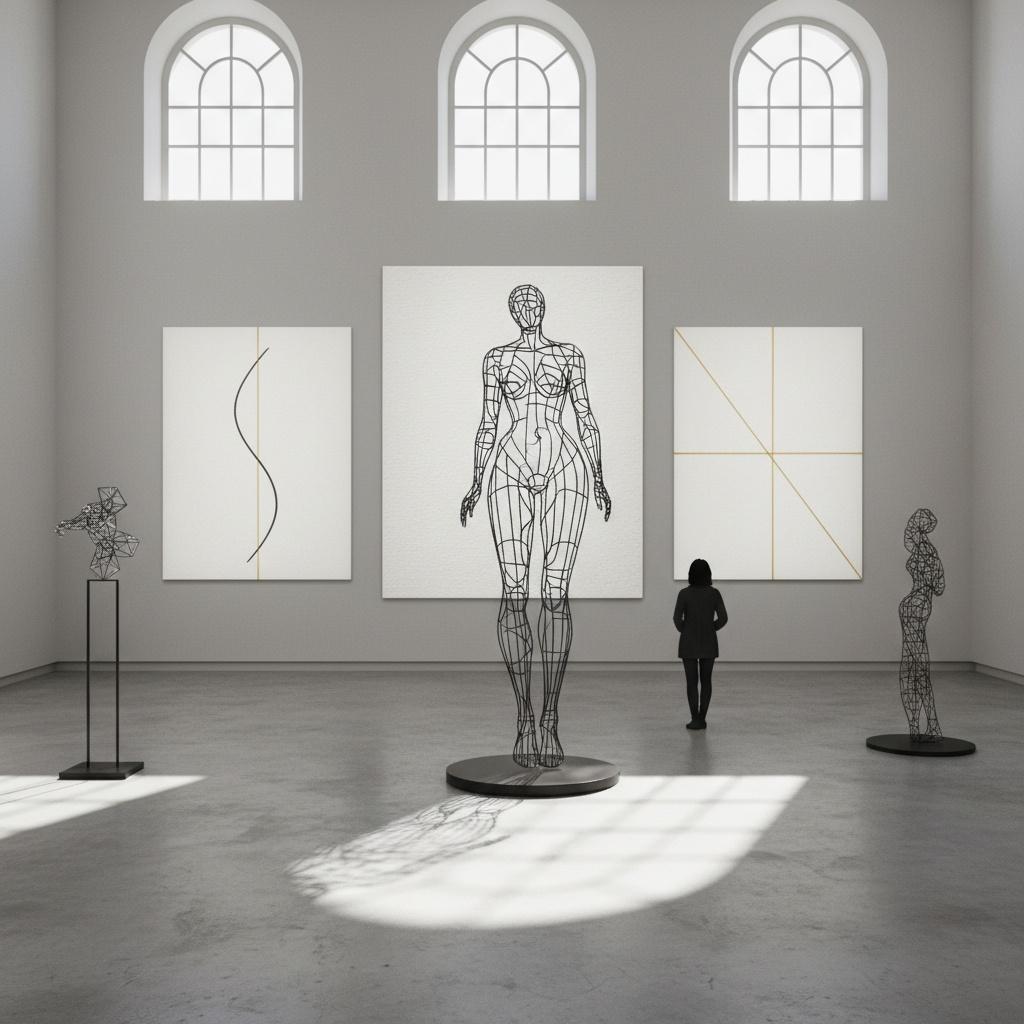
Similarly, the delicate graphic art of Joseph Cornell offers a different facet of minimalist elegance. His black line drawings of the female form demonstrate how a minimal amount of contouring can evoke a hauntingly beautiful presence. There is no need for heavy shading or ornate drapery when the precise placement of a single curve can suggest the tilt of a head or the softness of a shoulder. Even in large-scale installations, such as LeWitt’s Wall Drawing #338, the repetition of lines across divided planes creates a monumental architectural rhythm that feels both structured and ethereal. These works prove that when the line is mastered, it becomes an instrument of infinite expression.
Curating the Void: Integrating Minimalist Art into Sophisticated Interiors
For the modern connoisseur, integrating minimalist art into a curated home environment requires a delicate balance of curation and composition. Minimalism does not demand a sterile environment; rather, it thrives in spaces that respect the concept of "the breath." A large-scale abstract work, perhaps an expansive multi-panel series, can serve as the definitive anchor for a room, providing a focal point that commands attention without overwhelming the surrounding architecture. The key lies in treating the artwork not as an accessory, of decoration, but as a structural element of the interior design itself.
When selecting pieces for a sophisticated space, consider the interplay between the artwork's texture and the room's materiality. A hand-painted oil reproduction with visible, impasto brushstrokes can provide a necessary tactile warmth to a room characterized by smooth marble or glass. The shadows cast by the physical depth of the paint add a layer of complexity that flat prints simply cannot replicate. By pairing minimalist compositions with rich textures—such as velvet, solid wood, or heavy linen—the collector creates a sophisticated dialogue between the simplicity of the art and the luxury of the environment.
The Eternal Line: Why Minimalist Compositions Transcend Modern Trends
While design trends may fluctuate between the ornate and the austere, the power of the minimalist line remains remarkably constant. This is because minimalism taps into a universal aesthetic truth: the human brain is naturally drawn to order, clarity, and essentialism. A well-composed minimalist piece does not age; it does not become dated by the fashions of an era because it is built upon the timeless principles of balance and proportion. It possesses a permanence that allows it to remain relevant across generations.
Investing in minimalist art is an investment in longevity. Whether it is a custom commission that reimagines a personal memory through a geometric lens or a carefully selected historical reproduction, these works offer a lasting legacy. They provide a sanctuary of calm in an increasingly chaotic world, offering a window into a realm where beauty is found not in the excess of detail, but in the profound elegance of the essential. As we continue to navigate the complexities of the modern age, the simplicity of the line remains our most enduring and sophisticated guide.
Discover the transformative power of fine art with OriginalUniqueArt.com. From bespoke oil reproductions to expert art consultations, we bring the world's most profound aesthetics into your personal collection.