Introduction
To step into the world of Neoclassicism is to enter a realm of profound order, clarity, and moral gravity. Imagine walking through a silent, sun-drenched gallery where every line serves a purpose and every shadow tells a story of virtue. This was the heartbeat of an era that sought to move away from the perceived frivolity of the Rococo, turning its gaze instead toward the disciplined grandeur of Ancient Greece and Rome. It was a movement born from the Enlightenment—a period defined by reason, logic, and a renewed reverence for the classical ideals of heroism and civic duty.
As we traverse this historical landscape, we encounter canvases that do more than merely depict scenes; they embody the very spirit of an age striving for perfection. Through precise brushwork, a restrained palette, and compositions anchored in structural stability, these masters captured the tension between human emotion and stoic restraint. The textures of marble, the drape of heavy silk, and the starkness of dramatic light all serve to elevate the subject matter from the mundane to the monumental.
<Why do these works continue to resonate in our modern, often chaotic world? Because they speak to a universal human longing for stability, truth, and the eternal. The themes of sacrifice, patriotism, and the triumph of intellect over impulse remain as potent today as they were in the late 18th century. Whether through the sharp, academic precision of a portrait or the sweeping epic of a historical scene, these paintings offer a window into the foundational values of Western civilization.
In the following exploration, we shall guide you through ten definitive masterpieces—works that do not merely represent Neoclassicism but define it. Each painting selected for this list stands as a testament to the skill of artists who mastered the language of antiquity to create something timeless. Prepare to encounter the legends of the movement, from the dramatic compositions of Jacques-Louis David to the serene, sculptural elegance of those who followed in his footsteps.
The Grande Odalisque - Jean-Auguste-Dominique Ingres
 The Grande Odalisque - Jean-Auguste-Dominique Ingres
Imagine stepping into a quiet, sun-drenched chamber where the air is heavy with the scent of jasmine and the soft rustle of silk. In this moment of stillness, Jean-Auguste-Dominique Ingres’ 1814 masterpiece, The Grande Odalisque , unfolds before you—not merely as a painting, but as an invitation into a dream of exotic elegance. This work stands as a pillar of the Neoclassicism movement because it masterfully navigates the tension between academic precision and Romantic fantasy.
While Ingres adheres to the disciplined line-work of his era, he famously defies anatomical reality, elongating the figure's spine to achieve a transcendent, lyrical grace. The luminous flesh tones, contrasted against rich, deep blues and opulent textures, capture the 19th-century European fascination with Orientalist beauty. It is this ability to provoke wonder through technical virtuosity that secures its place among the top masterpieces of Neoclassicism. Bringing such a profound sense of serenity and historical depth into a modern home allows one to surround themselves with the enduring whispers of classical grandeur and timeless aesthetic perfection.
The Oath of the Horatii (detail) - Jacques-Louis David
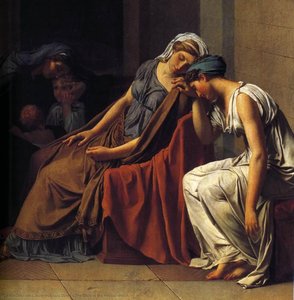 The Oath of the Horatii (detail) - Jacques-Louis David
In this poignant detail from Jacques-Louis David’s 1784 masterpiece, The Oath of the Horatii , we move away from the rigid geometry of civic duty to encounter the profound human cost of heroism. While the full composition celebrates Roman patriotism, this intimate segment focuses on the shadows of grief. We see women draped in heavy, classical fabrics, their forms rendered with a sculptural solidity that defines the Neoclassical era. The palette is a somber arrangement of warm ochres and deep, dramatic shadows, utilizing chiaroscuro to illuminate faces etched with despair.
There is a gaze in The Oath of the Horatii (detail) by Jacques-Louis David that follows you—not with judgment, but with understanding . This isn’t merely a historical tableau; it is a mirror reflecting our own capacity for sacrifice and sorrow. Its place among the top masterpieces of Neoclassicism is a testament to its power to make the invisible emotions of history visible. Imagine this profound tension in your own collection, not as a mere decoration, but as a silent reminder that you, too, are part of this enduring human story.
Plate one, from A Rake's Progress - William Hogarth
 Plate one, from A Rake's Progress - William Hogarth
In the first plate of A Rake's Progress , William Hogarth presents a masterclass in narrative complexity that serves as a vital precursor to the moral clarity sought by the Neoclassical movement. While the era was defined by an ordered return to antiquity, Hogarth utilizes the chaotic, Rococo-influenced energy of an 18th-century interior to deliver a biting social critique. Through meticulous engraving, he captures a scene teeming with symbolic disorder: scattered papers, gambling tables, and figures lost in frivolous pursuits all point toward the inevitable decay of Tom Rakewell’s character.
The artwork functions as a visual cautionary tale, where every fine line and cross-hatched shadow contributes to a sense of mounting anxiety and moral vanity. Owning this piece by Hogarth is not merely a purchase; it is an inheritance of the satirical tradition. At OriginalUniqueArt.com, we believe this lineage of taste belongs on your walls. Whether you seek a museum-quality print or a hand-painted oil reproduction that captures the tactile depth of his original engravings, you are bringing a piece of historical conscience into your modern home.
Self Portrait with Her Daughter, Julie - Louise Élisabeth Vigée Le Brun
 Self Portrait with Her Daughter, Julie - Louise Élisabeth Vigée Le Brun
In Self Portrait with Her Daughter, Julie , Élisabeth Vigée Le Brun transcends the rigid formalities of the late 18th century to capture a profound, breathing moment of maternal intimacy. As a cornerstone of the Neoclassicism movement, this 1789 masterpiece moves away from the frivolous ornamentation of the Rococo, instead utilizing balanced forms and a subdued, earthy palette to emphasize the raw emotional connection between mother and child. The dramatic, directional lighting carves the figures out of a dark, indistinct background, creating a sculptural depth that highlights the soft textures of skin and fabric.
This painting remains a vital reference for the Neoclassical era due to its ability to blend classical dignity with deep human sentiment. For the modern collector or interior designer, the work’s muted tones of cream, gray, and warm brown offer a sophisticated anchor for contemporary spaces, bringing an atmosphere of timeless serenity and grace. To possess a hand-painted oil reproduction of this work is to invite the enduring legacy of Vigée Le Brun’s mastery into your home, preserving the tender light and historical elegance of a bygone era.
Watson and the Shark - John Singleton Copley
 Watson and the Shark - John Singleton Copley
To encounter Watson and the Shark by John Singleton Copley is to witness a breathtaking moment of cinematic tension frozen in oil. As one of the most profound examples within the Top 10 Masterpieces That Defined the Neoclassicism Art Movement , this work transcends mere maritime reportage to become a visceral study of human vulnerability against the sublime power of nature.
Copley masterfully orchestrates a symphony of chaos; the churning, deep-blue waves and the looming, predatory shadow of the shark create an atmosphere of palpable peril. The dramatic lighting—reminiscent of a stage spotlight—illuminates the desperate reaching of Brook Watson, casting brilliant highlights against the somber, earthy tones of the turbulent Havana Harbor. This interplay of light and shadow lends the canvas a sculptural depth that resonates with the structured elegance of Neoclassical ideals.
For the discerning collector, this painting offers more than historical significance; it brings a sense of epic narrative and prestige to a refined interior. Its ability to command attention through movement and emotional intelligence makes it an enduring symbol of timeless beauty and dramatic legacy.
Basket of Peaches - Jean-Baptiste-Siméon Chardin
 Basket of Peaches - Jean-Baptiste-Siméon Chardin
What story does the quiet domesticity of Basket of Peaches by Jean-Baptiste-Siméon Chardin tell us about the shifting tides of the 18th century? While the era was often defined by the ornate, frothy excesses of the Rococo, Chardin emerged as a profound precursor to Neoclassicism by championing a return to substance and truth. In this 1768 masterpiece, he eschews courtly grandiosity for the humble beauty of ripe fruit, a dark glass, and textured walnuts arranged with masterful simplicity.
Through his signature use of impasto , Chardin breathes life into the velvety skins of the peaches, creating a tactile experience that invites the viewer to pause. The dramatic, directional lighting casts deep shadows, evoking a somber yet rich atmosphere reminiscent of the Dutch masters. For the modern collector, bringing such a piece into a home offers more than mere decoration; it provides a curated escape into a world of stillness and permanence. This painting serves as a cornerstone in our collection of the Top 10 Masterpieces That Defined the Neoclassicism Art Movement , offering a timeless sense of dignity to any sophisticated interior.
A Bay Hunter With Two Spaniels - George Stubbs
 A Bay Hunter With Two Spaniels - George Stubbs
To stand before A Bay Hunter With Two Spaniels is to witness the profound anatomical precision of George Stubbs, where every visible brushstroke serves to define the muscular tension of the bay horse and the soft, textured coats of his companions. In this 1777 masterpiece, Stubbs utilizes a meticulous layering of oil glazes to achieve a luminous, three-dimensional quality that captures the fleeting light of dawn. This technical mastery—blending scientific anatomical study with the serene, balanced compositions characteristic of the Neoclassical era—is what secures its place among the greatest works of the movement.
At OriginalUniqueArt.com, our mission is to preserve this tactile, sculptural depth for your own collection. Unlike flat prints, our handmade oil reproductions are painted on 100% cotton canvas, recreating the authentic impasto and rich tonal range of Stubbs' original work. We invite you to bring this sense of historical grandeur and naturalistic grace into your home through a piece that honors the true materiality of art history.
The Lictors Returning to Brutus the Bodies of his Sons - Jacques-Louis David
 The Lictors Returning to Brutus the Bodies of his Sons - Jacques-Louis David
In the somber shadows of 1789, The Lictors Returning to Brutus the Bodies of his Sons by Jacques-Louis David stands as a silent, harrowing testament to the heavy price of civic virtue. This masterpiece is immortalized among the greatest works of Neoclassicism because it captures the precise moment where personal grief collides with political duty. David employs a masterful chiaroscuro , using light to sculpt the agonizing tension in Brutus’s resolve against the cold, architectural stillness of the Roman setting.
The canvas breathes with a muted, earthy palette, where the textures of heavy drapery and stone evoke a sense of permanence and gravity. Every meticulous brushstroke serves the narrative of sacrifice, inviting viewers to contemplate the profound moral conflicts that define leadership. For the modern collector, bringing a high-quality oil reproduction of this work into a home offers more than mere decoration; it introduces a profound sense of historical weight and intellectual sophistication. The painting’s balanced composition and dramatic emotional depth provide a focal point of quiet strength, perfect for an interior dedicated to reflection and the enduring ideals of integrity.
Napoleon at the St. Bernard Pass - Jacques-Louis David
 Napoleon at the St. Bernard Pass - Jacques-Louis David
In Napoleon at the St. Bernard Pass by Jacques-Louis David, one is immediately struck by the resolute, commanding gaze of the First Consul, a look that transcends mere portraiture to embody the very essence of indomitable will. As a cornerstone of the Top 10 Masterpieces That Defined the Neoclassicism Art Movement , this work functions as a psychological study of ambition. David utilizes a dramatic interplay of light and shadow—chiaroscuro—to sculpt Napoleon’s youthful features against a turbulent, lightning-streaked sky, creating a sense of heroic grandeur that feels both historical and mythic.
The painting’s rhythmic composition, from the powerful white charger to the receding lines of marching soldiers, invites the viewer into a moment of profound transition. To possess a hand-made oil reproduction of such a monumental work is to bring more than just decor into your home; it is to invite a sense of disciplined strength and historical gravity into your personal sanctuary. Whether through the visible impasto brushstrokes of a custom canvas or a museum-quality print, displaying this masterpiece transforms any room into a space for deep reflection on leadership and the enduring human spirit.
The Loves of Paris and Helen - Jacques-Louis David
 The Loves of Paris and Helen - Jacques-Louis David
In the quiet, opulent corridors of history, few moments capture the tension between desire and destiny as exquisitely as Jacques-Louis David’s 1788 masterpiece, The Loves of Paris and Helen . As a cornerstone of the Neoclassicism movement, this work earns its place among the top masterpieces by pivoting away from the era's typical battlefield heroism toward an intimate, psychological drama. David masterfully utilizes a structured, linear perspective and directional lighting to sculpt the porcelain skin of the lovers against a backdrop of Roman-inspired grandeur.
The painting is a sensory triumph; one can almost feel the heavy, luxurious textures of the drapery and hear the soft resonance of Paris’s lyre. Beyond its surface beauty, the work serves as a profound meditation on how fleeting passion can ignite monumental historical shifts. For the modern collector, bringing a hand-painted reproduction of this piece into a home offers more than mere decoration; it introduces a timeless conversation between classical stability and the fluid, organic nature of human emotion, creating a sophisticated anchor for any curated interior.
Conclusion
As the light fades on our journey through the Neoclassical era, we are left not merely with a list of historical milestones, but with the enduring echoes of an age that sought order, virtue, and eternal beauty. These ten masterpieces serve as more than mere relics of the past; they are living presences, breathing with the disciplined grace of antiquity and the profound human emotions of a world in transition. To study them is to witness the triumph of clarity over chaos, where every deliberate brushstroke and balanced composition invites us to find stillness amidst the noise of modern life.
There is a unique profoundness in bringing such history into one's personal sanctuary. When you invite these works into your home through a hand-painted oil reproduction , you are doing more than decorating a wall; you are establishing a daily dialogue with the masters. The tactile depth of visible brushstrokes and the rich, luminous textures of canvas allow the solemnity of Jacques-Louis David or the soft elegance of Ingres to resonate within your own space, transforming a simple room into a gallery of reflection and inspiration.
We invite you to continue this exploration and find the piece that speaks to your soul. Whether you seek the heroic strength of a grand historical scene or the quiet poise of a classical portrait, you may discover your next timeless companion within our full collection . Let these works be a constant reminder of the heights human creativity can reach, serving as anchors of grace and light in your everyday world.