The Philosophy of the Sublime: Nature’s Untamed Majesty
 Romanticism
Romanticism (also known as the Romantic movement or Romantic era) was an artistic and intellectual movement that originated in Europe towards the end of the 18th century. The purpose of the movement was to advocate for the importance of subjectivity,...
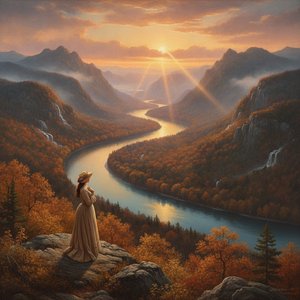
To understand the history of storm paintings, one must first grasp the profound philosophical shift that occurred during the late 18th and early 19th centuries. As the Age of Enlightenment sought to categorize and tame the world through reason and scientific order, a powerful counter-movement emerged: Romanticism. This era celebrated the sublime—an aesthetic experience that sits at the precarious intersection of overwhelming beauty and paralyzing terror. Unlike the serene landscapes of the classical tradition, storm paintings were designed to remind the viewer of human insignificance in the face of an infinite, untamed universe.
Artists like Caspar David Friedrich did not merely paint weather; they painted the stirrings of the human soul. In these works, a turbulent sky or a mist-shrouded mountain serves as a mirror for internal emotional states—melancholy, awe, and spiritual longing. The storm becomes a metaphor for the unpredictable nature of existence itself. When we stand before these masterpieces, we are not just observing a meteorological event; we are participating in a meditation on our own vulnerability and our enduring connection to the elemental forces of the earth.
Maritime Peril: The Dramatic Tradition of Shipwreck and Sea
 A Shipwreck in Stormy Seas
A Shipwreck in Stormy Seas (French: Tempête) is an oil on canvas seascape painting by the French artist Claude-Joseph Vernet, from 1773. He was known for his maritime art, such as his Views of the Ports of France series. The painting depicts a shipwr...
Perhaps no arena captures the drama of nature’s fury more effectively than the maritime seascape. For centuries, the sea has been depicted as a chaotic protagonist, capable of both providing bountiful life and delivering sudden, violent destruction. A cornerstone of this tradition is Claude-Joseph Vernet’s 1773 masterpiece, A Shipwreck in Stormy Seas. Originally commissioned by the King of Poland, this work exemplifies the tension between the elements; it depicts a vessel caught in the throes of a tempest, illustrating the sheer fragility of human endeavor against the crushing weight of the Atlantic waves.
This fascination with maritime peril extended through the generations, finding unique expressions in the works of artists like the Canadian marine painter John O'Brien. While O'Brien excelled at the precise portraiture of ships, he frequently infused his compositions with ominous skies and the churning energy of a storm. These paintings serve as historical documents of an era defined by exploration and trade, where the line between prosperity and catastrophe was often drawn by the sudden arrival of a gale. To possess such a work is to hold a piece of nautical history, capturing the very essence of the adventurer's spirit.
Atmospheric Tension: Stormy Skies in the Landscape Tradition
 Landscape with Cattle at Limousin
The Drama of the Pastoral: Capturing Movement in Dupre's Landscape To stand before Jules Dupré’s Landscape with Cattle at Limousin is to be enveloped by a moment suspended between tranquility and impending drama. This magnificent oil on canvas, datin...
While the sea offers overt violence, the landscape tradition often explores a more subtle, psychological form of storminess. This is found in the concept of atmospheric tension—that breathless moment when the air grows heavy and the light shifts, signaling an impending deluge. Jules Dupré, a prominent figure of the Barbizon School, mastered this art of anticipation. In works such as his Landscape with Cattle at Limousin, the drama is not found in a crashing wave, but in the way dark, encroaching clouds press down upon a pastoral scene, creating a sense of movement and unease within an otherwise tranquil setting.
Similarly, the Swedish painter Simeon Marcus Larson, a leading figure of the Düsseldorf school, utilized turbulent skies to imbue his river landscapes with intense emotional weight. His ability to capture the raw power of water under a heavy, storm-laden sky demonstrates how light and shadow can be manipulated to create a sense of profound movement. These artists taught us that a storm does not need to be at its peak to be felt; the mere threat of its arrival is enough to transform a landscape into a theater of high drama.
Brushwork of Chaos: Technical Mastery Over Light and Motion
 The Width of Anglesey
Explore 'The Width of Anglesey' by David James Woodford – a dramatic oil landscape capturing Welsh storminess. Romantic style, thick brushstrokes & cool colors. A captivating art piece for collectors.
The depiction of a storm requires more than just subject matter; it demands a specialized technical vocabulary. To convey the chaotic energy of wind and rain, artists must move beyond smooth, academic finishes toward more expressive techniques. The use of impasto—the thick, textured application of oil paint—is essential. It allows the artist to physically build up the crest of a wave or the heavy weight of a cloud, giving the canvas a three-dimensional vitality that a flat print can never replicate.
Consider the contrast between the meticulous, light-drenched truth of John Constable and the more rugged, thick brushstrokes found in modern Romantic interpretations. The true magic lies in the interplay of light and shadow, or chiaroscuro, where brilliant highlights on a spray of sea foam clash against deep, ominous tones. At OriginalUniqueArt.com, our artists honor this tradition by ensuring every reproduction is 100% hand-painted on cotton canvas. We avoid the flat, computer-printed look of modern posters, focusing instead on:
- Visible Brushstrokes: Capturing the energetic hand of the master to convey motion.
- Chromatic Depth: Utilizing high-quality oils to achieve a richer tonal range than any digital print.
- Textural Integrity: Creating the physical relief necessary to catch the light, much like the original masterpieces.
Timeless Grandeur: Preserving the Power of Storm Art in Your Collection
Bringing the majesty of these historical storms into a contemporary home is an act of curation and preservation. Whether you are drawn to the maritime legends of the 18th century or the atmospheric landscapes of the Barbizon School, art serves as a window into a more profound way of seeing the world. At OriginalUniqueArt.com, we specialize in making these canonical masterpieces accessible to the modern collector through our bespoke reproduction services.
Our process is designed for the discerning enthusiast who values both historical accuracy and artistic craftsmanship. We offer a unique opportunity to "remix" art history, allowing you to transform personal memories into the style of the masters or even request custom color palettes to match your interior design. From our professional digital mockups to our final hand-varnished finish, every step is managed by a dedicated Project Coordinator to ensure museum-grade quality.
We invite you to explore our collection and discover how a single, powerful landscape can transform a space into a sanctuary of contemplation. Whether through a large-format mural or a meticulously detailed oil reproduction, the power of the storm remains eternal.
Discover your next masterpiece at OriginalUniqueArt.com.