The Romantic Elevation: Clouds and Spiritual Contemplation
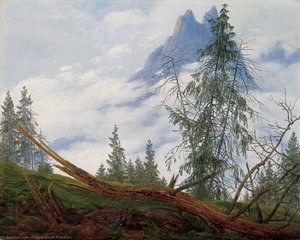 Mountain Peak with Drifting Clouds
Explore Caspar David Friedrich's iconic 'Mountain Peak with Drifting Clouds,' a masterpiece of Romantic landscape painting embodying spiritual contemplation and awe amidst sublime natural beauty. Admire its masterful use of light and shadow.
The presence of clouds in art is as old as art itself, yet their significance underwent a profound transformation during the Romantic era (late 18th – mid-19th century). No longer merely decorative elements or indicators of weather, clouds became potent symbols of the sublime, vehicles for spiritual contemplation, and reflections of the inner turmoil and awe experienced by artists in response to the natural world. This shift coincided with a growing dissatisfaction with Enlightenment rationalism and an increasing fascination with subjectivity, imagination, and emotion. Artists sought not to depict nature *as it was*, but as it *felt*. Caspar David Friedrich’s work exemplifies this perfectly. His iconic “Mountain Peak with Drifting Clouds” isn't simply a landscape; it is a meditation on human insignificance in the face of God’s creation, the swirling clouds acting as intermediaries between the earthly realm and the infinite beyond. The misty veils obscure detail, inviting viewers to project their own emotions onto the scene – loneliness, longing, or perhaps a sense of transcendent peace. The cloud, therefore, ceased to be a passive observer and became an active participant in the emotional drama unfolding on canvas.
Constable’s Skies: Observation, Meteorology, and Emotional Realism
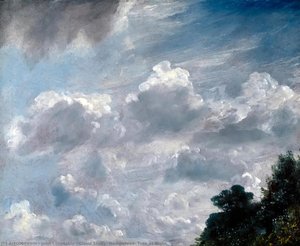 Cloud Study, Hampstead, Tree at Right
This artwork exemplifies Constable's Romantic style, prioritizing observation and conveying the sublime beauty of nature through expressive brushstrokes.
While Friedrich embraced the symbolic power of clouds, John Constable approached them with a scientific rigor rarely seen in his contemporaries. He wasn't interested in representing abstract concepts but rather in capturing the precise effects of light and atmosphere on the English countryside. His meticulous “Cloud Study, Hampstead, Tree at Right” is a testament to this dedication – a detailed observation of cloud formations, their textures, and shifting colors. Constable’s fascination extended beyond mere visual representation; he actively studied meteorology, seeking to understand the physical processes that shaped the skies above him. This pursuit wasn't simply academic; it informed his artistic technique, allowing him to render clouds with an unprecedented degree of realism and luminosity. However, even in these seemingly objective studies, Constable imbued his skies with a palpable emotional quality. His paintings evoke a sense of tranquility, nostalgia, and a deep connection to the rural landscape – qualities that resonated deeply with audiences seeking solace from the rapid industrialization of England. As described in “John Constable: Nature, Light & the Romantic Vision of Rural England,” he revolutionized landscape painting by prioritizing emotive scenes.
Aerial Perspective: From Pompeii to the Renaissance – Depicting Distance and Atmosphere
Aerial perspective, or atmospheric perspective, is the effect the atmosphere has on the appearance of an object as viewed from a distance. As the distance between an object and a viewer increases, the contrast between the object and its background de...
The artistic exploration of clouds is inextricably linked to the development of aerial perspective, a technique used to create an illusion of depth on a two-dimensional surface. Though fully realized during the Renaissance, its roots can be traced back much further. Remarkably, examples appear in Pompeian Second Style frescos dating as early as 30 BCE, demonstrating an early understanding of how atmosphere affects the appearance of objects at a distance. As explained by Wikipedia’s entry on aerial perspective, distant elements are depicted with reduced contrast and color saturation, shifting towards bluish tones – mimicking the way light scatters through the air. Leonardo da Vinci masterfully employed this technique in works like “The Annunciation” and the “Mona Lisa,” creating a sense of atmospheric depth that was revolutionary for his time. This wasn’t merely about technical skill; it reflected a growing scientific interest in optics and perception, influencing how artists represented the world around them. The ability to convincingly portray distance and atmosphere allowed painters to create more immersive and realistic landscapes, setting the stage for the Romantic era's heightened focus on natural phenomena.
Symbolist Cloudscapes: The Visible Invisible and the Fin-de-Siècle Aesthetic
By the late 19th century, as Symbolism gained prominence, clouds underwent another transformation. Artists no longer sought to represent nature realistically or even emotionally; instead, they explored its symbolic potential, often detaching clouds from their terrestrial context and presenting them as independent subjects of contemplation. This period saw a surge in cloudscapes that were less about depicting specific weather patterns and more about evoking moods, dreams, and the intangible realms of the subconscious. The article “Cloudscapes over the Baltic Sea–Cloud Motifs in Finnish, Swedish, German, Russian, Polish, Lithuanian, and Latvian Symbolic Landscape Painting around 1900” highlights this trend, noting that clouds became imbued with a variety of cultural and literary associations. Artists like Odilon Redon created ethereal cloud formations against dreamlike skies, while Ferdinand Hodler invested his ornamental cumuli with almost transcendental meaning. The emphasis shifted from observation to introspection, with clouds serving as mirrors reflecting the artists’ inner states and anxieties – a hallmark of the fin-de-siècle aesthetic.
Beyond Representation: Clouds as Subject in Modern Landscape Painting
Even into the 20th century and beyond, the fascination with clouds persisted. While modern art movements often rejected traditional landscape painting, many artists continued to explore the expressive potential of cloudscapes. Peder Balke’s “Vue du Presbytère d’Eidsvold” offers a compelling example – a captivating Norwegian landscape where atmospheric detail and romantic emotion take precedence over precise representation. The clouds aren't merely background elements; they are integral to the painting’s overall mood, conveying a sense of serenity and isolation. Mark Maggiori continues this tradition today, creating highly nostalgic takes on the “golden era” of the West, often featuring dramatic thunderheads that dominate the skylines of his paintings. The enduring appeal of clouds lies in their inherent ambiguity – they are constantly shifting, ever-changing forms that invite interpretation and evoke a sense of wonder. Whether depicted with scientific precision or symbolic abstraction, clouds remain a powerful motif for artists seeking to capture the beauty, mystery, and emotional resonance of the natural world. OriginalUniqueArt.com offers a diverse collection of landscape paintings featuring stunning cloudscapes, allowing you to explore this rich artistic tradition and find the perfect artwork to inspire your own contemplation.