American Realism · 1898
Salutat (토마스 에이킨스, 1898)
토마스 에이킨스 (1844–1916) 작가의 Salutat 1898년에 제작되었습니다. American Realism 운동에 속합니다. Oil On Canvas(으)로 제작되었습니다. 매사추세츠, 미국에 위치한 Addison Gallery of American Art에 소장되어 있습니다.
- 1898
- Oil On Canvas
- Addison Gallery of American Art, 매사추세츠

 미리보기

 수작업 유화 작품
 공유하기
 공유하기
 학습용 요약본


 다운로드
 유사 작품 더 보기
 X-레이
 슬라이드 쇼 보기
 질의응답

 통계 정보
Salutat 요약
- 제목
- Salutat
- 작가
- 토마스 에이킨스 (1844–1916)
- 작가 출생지
- 필라델피아, 미국
- 제작 연도
- 1898
- 매체
- Oil On Canvas
- 전시 장소
- Addison Gallery of American Art, 매사추세츠, 미국
- 주제
- human figure, performance art, monochromatic palette, psychological depth, american painting, realism technique
Salutat은(는) 무엇을 묘사하고 있나요?
A Portrait of Vulnerability: Exploring Thomas Eakins’ Salutat
- Subject Matter The painting “Salutat,” created in 1898 by American artist Thomas Eakins, depicts a solitary man standing amidst a crowd. Strikingly nude from the waist up, he presents his back to the audience, embodying an arresting stillness that contrasts sharply with the bustling activity surrounding him.
- Style and Technique Eakins’ masterful use of oil on canvas exemplifies realism—a hallmark of his oeuvre. The monochromatic palette—primarily shades of gray—intensifies the emotional impact, focusing attention squarely on the central figure's posture and expression. Precise brushstrokes contribute to a textured surface that conveys both physicality and psychological depth.
- Historical Context Produced during the late Victorian era, “Salutat” reflects the artistic currents of its time, prioritizing observation and anatomical accuracy over idealized representations. Eakins’ fascination with scientific illustration—evident in his meticulous rendering of musculature—mirrors a broader trend toward documenting the human form with unprecedented detail.
- Symbolism The man's posture – turned away from scrutiny – speaks to themes of introspection and vulnerability. The bucket held aloft symbolizes perhaps an act of defiance or performance, adding layers of narrative complexity to the composition. It invites contemplation on notions of exposure and self-presentation within a social context.
- Emotional Impact “Salutat” transcends mere visual depiction; it evokes feelings of quiet contemplation and subtle unease. The painting’s stark simplicity underscores the profound psychological portraiture characteristic of Eakins's work, prompting viewers to consider questions of identity and perception.
The Artist: Thomas Eakins – A Pioneer of Realism
Thomas Cowperthwait Eakins (1844-1916), born in Philadelphia, stands as a cornerstone of American art history. Unlike many artists of his era preoccupied with grand narratives or romantic ideals, Eakins relentlessly pursued the depiction of everyday life—the world of doctors, rowers, and hunters—with an unwavering commitment to anatomical precision and psychological insight.
His formative years instilled in him a profound appreciation for observation and scientific inquiry. This dedication would propel him to become one of the most influential realist painters of the late nineteenth century, challenging conventions and establishing a new standard for artistic representation. Eakins’s Philadelphia was not a city of picturesque vistas; it was a crucible of intellectual ferment—a place where he honed his skills and developed his distinctive vision.
Exploring Eakins's Method: Anatomical Precision and Monochromatic Palette
Eakins’ artistic approach stemmed from a deep understanding of human anatomy. He meticulously studied musculature, striving to capture the subtle nuances of posture and movement—a practice that would inform his paintings with remarkable accuracy. This scientific rigor extended beyond mere anatomical representation; it served as a springboard for exploring psychological states.
Furthermore, Eakins favored a monochromatic palette—primarily shades of gray—to heighten emotional resonance. By eliminating color, he focused the viewer’s gaze on form and texture, emphasizing the expressive qualities of light and shadow. This technique underscores his belief that visual art could convey profound truths about human experience.
Beyond Representation: The Psychological Depth of Salutat
"Salutat" isn't simply a portrait; it’s an invitation to delve into the complexities of human consciousness. Eakins skillfully captures the vulnerability inherent in solitude—the man’s averted gaze conveying a sense of introspection and confronting unspoken anxieties.
The painting’s deliberate simplicity amplifies its impact, prompting viewers to consider questions of identity and perception. Like Elizabeth at the Piano and Portrait of Professor Henry A. Rowland – also available on OriginalUniqueArt.com – “Salutat” exemplifies Eakins's unwavering dedication to portraying the human condition with unflinching honesty.
Salutat은(는) 어느 미술관에 소장되어 있나요?
Addison Gallery of American Art
매사추세츠, 미국
미국적 비전의 등불: 애디슨 갤러리를 탐험하다 매사추세츠주 앤도버에 위치한 필립스 아카데미의 유서 깊은 캠퍼스 안에 자리 잡은 애디슨 미국 미술관(Addison Gallery of American Art)은 단순한 회화와 조각의 저장소를 넘어, 미국 내 예술적 표현이 지닌 진화하는 정신과 불멸의 힘을 보여주는 생생한 증거입니다. 비판적 사고와 미적 감수성을 함양하려는 비전 아래 1931년에 설립된 애디동 갤러리는 학습과 대화, 그리고 영감이 교차하는 역동적인 중심지로 꽃을 피웠습니다. 이곳은 미국의 풍요로운 창의적 유산과 연결되기를 갈망하는 모든 이들에게 열려 있는 공간입니다.


Salutat의 고해상도 이미지

토마스 에이킨스, Salutat (1898), Addison Gallery of American Art. 퍼블릭 도메인
Salutat에 관한 질문과 답변
토마스 에이킨스의 "Salutat"의 원화는 어디에서 감상할 수 있나요?
토마스 에이킨스의 "Salutat"의 원작은 Addison Gallery of American Art, 매사추세츠, 미국에 소장되어 있습니다. 복제화를 통해 이 작품을 집에서도 감상하실 수 있습니다.
"Salutat"은 어떤 기법으로 제작되었나요?
토마스 에이킨스의 "Salutat"에는 어떤 모습이 담겨 있나요?
"Salutat"에 담긴 소재는 human figure, performance art, monochromatic palette, psychological depth, american painting, realism technique, bucket gesture입니다.
"Salutat"은(는) 저작권으로부터 자유로운가요?
"Salutat"은(는) 어떤 화풍에 속하나요?
Salutat은(는) 토마스 에이킨스의 예술적 경력 중 어느 시기에 해당하나요?
아티스트 토마스 에이킨스 소개

1844–1916, 미국
토마스 에이킨스
토마스 이킨스의 삶 1844년 7월 25일, 펜실베이니아주 필라델피아에서 태어난 토마스 이킨스는 자신이 태어난 도시의 토양에 깊이 뿌리를 둔 삶을 살았습니다. 그는 화가이자 사진가, 조각가, 그리고 미술 교육자로서 여러 분야를 넘나들며 다재다능한 면모를 보여준 예술가였습니다. 그의 예술적 호기심은 종종 그를 해외로 이끌어 학문적 탐구를 이어가게 했지만, 그의 존재를 지탱하는 지리적 중심은 언제나 필라델피아에 머물러 있었습니다. 그는 도시의 지적, 사회적 관계망 속을 유영하며, 지역의 풍경을 정의하는 사람들과 그들이 마주한 물리적 실재를 예리하게 관찰했습니다.
토마스 에이킨스의 다른 작품들
 그로스 클리닉1875
 수영1885
 맥스 쉼트, 단상선배를 조종하며1871
 Portrait of Samuel Murray1889

Salutat 관련 에세이
 American contemporary realist paintersMasterpieces by Chuck Close and Amy Sherald define American contemporary realism. Explore the full collection online at OriginalUniqueArt.c…
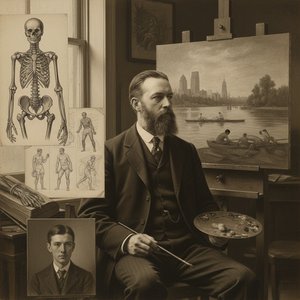 Thomas Eakins: Realism, Anatomy & the American Spirit – A Comprehensive Exploration of Life and LegacyExplore the life & legacy of Thomas Eakins, a pivotal American Realist painter. Discover his groundbreaking techniques, anatomical precisio…
 제임스 애벗 맥닐 휘슬러 최고 걸작 25선: 예술의 정수, 공간에 스며드는 아름다움제임스 애벗 맥닐 휘슬러의 최고 걸작 25선을 만나보세요. 야간 풍경부터 아랑미술관 소장품까지, 예술가의 삶과 작품 세계를 탐험합니다. 색채와 분위기가 완벽한 조화를 이루는 그림들을 OriginalUniqueArt.com에서 감상하고 특별한 공간을 …