Expressionism
Prophet (에밀 놀데)
에밀 놀데 (1867–1956) 작가의 Prophet Expressionism 운동에 속합니다. Woodcut(으)로 제작되었습니다.
- Woodcut

 미리보기

 수작업 유화 작품
 공유하기
 공유하기
 가이드 보기


 다운로드
 유사 작품 더 보기
 X-레이
 슬라이드 쇼 보기
 질의응답

 통계 정보
Prophet: 핵심 정보
Prophet은(는) 무엇을 묘사하고 있나요?
The Portrait of Prophet by Emil Nolde
In Prophet, the German Expressionist painter Emil Nolde captures a man who exists between the physical and the divine. The subject is a portrait of a man likely intended to represent a prophet, a figure carved from shadow and light. His beard and hairstyle suggest a man from a distant past or a religious leader, a person shaped by the weight of revelation. The face is a landscape of heavy lines and stark contrasts.
The man’s intense gaze pierces through the grain of the medium. A furrowed brow carries the imprint of deep emotion, perhaps a mixture of sadness, concern, or a singular, driving determination. This is not a likeness of a person in repose, but a study of a soul under pressure. The features are simplified, stripped of unnecessary detail to reveal the raw essence of the subject's internal state.
Emil Nolde uses the starkness of the form to emphasize this spiritual tension. Every line serves the gravity of the man's expression. The eyes do not merely look; they witness. The stillness of the portrait holds a quiet, heavy ache.
Composition and Visual Elements
The man's face occupies the center, a heavy presence that fills most of the frame. His head tilts slightly, caught in a moment of quiet anguish or deep contemplation. Around him, the background remains largely empty, a void that forces the eye back to the subject's features. There is no horizon, only the weight of the gaze.
Bold, thick lines carve the anatomy of the man. They define the coarse texture of his beard, the sharp ridge of his nose, and the deep-set hollows of his eyes. These lines are not smooth; they are angular and sharp, cutting through the space to shape his hair and facial structure. The geometry is simplified, reducing the man to essential, striking forms.
The color palette is stripped of all distraction. It exists in a narrow world of black and white, bridged only by subtle shades of grey. This lack of color heightens the dramatic tension, turning the portrait into a study of light and shadow. The starkness leaves no room for anything but the raw emotion of the expression.
Technique and Artistic Medium
The work emerges from the physical resistance of wood. This woodcut print relies on the deliberate act of carving lines into a solid block to define its form. Each stroke is a subtraction, a removal of material that leaves behind a sharp, angular topography. The artist works with wood, ink, and paper to translate a vision into a permanent, tactile presence.
Ink meets the paper through the pressure of the press. This contact creates a grainy texture across the surface, a subtle roughness that speaks of the material's origin. The depth of the shadows and the brightness of the highlights depend entirely on the variation of the lines. Thicker cuts hold more ink to create heavy shadows, while thinner, delicate lines allow the paper to breathe through the composition. The result is a stark, high-contrast landscape of light and dark.
The medium demands a directness of hand. There is no blending here, only the immediate impact of the carved edge. The grain of the wood and the weight of the ink settle into the fibers of the paper, creating a surface that feels both raw and finished. It is a quiet collision of tool and grain.
고해상도 Prophet
에밀 놀데, Prophet. 퍼블릭 도메인
Prophet에 관한 질문
"Prophet"은(는) 어떤 내용을 담고 있나요?
"Prophet"에 담긴 소재는 man, face, beard, black and white, portrait, eyes입니다.
"Prophet"은(는) 저작권으로부터 자유로운가요?
에밀 놀데의 "Prophet"은(는) 어떤 미술 사조에 속하나요?
"Prophet"의 저작권 상태가 왜 이렇게 지정되어 있나요?
"Prophet"은(는) 에밀 놀데의 작품 세계에서 어떤 위치를 차지하고 있나요?
아티스트 에밀 놀데 소개
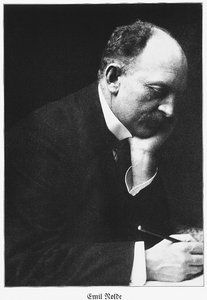
1867–1956, 덴마크
에밀 놀데
에밀 놀데의 삶과 정체성 1867년 8월 7일, 한스 에밀 한센이라는 이름으로 태어난 그는 훗날 에밀 놀데라는 이름으로 세상에 각인되었습니다. 그의 유년 시절은 슐레스비히 공국의 놀데 마을 근처에서 가족들과 함께 영위하던 농촌의 소박한 삶 속에서 형성되었습니다. 그러나 그는 정해진 운명과도 같은 농경의 길을 뒤로하고, 목공예가이자 가구 장식가로서의 삶을 선택했습니다. 이러한 촉각적이고 육체적인 노동의 경험은 훗날 그가 회화와 판화의 세계로 나아가는 데 있어 중요한 밑거름이 되었습니다.
에밀 놀데의 다른 작품들
 Sunset
 Sea with Red Sky
 Couple on the beach1903
 Masks1911
Prophet 관련 에세이
 Stone and Sinew: The Sculptural Foundations of Modigliani’s PortraitsExplore the sculptural roots and structural mastery of Modigliani's portraits. Discover the secrets behind his iconic, carved style now.
 Expressionism vs. New Objectivity: Emotion vs. Precision in German ArtMaster the tension between Expressionist emotion and New Objectivity precision. Explore the soul of German modern art now.
 Emile Nolde: A Journey into Expressionist Nature & the Primal SelfExplore the powerful Expressionism of Emile Nolde – a pioneer of emotive landscapes & spiritual themes. Discover his journey, influences, a…