Art Nouveau
Muse (알폰스 무하)
알폰스 무하 (1860–1939) 작가의 Muse Art Nouveau 운동에 속합니다. Oil On Canvas(으)로 제작되었습니다.
- Oil On Canvas

 미리보기

 수작업 유화 작품
 공유하기
 공유하기
 학습용 요약본


 다운로드
 유사 작품 더 보기
 X-레이
 슬라이드 쇼 보기
 질의응답

 통계 정보
Muse 요약
- 제목
- Muse
- 작가
- 알폰스 무하 (1860–1939)
- 작가 출생지
- 브르노, 체코
- 매체
- Oil On Canvas
- 운동성
- Art Nouveau
- 제작 시기
- 19th Century
- 주제
- portrait, muse, artnouveau, floral, melancholy, woman
Muse은(는) 무엇을 묘사하고 있나요?
A Whisper of Inspiration: Exploring Alphonse Mucha’s “Muse”
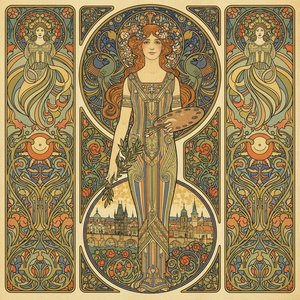
Alphonse Maria Mucha's "Muse" is more than just a portrait; it’s an immersion into the heart of Art Nouveau, a testament to the movement’s obsession with beauty, nature, and the idealized feminine form. Executed in Mucha’s signature style – characterized by sinuous lines, delicate ornamentation, and a profound sense of serenity – this artwork captures a moment of quiet contemplation, inviting the viewer to step into a world of graceful elegance and subtle emotion. The piece speaks volumes about Mucha's influence, his ability to translate decorative fantasy into enduring artistic statements.
Decoding the Visual Language: Composition & Technique
The composition immediately draws the eye towards the central figure, seated with an almost languid grace. Mucha employs a pyramidal structure, anchoring the viewer’s gaze to her head – framed by a breathtaking headdress overflowing with blossoms. This deliberate arrangement echoes classical portraiture while simultaneously embracing the Art Nouveau preference for organic forms. The artist's masterful technique is evident in the layering of colors and the seamless blending of tones, creating a luminous effect that seems to emanate from within. Notice the meticulous detail applied to her drapery and facial features – a hallmark of Mucha’s dedication to realism within his stylized aesthetic. The use of oil or pastel on canvas (or perhaps paper) allows for this incredible level of nuance, capturing both light and shadow with remarkable sensitivity.
A Symphony of Color & Symbolism
The color palette – a harmonious blend of creams, beiges, pale yellows, and muted oranges – evokes a sense of timelessness and tranquility. The strategic use of red-brown accents in the drapery adds depth and richness, while subtle blues and greens within the floral motifs subtly connect the figure to the natural world, a recurring theme in Mucha’s work. Beyond mere aesthetics, the headdress itself is laden with symbolism. Flowers have long represented beauty, fertility, and the influence of nature – concepts central to Art Nouveau's celebration of the organic. The woman’s direct gaze, imbued with a touch of melancholy, invites introspection and suggests a connection to the timeless themes explored by artists throughout history.
Contextualizing the Masterpiece: Mucha & the Art Nouveau Movement
Created during Mucha’s most prolific period (1887-1939), “Muse” exemplifies his pivotal role in shaping the Art Nouveau style. Born in Brno, Czech Republic, Mucha initially studied at the Academy of Fine Arts in Prague but quickly rejected its academic constraints, seeking a more expressive and decorative approach. He found success in Paris, creating iconic posters and illustrations for prominent clients like Sarah Bernhardt. His work reflects influences from artists such as Pierre-Auguste Renoir and Gustave Moreau, yet he forged his own distinct path – one defined by flowing lines, intricate patterns, and an unwavering commitment to portraying idealized female figures. “Muse” stands as a prime example of this legacy, solidifying Mucha’s place as one of the most significant artists of the Art Nouveau movement.
Muse의 고해상도 이미지
알폰스 무하, Muse. 퍼블릭 도메인
Muse에 관한 질문과 답변
알폰스 무하의 "Muse"에는 어떤 소재가 등장하나요?
알폰스 무하의 "Muse"은(는) 퍼블릭 도메인인가요?
알폰스 무하의 "Muse"은(는) 어떤 미술 사조에 속하나요?
Muse은(는) 알폰스 무하의 예술적 여정 중 어느 시기의 작품인가요?
"Muse"의 저작권 상태가 왜 이렇게 지정되어 있나요?
"Muse"은(는) 알폰스 무하의 작품 세계와 화풍을 어떻게 반영하고 있나요?
"Muse"의 주제가 알폰스 무하 작가의 평소 작업 세계와 어떤 연관이 있나요?
아티스트 알폰스 무하 소개

1860–1939, 체코
알폰스 무하
알폰스 무하: 꿈결 같은 선과 슬라브 민족의 영혼을 담은 예술가 1860년 보헤미아의 작은 마을 이바나치체에서 태어난 알폰스 무하는 어린 시절부터 뛰어난 예술적 재능을 드러냈다. 프라하 미술 아카데미에 입학했지만, 전통적인 교육 방식에 만족하지 못하고 새로운 가능성을 찾아 1887년 파리로 떠났다. 당시 파리는 인상주의와 신인상주의 등 다양한 사조가 공존하며 격동적인 예술적 변화를 겪고 있었다. 무하는 이러한 환경 속에서 자신만의 독특한 스타일을 구축하기 시작했다.
알폰스 무하의 다른 작품들
 The Moon
 Nude
 The Apotheosis of the Slavs1926
 Stained-Glass Window in St. Vitus Cathedral
Muse 관련 에세이
 Alphonse Mucha: A Comprehensive Exploration of Art Nouveau's Master of Decorative SymbolismExplore the life & art of Alphonse Mucha, master of Art Nouveau! Discover his iconic posters, stunning illustrations, and the monumental Sl…
 The Elegance of Art Nouveau: Embracing Nature's Fluid Beauty and the Belle Époque SpiritDiscover the enchanting world of Art Nouveau. Explore the organic beauty, flowing lines, and Belle Époque elegance that defined an era of u…
 The Language of Brushstrokes: How Texture and Technique Reveal the Soul of ArtDiscover the profound connection between texture and emotion in Impressionist art. Explore how masterful brushstrokes by Renoir and Monet c…