Art Nouveau Art Nouveau
(41) (알폰스 무하)
알폰스 무하 (1860–1939) 작가의 (41) Art Nouveau Art Nouveau 운동에 속합니다. Acrylic On Canvas(으)로 제작되었습니다.
- Acrylic On Canvas

 미리보기

 수작업 유화 작품
 공유하기
 공유하기
 학습용 요약본


 다운로드
 유사 작품 더 보기
 X-레이
 슬라이드 쇼 보기
 질의응답

 통계 정보
(41) 요약
- 제목
- (41)
- 작가
- 알폰스 무하 (1860–1939)
- 작가 출생지
- 브르노, 체코
- 매체
- Acrylic On Canvas
- 주제
- woman, hair, dress, baby, floral, organic
(41)은(는) 무엇을 묘사하고 있나요?
Alphonse Mucha: The Enchanting Symbolism of Art Nouveau
Alphonse Maria Mucha stands as one of the most recognizable figures of Art Nouveau, an artistic movement that flourished between 1890 and 1910 across Europe. Born in Brno, Czech Republic, in 1860, Mucha rejected the rigid academic traditions of his time, forging a path toward a uniquely expressive style that captivated audiences and continues to inspire artists today.
Much’s artistic vision centered around capturing ethereal beauty—primarily through idealized depictions of women—often presented in flowing robes adorned with intricate floral motifs. Influenced by Impressionism and Symbolism, he skillfully blended these influences into his distinctive Art Nouveau aesthetic. Unlike the prevailing stylistic trends of his era, Mucha prioritized organic forms and graceful curves, mirroring the natural world’s rhythms and conveying a sense of movement.
His breakthrough came with collaborations on decorative posters for Parisian theaters and exhibitions. These commissions demanded meticulous attention to detail—particularly in the rendering of textures and colors—resulting in stunning visual experiences that cemented Mucha's reputation as a master craftsman. He employed techniques such as cloisonné enamel, gilding, and lithography to achieve unparalleled luminosity and vibrancy, pushing the boundaries of printmaking.
The Slavonic Uprising: A Fusion of Tradition and Innovation
Perhaps Mucha’s most ambitious project was “The Slavonic Uprising,” a monumental mural commissioned for Prague’s National Theatre. This artwork exemplifies Mucha's ability to synthesize disparate elements into a cohesive narrative—combining traditional Czech folklore with the dynamism of Art Nouveau principles.
The mural depicts a stylized battle scene, featuring figures draped in flowing robes reminiscent of Slavic princesses and warriors. Mucha skillfully utilized bold colors and sweeping lines to convey the urgency and grandeur of the uprising, capturing both its heroic spirit and its underlying melancholy. The intricate floral ornamentation—particularly around the central figures—underscores the movement’s preoccupation with nature and symbolizes resilience amidst adversity.
Symbolism Rooted in Myth and Folklore
Throughout Mucha's oeuvre, symbolism played a crucial role in conveying deeper meanings beyond mere visual representation. Recurring motifs—such as lilies, roses, and peacocks—carried associations rooted in Slavic mythology and Christian iconography. These symbols served to elevate the artwork’s emotional impact, inviting viewers to contemplate themes of heroism, sacrifice, and spiritual transcendence.
Consider “La Ribambelle des Gobelins,” a collaborative project with Piero Dorazio that explored the concept of collective creativity. Mucha's contribution—a stylized depiction of women—embodied the movement’s belief in the transformative power of art to inspire social change and celebrate human beauty.
A Legacy Enduring Through Reproduction
Today, Alphonse Mucha’s artwork continues to resonate with audiences worldwide. High-quality reproductions offer a captivating glimpse into his artistic genius—allowing collectors and interior designers alike to experience the enchantment of Art Nouveau firsthand. His enduring influence testifies to the power of visionary art to transcend time and inspire generations of artists.
(41)의 고해상도 이미지
알폰스 무하, (41). 퍼블릭 도메인
(41)에 관한 질문과 답변
알폰스 무하의 "(41)"의 기법은 무엇인가요?
알폰스 무하의 "(41)"에는 어떤 모습이 담겨 있나요?
"(41)"은(는) 저작권으로부터 자유로운가요?
"(41)"은(는) 어떤 화풍에 속하나요?
"(41)"은(는) Art Nouveau Art Nouveau 양식의 작품입니다. 이 사조는 해당 작품이 속한 예술적 전통을 나타냅니다.
"(41)"의 저작권 상태가 왜 이렇게 지정되어 있나요?
"(41)"은(는) 알폰스 무하의 다른 작품들과 어떤 공통점을 지니고 있나요?
아티스트 알폰스 무하 소개

1860–1939, 체코
알폰스 무하
알폰스 무하: 꿈결 같은 선과 슬라브 민족의 영혼을 담은 예술가 1860년 보헤미아의 작은 마을 이바나치체에서 태어난 알폰스 무하는 어린 시절부터 뛰어난 예술적 재능을 드러냈다. 프라하 미술 아카데미에 입학했지만, 전통적인 교육 방식에 만족하지 못하고 새로운 가능성을 찾아 1887년 파리로 떠났다. 당시 파리는 인상주의와 신인상주의 등 다양한 사조가 공존하며 격동적인 예술적 변화를 겪고 있었다. 무하는 이러한 환경 속에서 자신만의 독특한 스타일을 구축하기 시작했다.
알폰스 무하의 다른 작품들
 The Moon
 Nude
 The Apotheosis of the Slavs1926
 Stained-Glass Window in St. Vitus Cathedral
(41) 관련 에세이
 Resilience and Heritage: A Curated Journey Through the Soul of Ukrainian Art HistoryExplore the profound legacy of Ukrainian art from Baroque grandeur to Repin's realism. Discover this rich cultural journey now.
 손으로 그린 명작 복제의 매력: 질감, 깊이 및 장인 정신적 가치에 대한 투자 (Soneuro geurin myeongjak bokje-ui maeryeok: jilgam, gipi wa jangin jeongsintjeok gaji-e daehan tuja)OriginalUniqueArt에서 손으로 그린 명작 복제를 만나보세요. 숙련된 화가의 섬세한 기술과 최고급 재료로 원작의 아름다움을 완벽하게 재현합니다. 예술 투자, 인테리어 아트, 맞춤형 제작까지! 지금 바로 경험하세요.
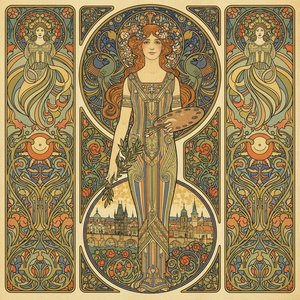 Alphonse Mucha: A Comprehensive Exploration of Art Nouveau's Master of Decorative SymbolismExplore the life & art of Alphonse Mucha, master of Art Nouveau! Discover his iconic posters, stunning illustrations, and the monumental Sl…