


1


11월 2026 업데이트 · 인기 점수 기준 순위 (각 작품의 검색, 방문 및 주문 수) · 27점의 Adriaan Jozef Heymans 작품 (당사 카탈로그 기준)
요약하자면
갤러리가 선정한 Adriaan Jozef Heymans의 가장 유명한 작품은 Sunset on the Heath (1877)이며, 원작은 헨트의 Museum of Fine Arts Ghent (MSK)에 전시되어 있습니다. Woodland near Bertogne (1875)와 St Abbs Harbour (1891)가 더해져 누구나 한눈에 알아볼 수 있는 완벽한 트리오를 완성합니다. Adriaan Jozef Heymans의 작품 27점 중, 갤러리는 가장 유명한 27점을 아래와 같이 소개합니다. 각 작품은 제작 연도, 소장 미술관 및 작품의 특징을 포함한 독창적인 원작입니다.


 Stable Interior안트베르펜 왕립 미술관
12
 On the Scheldt at Antwerp, Belgium
13
 Le repos, neigeLeeds Art Gallery
14
 A Corner of the HeathLeeds Art Gallery
15
 Night An ImpressionLeeds Art Gallery
16
 Silver Birches
17
 Road over the HeathLeeds Art Gallery
18
 Summer in Campine, BelgiumLeeds Art Gallery
19
 Soleil couchant dans les marécages
20
 LandscapeLeeds Art Gallery
21
 LandscapeLeeds Art Gallery
22
 The Path across the HeathLeeds Art Gallery
23
 Paysage d'HollandeLeeds Art Gallery
24
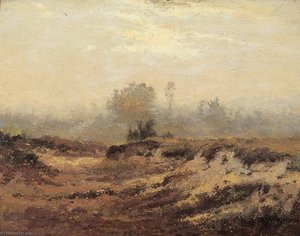 Dunes dans la bruyèreLeeds Art Gallery
25
 Towards Evening, Campine, BelgiumLeeds Art Gallery
26
 Shepherd Putting in His SheepLeeds Art Gallery
27
 Soleil couchant, Houffalize, Belgium
이 오리지널 작품들에서 가장 자주 등장하는 네 가지 주제와 그 정수를 보여주는 대표작들.
이 페이지에 있는 작품을 가장 많이 소장하고 있는 4개의 미술관
| 소장 미술관 | 도시 | Adriaan Jozef Heymans의 작품 | 이 목록의 작품들 |
|---|---|---|---|
 Leeds Art Gallery |
리즈 | 12 | Le repos, neige, A Corner of the Heath, Night An Impression |
 Museum of Fine Arts Ghent (MSK) |
헨트 | 5 | Sunset on the Heath, Early Morning, Snow-covered Hamlet |
 안트베르펜 왕립 미술관 |
안트베르펜 | 4 | Woodland near Bertogne, Duck Nests in the Reed, Wood by Moonlight |
 인디애나폴리스 미술관 (Indianapolis Museum of Art) |
인디애나폴리스 | 1 | The Dunes |
그 시대를 정의하는 오리지널 작품을 만나보려면 연대를 선택하세요.
Sunset on the Heath (1877), Museum of Fine Arts Ghent (MSK), 헨트. 다음은 Woodland near Bertogne (1875)와 St Abbs Harbour (1891)입니다.
38세: Sunset on the Heath은(는) 1877년 작품이며, Adriaan Jozef Heymans은(는) 1839년에 태어났습니다.
Sunset on the Heath, Woodland near Bertogne, St Abbs Harbour, Early Morning, Snow-covered Hamlet, The Dunes, Houffalize by Night, Haystacks by Night, Duck Nests in the Reed 및 Wood by Moonlight. 위 순위는 각 작품의 제작 연도와 소장 박물관을 나타냅니다.
저희 카탈로그에는 1875년부터 1909년 사이의 Adriaan Jozef Heymans 작가의 작품 27점이 수록되어 있습니다.
대부분 Leeds Art Gallery (리즈), Museum of Fine Arts Ghent (MSK) (헨트) 및 안트베르펜 왕립 미술관 (안트베르펜)에 소장되어 있습니다. 위의 박물관 목록에서 전체 목록을 확인하실 수 있습니다.
1870s 동안: 이 페이지의 총 27점의 작품 중 2점이 해당 시기에 제작되었으며, 그중 Sunset on the Heath점입니다.
이 페이지에서 가장 오래된 작품은 Woodland near Bertogne (1875)이며, 가장 최근 작품은 Snow-covered Hamlet (1909)입니다.
Le repos, neige, A Corner of the Heath 및 Night An Impression: Leeds Art Gallery, 리즈은(는) 이 페이지에 있는 작품 중 12점을 소장하고 있습니다.
Adriaan Jozef Heymans, a name synonymous with the quiet majesty of the Belgian countryside, stands as a transformative figure in the annals of nineteenth-century art. Born in 1839 in Antwerp, his early life was marked by both simplicity and a profound connection to the natural world. Following the untimely loss of his father when he was just seven years old, Heymans found solace and inspiration in the care of his uncle, the mayor of Wechelderzande. This small village near Antwerp served as his first classroom, where the subtle shifts in light across the meadows and the rhythmic textures of the local flora planted the seeds of a lifelong devotion to plein air painting.
His formal artistic journey began in 1853 at the Royal Academy of Fine Arts in Antwerp. Under the tutelage of masters like Jacob Jacobs, Heymans absorbed the foundational principles of classical composition and Romanticism. However, his spirit was too restless for the rigid confines of academic tradition. A pivotal sojourn to Paris between 1855 and 1858 exposed him to the revolutionary currents of the Barbizon School. Immersed in the works of artists who sought truth in the direct observation of nature, Heymans began to shed the dramatic, often staged lighting of Romanticism in favor of a more honest, atmospheric realism. This period was crucial, as it instilled in him a reverence for tonal harmony and the belief that a landscape could convey deep emotional resonance through nothing more than the interplay of shadow and mist.
As his career matured, Heymans became a central architect of a movement that would redefine Belgian Impressionism. In 1890, alongside contemporaries such as Gustave Courbet and Jean Petit Albert Dumont, he helped establish the Kalmthout School, often affectionately referred to as the "Grey School." This was not a rejection of color, but rather a sophisticated refinement of it. The movement sought to move away from the garish, high-contrast palettes of earlier eras, choosing instead to explore the nuanced beauty found within muted tones—soft greys, deep blues, and earthy browns. For Heymans, these colors were the true language of the Belgian atmosphere, capable of capturing the damp, heavy air of the Campine region and the fleeting, melancholic light of a fading dusk.
His technical evolution is most strikingly visible in his transition from expressive, energetic brushwork to a more restrained and precise application of paint. In masterpieces such as "Soleil couchant, Houffalize," one can witness his ability to render the dying light of the Ardennes hills with breathtaking subtlety. He did not merely paint scenery; he painted the very breath of the landscape. His works like "Towards Evening, Campine" demonstrate a profound mastery of tonal gradation, where the boundaries between earth and sky seem to dissolve into a singular, emotive experience. This dedication to capturing the ephemeral qualities of light—the way it clings to a leaf or softens the horizon—became his artistic signature.
The historical significance of Adriaan Jozef Heymans lies in his role as a bridge between the traditional landscape traditions of the past and the modern, sensory-focused approach of the future. By championing the Kalmthout School, he provided a distinct identity for Belgian art, one that was rooted in local topography yet connected to the broader European movement toward Impressionism. His ability to find grandeur in the humble, and drama in the quietest moments of nature, has ensured his place as a pioneer of the Belgian landscape.
Today, his contributions are remembered through several key artistic milestones:
Though he passed away in Brussels in 1921, the legacy of Heymans continues to resonate. His paintings remain windows into a vanished era of the Belgian countryside, inviting modern viewers to pause and find beauty in the soft, grey, and infinitely moving light of the natural world.