The Alchemy of Pigment: Understanding the Soul of Oil on Canvas
To behold a true oil painting is to witness a slow, deliberate alchemy where earth and light converge upon a woven surface. Unlike the ephemeral nature of digital imagery or the flat uniformity of modern prints, oil on canvas possesses a biological rhythm, a breathing quality born from the marriage of linseed oils and mineral pigments. This medium has long been the preferred vessel for the masters, not merely for its versatility, but for its capacity to hold time itself within its translucent layers. When an artist applies pigment, they are not simply coloring a surface; they are building a history of light. Each layer, or glaze, acts as a window, allowing light to penetrate deep into the paint film and reflect back through the colors, creating a luminosity that seems to emanently glow from within.
This luminous depth is what separates a mere depiction from a masterpiece. The chemistry involved—the use of specific oils like safflower to ensure whites remain pristine and free from the dreaded yellowing of age—is a testament to the meticulous care required to preserve this brilliance. As these layers dry over weeks and months, they settle into a complex architecture of color. For the discerning enthusiast, the allure lies in this subtle complexity, where a single shade of forest green might contain hints of ultramarine and burnt umber, hidden beneath a veil of translucent glaze, waiting to be discovered by the wandering eye.
Tactile Narratives: The Role of Impasto and Visible Brushwork
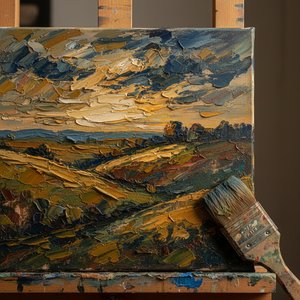
Beyond the visual lies the tactile, a dimension of art that invites the viewer to feel the movement of the artist’s hand. This is most profoundly expressed through impasto, a technique where paint is applied in thick, sculptural layers. In an impasto work, the canvas ceases to be a flat plane and becomes a topographical map of emotion. One might observe a textured magnolia bloom where the white petals are lifted physically off the surface, or an abstract landscape where ridges of forest green and white create shadows that shift as the room's light changes throughout the day. These raised textures do more than catch the light; they provide a physical manifestation of the artist's energy.
The visible brushstroke serves as a signature of human presence, a rhythmic trace of the creative struggle. In the works of the great Impressionists and modern abstract masters alike, the brushwork tells a story of speed, hesitation, or bravado. When we encounter a textured canvas—perhaps one featuring the earthy tones of terracotta and olive—we are witnessing the physical residue of a moment in time. This tactile depth transforms a painting from a static object into a dynamic experience, where the interplay between the raised paint and the surrounding shadows creates a sense of life that no flat reproduction can ever replicate.
Chiaroscuro and Beyond: Creating Dimensionality Through Light and Shadow
The mastery of oil painting is perhaps most famously defined by chiaroscuro, the dramatic tension between light and dark. This technique, perfected during the Renaissance and Baroque eras, uses extreme contrasts to sculpt figures out of the darkness, lending them a three-dimensional weight and psychological gravity. By carefully controlling where the light falls and where the shadows retreat into obscurity, an artist can direct the viewer's gaze with surgical precision, creating a sense of drama that is both theatrical and deeply intimate.
However, the use of shadow extends far beyond mere contrast; it is about the creation of atmosphere. The soft transition from light to dark—the sfumato effect—allows for the seamless blending of forms, mimicking the way the human eye perceives depth in a misty morning or a moonlit garden. This manipulation of light allows for the illusion of volume, making a painted limb appear rounded and heavy, or a distant mountain range appear shrouded in atmospheric haze. It is through this sophisticated command of luminance that a canvas achieves its true dimension, pulling the viewer into a space that feels as vast and profound as reality itself.
The Architecture of Surface: From Gesso Priming to Damar Varnish
The enduring legacy of an oil painting relies heavily on the unseen architecture beneath the pigment. A masterpiece begins long before the first stroke of color, starting with the preparation of the 100% cotton canvas. The application of flexible gesso is a critical foundational step; this primer provides the necessary tooth for the paint to adhere while ensuring the surface remains resilient against the natural expansion and contraction of the fabric. Without this structural integrity, the very soul of the painting would be at risk of cracking or delaminating over time.
As the painting reaches its conclusion, the artist applies a final, protective seal: the Damar varnish. This is not merely a decorative finish but a vital preservative. The varnish protects the delicate surface from the insidious effects of dust, moisture, and atmospheric pollutants, while simultaneously saturating the colors to bring out their full, intended brilliance. For those who appreciate the antique aesthetic, an optional craquelure finish can even be applied to simulate the venerable character of aged works, providing a sense of historical continuity. This rigorous cycle of preparation and protection ensures that the artwork remains a vibrant, living entity for generations.
Curating Depth: Integrating Textured Masterpieces into Modern Interiors
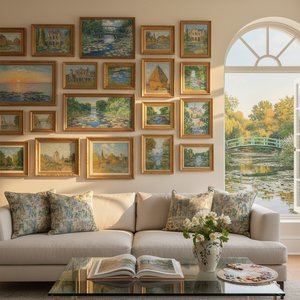
In the contemporary home, the introduction of a textured oil painting serves as an anchor of sophistication. A well-chosen piece does more than fill a void on a wall; it introduces a sensory complexity that complements modern architectural elements. Whether it is a large-format mural that recreates the grandeur of a historical fresco or a multi-panel set that flows seamlessly across a wide staircase, textured art adds a layer of "soul" to minimalist spaces. The physical depth of an impasto work provides a necessary counterpoint to the smooth surfaces of glass, steel, and polished stone found in modern design.
When curating such a collection, one must consider how light interacts with the room's environment. A painting with significant texture will react to ambient lighting, offering different perspectives as the sun moves across the sky. For professionals and collectors alike, the goal is to create a dialogue between the art and the architecture. By selecting works that offer deep tonal ranges and palpable textures, one can transform a living space into a curated gallery, where every brushstroke invites contemplation and every shadow tells a story of timeless elegance.
At OriginalUniqueArt.com, we are dedicated to preserving this tradition of excellence. From our roots in 2004 to our global presence today, our mission has been to make the profound beauty of fine art accessible to all. We specialize in hand-painted reproductions and bespoke commissions, where master artists—each a specialist in their genre—bring historical techniques to life on premium cotton canvas. Whether you seek to transform a personal memory into a Renaissance-style portrait or wish to adorn your home with a textured abstract masterpiece, our commitment to quality, from the first digital mockup to the final varnished stroke, ensures that your investment becomes a lasting legacy.